
Dilexit Nos: Conclusion
This is the seventh post in a series of reflections by Nathaniel Marx on the final encyclical letter of Pope Francis, Dilexit Nos.
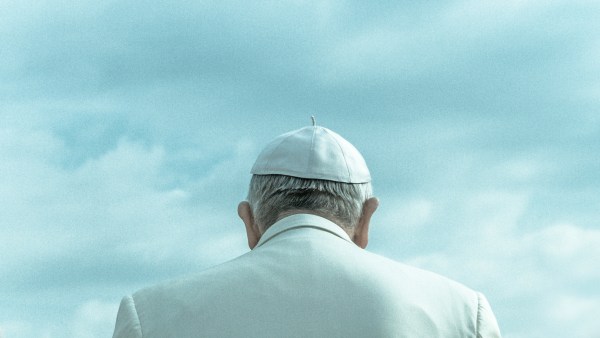
The Last Testament of Pope Francis
“The late Pope Francis left us, rather like a testament, a beautiful Encyclical on the Sacred Heart.” So says his successor, Leo XIV, in one of his first messages, delivered to the bishops of France on the 100th anniversary of the canonization of three saints who receive extended attention in Dilexit Nos: Saint John Eudes, Saint John Vianney, and Saint Thérèse of Lisieux.1 Leo quotes from the conclusion, in which Francis reaffirms that love still flows from the heart of Jesus.
The wounded side of Christ continues to pour forth that stream which is never exhausted, never passes away, but offers itself time and time again to all those who wish to love as he did. For his love alone can bring about a new humanity. (DN 219)
“There could be no more beautiful and simple program of evangelization and mission,” Leo says, than “to help everyone discover the tender and devoted love that Jesus has for them, to the point of transforming their lives.”2 Leo also implies that spreading the love of Christ is the surest way to fulfill the testament of Pope Francis and extend his legacy.
Only Love Can Set Us Free
What does the late pontiff’s legacy look like, viewed through the lens of Dilexit Nos? Not long after its publication, a colleague mused that students at our seminary might have welcomed the pope’s teaching on the environment and on universal fraternity with more understanding and less suspicion if Dilexit Nos had come first. Speculation aside, it is clear that Francis wants these three letters to mutually interpret one another.
The present document can help us see that the teaching of the social Encyclicals Laudato Si’ and Fratelli Tutti is not unrelated to our encounter with the love of Jesus Christ. For it is by drinking of that same love that we become capable of forging bonds of fraternity, of recognizing the dignity of each human being, and of working together to care for our common home. (DN 217)
Some Catholics undoubtedly view care for the environment and forging friendships with non-Christians as peripheral issues. Don’t these au courant social concerns distract us from the ancient heart of the Christian faith? On the other hand, Catholics who lauded Laudato Si’ and Fratelli Tutti for advancing the church’s social teaching may shrug at another encyclical about the Sacred Heart. Is there any ground left to break after hearing from Leo XIII, Pius XI (twice), and Pius XII on this uber-Catholic devotion?
Such polarization between “devout” Catholics and “social justice” Catholics is one of the painful divisions in the church that Pope Francis desired to heal. In Dilexit Nos, he offers encounter with the love of Jesus Christ as a suture. Love binds Christians to each other by dissolving our “excessive attachment to our own ideas and opinions” and freeing us from “fanaticism in any number of forms.” Without love, all ideologies—left and right, progressive and traditionalist, reformist and reactionary—end up enthralled by “outdated structures and concerns” and fixated on what people “can accumulate with the power of money.” By contrast, “the gratuitous love of God … liberates, enlivens, brings joy to the heart, and builds communities” (DN 218–219).
Hearts Open to the World
Pope Francis’s inspiring words about the love of Christ might sound like nothing more than that, if in previous encyclicals he had not already detailed how to forge bonds of fraternity and care for our common home. Indeed, Francis wrote Fratelli Tutti “in the hope that in the face of present-day attempts to eliminate or ignore others, we may prove capable of responding with a new vision of fraternity and social friendship that will not remain at the level of words” (FT 6).
Newness, in Francis’s vision of fraternity, would consist in institutions and individuals sincerely aspiring to goods that we say are “universal”: human rights, respectful dialogue, self-esteem, open societies, political participation, and doing unto others as we would have them do unto us (FT 60; cf. Mt 7:12). The basis for all these elements of “social friendship” is “a love capable of transcending borders” (FT 99). Administrative guarantees, defense of individual liberties, and the rule of law are necessary but insufficient to build societies of universal friendship and realize the dream of living as “a single human family” (FT 8). Supposedly concrete policies and principles inevitably become fine words, abstractions, or tools of authoritarian universalism if they are not rooted in universal love.
Recognizing the indispensability of fraternal love to social friendship, Francis devotes an entire chapter of Fratelli Tutti to cultivating “a heart open to the whole world” (FT 128–153). Universal love might be a saintly ideal, but it is not abstract. We see love’s concrete demands in models like Saint Francis, whose “openness of heart … knew no bounds and transcended differences of origin, nationality, color, or religion” (FT 3). We hear the Second Vatican eschew any “cool and detached description of today’s problems” to declare that “‘the joys and hopes, the grief and anguish of the people of our time’” all echo in the hearts of the followers of Christ (FT 56).3 And we experience, “in the depths of every heart,” that “love creates bonds and expands existence, for it draws people out of themselves and towards others” (FT 88). If we do not open our hearts, there is no other organ of the person or of society in which God’s love can make brothers and sisters of us all.
Hearts Moved to Praise
Similarly, as Pope Francis says in Laudato Si’, “the violence present in our hearts, wounded by sin, is also reflected in the symptoms of sickness evident in the soil, in the water, in the air and in all forms of life” (LS 2). The ecological encyclical examines the visible symptoms of our suffering “sister, Mother Earth,” in minute scientific detail. But to treat the underlying disease of our hearts, Francis prescribes a spiritual—or better yet, sacramental—remedy. And, again, the pope proposes Saint Francis as a model.
Francis helps us to see that an integral ecology calls for openness to categories which transcend the language of mathematics and biology, and take us to the heart of what it is to be human. Just as happens when we fall in love with someone, whenever he would gaze at the sun, the moon or the smallest of animals, he burst into song, drawing all other creatures into his praise. (LS 11)
If fraternal love requires open hearts, care for our common home requires worshipful hearts. “Praise be to you, my Lord” is a fitting hymn to open what we may rightly call a liturgical encyclical. Pope Francis describes creation as finding its “greatest exaltation” in the Eucharist, which “is itself an act of cosmic love” (LS 236). Again, the heart is the organ that perceives this cosmic liturgy and is moved to join it.
When we can see God reflected in all that exists, our hearts are moved to praise the Lord for all his creatures and to worship him in union with them. This sentiment finds magnificent expression in the hymn of Saint Francis of Assisi. (LS 87)
Praise follows self-examination, penance, and reconciliation with God’s creation, which we have harmed through selfish action and inaction. Pope Francis quotes the bishops of Australia: “‘We need to experience a conversion, or change of heart’” (LS 218).4
Prayers from the Heart
Both “social encyclicals,” then, culminate in prayers offered from the heart and for all hearts.
Touch the hearts
of those who look only for gain
at the expense of the poor and the earth…
Holy Spirit, by your light
you guide this world towards the Father’s love
and accompany creation as it groans in travail.
You also dwell in our hearts
and inspire us to do what is good.
Praise be to you! (LS 246)Pour forth into our hearts a fraternal spirit
and inspire in us a dream of renewed encounter,
dialogue, justice, and peace…
May our hearts be open
to all the peoples and nations of the earth.
May we recognize the goodness and beauty
that you have sown in each of us,
and thus forge bonds of unity, common projects,
and shared dreams. Amen. (FT 287)
Viewed through the lens of Dilexit Nos, the social encyclicals and the whole legacy of Pope Francis may be seen as a call to make a liturgy of life, beginning with the heart. Only by encountering the human and divine love of the heart of Jesus Christ can we welcome a change of heart. In his love, we can love our brothers and sisters and praise God in communion with all creation.
Pope Francis departed earthly life before he could lead the church in prayer on this Solemnity of the Sacred Heart of Jesus. In his homily today, however, Pope Leo again quoted his predecessor’s assurance that the stream of love that flows from the pierced heart of Christ “never passes away” (DN 219). Pope Francis left us that testament and this prayer:
I ask our Lord Jesus Christ to grant that his Sacred Heart may continue to pour forth the streams of living water that can heal the hurt we have caused, strengthen our ability to love and serve others, and inspire us to journey together towards a just, solidary and fraternal world. Until that day when we will rejoice in celebrating together the banquet of the heavenly kingdom in the presence of the risen Lord, who harmonizes all our differences in the light that radiates perpetually from his open heart. May he be blessed forever. (DN 220)
Amen.
- Leo XIV, Message to the Bishops’ Conference of France on the Occasion of the 100th Anniversary of the Canonization of Saint John Eudes, Saint John Mary Vianney, and Saint Thérèse of the Child Jesus and the Holy Face, May 28, 2025. ↩︎
- Leo XIV, Message to the Bishops’ Conference of France on the Occasion of the 100th Anniversary of the Canonization of Saint John Eudes, Saint John Mary Vianney, and Saint Thérèse of the Child Jesus and the Holy Face, May 28, 2025. ↩︎
- Quoting Second Vatican Council, Pastoral Constitution on the Church in the Modern World Gaudium et Spes, 1. ↩︎
- Quoting Australian Catholic Bishops’ Conference, A New Earth – The Environmental Challenge (2002). ↩︎
Please leave a reply.