
This post is the first in a Seven-Week Series by Nathaniel Marx.
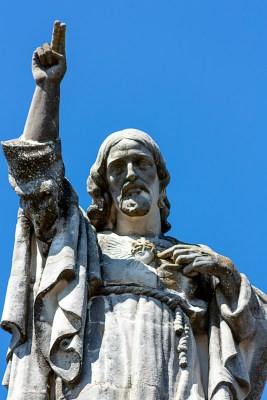
Starting From the Heart
“He loved us” (see Rom 8:37) is the disarming incipit of Pope Francis’s final encyclical. Released at a moment of sharp discord, the letter seeks concord in the church and in the world by returning to the heart (kardía / cor) of Jesus as the unifying principle of the person, of human society, and of the cosmos. It has much to say, therefore, about the heart of Christian worship that integrates and transcends words, gestures, and thoughts. “Where the thinking of the philosopher halts, there the heart of the believer presses on in love and adoration” (DN 25).
Remembering the late Holy Father and anticipating the Solemnity of the Most Sacred Heart of Jesus, Pray Tell will publish a series of Friday reflections on Dilexit Nos:
- Friday, May 16, 2025: Starting from the Heart
- Friday, May 23, 2025: Chapter One: The Importance of the Heart
- Friday, May 30, 2025: Chapter Two: Actions and Words of Love
- Friday, June 6, 2025: Chapter Three: This Is the Heart that Has Loved So Greatly
- Friday, June 13, 2025: Chapter Four: A Love that Gives Itself as Drink
- Friday, June 20, 2025: Chapter Five: Love For Love
- Friday, June 27, 2025 (Solemnity of the Most Sacred Heart of Jesus): Love, Fraternity, and Care for Our Common Home
Human and Divine
This Friday, we consider Pope Francis’s starting point in Dilexit Nos, “the human and divine love of the heart of Jesus Christ.” The lengthy subtitle bears Christological significance that receives systematic treatment in chapter three. But the words “human and divine” also indicate the sacramental outlook of the whole encyclical. In the Constitution on the Sacred Liturgy, the same combination of adjectives describes “the mystery of Christ and the real nature of the true church.” Receiving its “essence” from Christ, the church is “both human and divine” so that it may be “a sign lifted up among the nations under which the scattered children of God may be gathered together” (SC 2). The significance of the church, in other words, is human unity caused by the Father’s divine love.
In just the same way, the heart of Jesus Christ is an effective sign of grace. Indeed, it is the signum efficax gratiae from which the church and all the sacraments flow. “For it was from the side of Christ as He slept the sleep of death upon the cross that there came forth ‘the wondrous sacrament of the whole Church’” (SC 5).
“He Loved Us First”
The first paragraph of Dilexit Nos cites Paul and John to establish the sacramentality of the “open heart” of Jesus. Specifically, Francis evokes three of the best-loved passages about love in the New Testament. A thoughtful or prayerful reader of the encyclical might pause here to review Romans 8:28–39, John 15:9–17, and 1 John 4:7–21.
Although Johannine and Pauline texts speak in different ways about signs and mysteries, they share the bedrock conviction that Christ is the revelation of God’s love. More exactly, in the texts that Francis cites, God’s love revealed in Christ is the bedrock of conviction itself. God’s love is the ground of faith, the reason for hope, and the stimulus to charity. “Love alone is credible,” as von Balthasar said,1 so Francis starts with the gospel of love. Out of love, the Father gave his own Son to lay down his life for those whom Jesus calls “friends” (Rom 8:32; Jn 15:13; 1 Jn 4:10). He who raised Jesus from the dead will give his friends everything, even his own Spirit (Rom 8:32; Jn 15:16; 1 Jn 4:13). In the Spirit, the friends of Jesus remain in God’s love and love one another (Rom 8:28; Jn 15:10, 17; 1 Jn 4:11–12).
Encountering Love
Near the start of his pontificate, Francis similarly summarized “the heart of the Gospel” from which every effort at evangelization must proceed. “In this basic core, what shines forth is the beauty of the saving love of God made manifest in Jesus Christ who died and rose from the dead” (Evangelii Gaudium, 36). At that time, Francis wrote that he would “never tire of repeating those words of Benedict XVI which take us to the very heart of the Gospel: ‘Being a Christian is not the result of an ethical choice or a lofty idea, but the encounter with an event, a person, which gives life a new horizon and a decisive direction’” (EG 7, quoting Deus Caritas Est, 1).
The sacramental encounter with the saving love of God remained likewise the heart of Francis’s message. To open the Extraordinary Jubilee of Mercy in 2015, he wrote, “Jesus Christ is the face of the Father’s mercy,” adding that “these words might well sum up the mystery of the Christian faith” (Misericordiae Vultus, 1). To inaugurate the Ordinary Jubilee of the Year 2025, Francis wrote, “Hope is born of love and based on the love springing from the pierced heart of Jesus upon the cross” (Spes Non Confundit, 3).
“He Is Going Before You”
Dilexit Nos might seem a fitting conclusion to this pope’s ministry, which always returned to the human encounter with Jesus, through which we know and trust the divine love manifest in his sacrificial death and glorious resurrection. But in the last months of his earthly life, Francis was writing a new overture, not a coda. For if Christ, in is humanity, is the saving manifestation of divine love, then the Sacred Heart of Jesus is not a peripheral devotion. Rather, it is the central symbol of the church’s mission to circulate God’s love ever more widely. Thus, Pope Francis, who has now gone ahead of us, begins his final major message by directing our gaze forward to the beloved Son of God. “His open heart has gone before us and waits unconditionally, asking only to offer us his love and friendship” (DN 1).
- Hans Urs von Balthasar, Love Alone Is Credible, tr. D. C. Schindler (Ignatius Press, 2004). ↩︎
Please leave a reply.