
“Let’s do Mass in Latin,” the request came from my grad class in reading church Latin. Excitement on all sides. “How about at the altar with the relics of St. Peregrine” somebody proposed, and the excitement grew. After just a bit of hesitation, I consented.
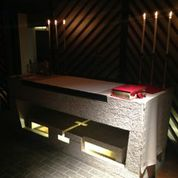
We have the full remains of the second century martyr Peregrine at an altar in our lower church. It turns out that the solemn translation of the relics to Collegeville was on May 6th, and so its anniversary on this past Tuesday was the date for our noble venture.
I thought of the ordinance of the Church of England after the break with Rome that the liturgy could only be celebrated in a language understood by the people – I’m told that high church folks in the 19th century at places like Oxford used this as a justification for liturgy in Latin in academic settings. And so it would be here – these are sharp Latin students, and they would understand and be able to pray the liturgical texts. In the course of the year we’ve memorized texts like the Pater noster in Latin, and we’ve worked through the Order of Mass and the Roman canon (EP1) as translation assignments. I was confident this would be worship “in spirit and truth.”
I had to restrain the enthusiasm of some just a bit and lay down the law that this would be a celebration according to the liturgical reforms and the Collegeville spirit of liturgical renewal. This is no pretext for preconciliar mannerisms, and we weren’t going to be liturgically “naughty,” as I put it to the class. Communion under both forms with homemade substantial bread, prayers of the faithful, congregational singing, and all the rest. Leaflet with translations of all proper texts, and no fussy neo-gothic or faux medieval fonts. I didn’t want to do all the unnecessary duplications of the optional (Per Christum Dominum nostrum) throughout the Eucharistic Prayer but was persuaded otherwise. I won’t say by whom, so as not to call undue attention to my trusty blog assistant. (He’s no Tridentist by a long shot, but one of his masters comps questions was about liturgical units, rationalistic liturgical reform, and symbolic wholeness so I just gave in.)
I wavered a bit on whom to invite to the Mass. I believe pretty strongly that the liturgy is open to all the baptized, and so I thought of inviting the entire School of Theology community and interested undergrads. But I didn’t want this to be a show at the county fair either, so we came to the agreement that under the circumstances this would be a liturgy for students of Latin.
Audrey Seah, an independent study Gregorian chant student who has sung in my chant schola, sang at the introit, offertorium, and communio. Everything taken from the Common of Martyrs in the Graduale Simplex. All sang the simple Latin chant acclamations. Maybe I’m too scrupulous, but I wasn’t absolutely sure that all could sing the Memorial Acclamation melody confidently so we sang it on one pitch. We recited rather than sang the Lord’s Prayer for the same reason.
Here’s an excerpt from the leaflet. Its preparation occasioned a new liturgical axiom for me: the proportion between hours spent in leaflet layout and hours spent in actual worship should not be greater than 10:1. Oh well, it was a great weekend that got wrecked.
And so it was. I have great memories of it. And after all that time preparing the leaflet, maybe it will get re-used at what will become a regular event in future years.
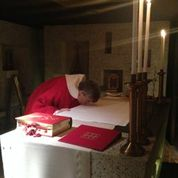
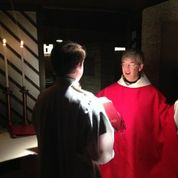
Here are some photos of the space and the event. One of the ceiling bulbs had just burned out, so I was glad the acolyte set up six candles to give us more light.
awr 


Please leave a reply.