
By Fr. Marco Benini, August 21, 2026
In this weekly series, Fr. Benini invites the reader to join him in a prayerful exploration of Eucharistic celebration as a daily encounter with Christ. Used with permission of Paulist Press, www.paulistpress.com.
LIVING THE EUCHARIST
In his Confessions, St. Augustine tells of a vision before his conversion in which Christ said to him: “I am the food of the strong, eat me! Yet you will not change me into you, but I will change you into me” (Conf. 9:16). This vision is particularly appropriate for the Eucharist. A distinction is made here between ordinary food and the Eucharistic bread. With ordinary food, we are the stronger ones: we take in the food and assimilate it into our bodies. With divine food, on the other hand, Christ is the stronger one who, contrary to appearances, takes us into himself and “embodies” us: he transforms us into himself. He makes us members of his body, the Church. The Eucharist builds up the Church. It is the bread of the strong, which makes us strong in the power of his divine love, which is able to transform us step by step despite challenges and trials.
“I am the bread of life.…For my flesh is true food, and my blood is true drink” (John 6:48, 55). In the great bread of life discourse, Jesus emphasizes not only his real presence in the Eucharist, but also his efficacy “for the life of the world” (6:51). Eating is never just an end in itself: it enables us to work, to labor, even to live. Likewise, the Eucharist is more than a rite—it is life! It is aimed at our life as Christians. That is why the Mass ends with the renewed promise of his presence (“The Lord be with you”), with the blessing and the mission: “Go in peace.” The Latin Ite missa est literally means “Go, it is mission.” Another dismissal appropriately says: “Go in peace, glorifying the Lord by your life.” Celebrating the Eucharist motivates us to live the Eucharist.
To live eucharistically means to be grateful. It also includes the confidence that the Risen Lord nourishes us and gives us a basic attitude of joy that does not depend on the ups and downs of emotions, on success or failure, but on his closeness (see Phil 4:4f.).
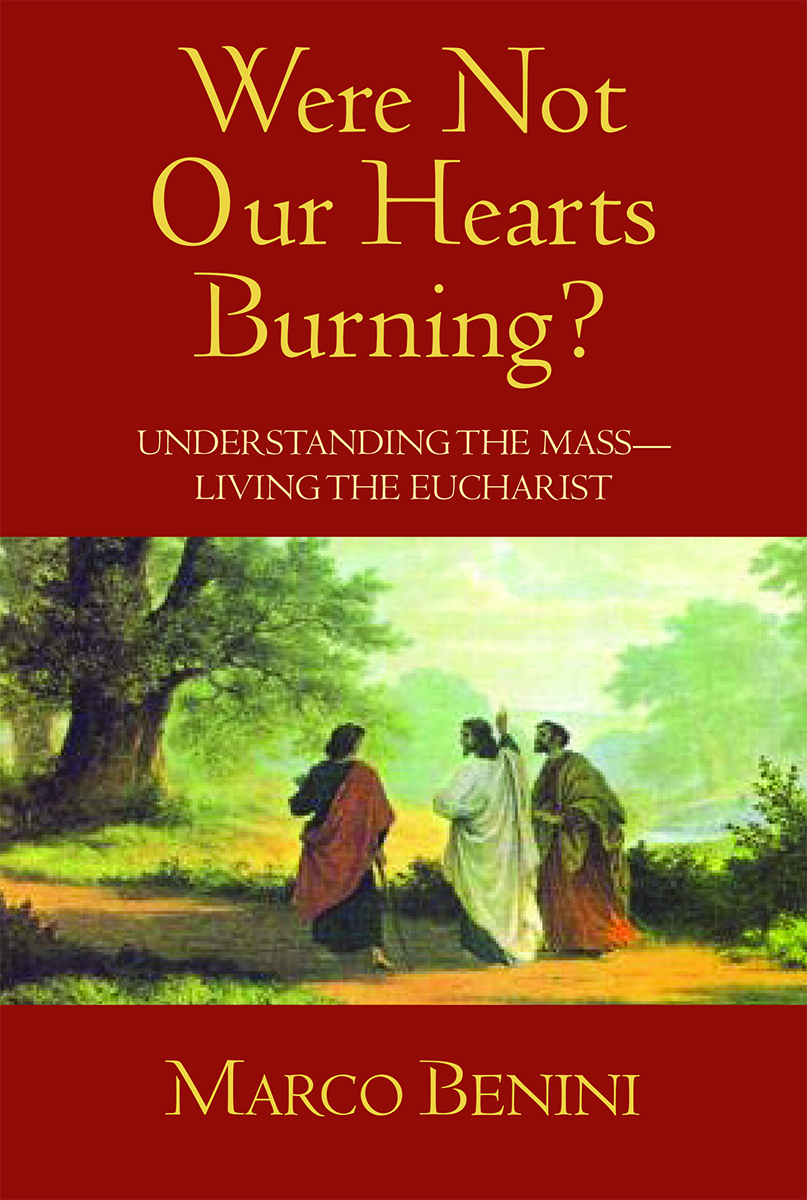
From: Marco Benini, Were Not Our Hearts Burning? Understanding the Mass – Living the Eucharist, Paulist Press: New York / Mahwah, NJ, 2026, p. 99 f.
Marco Benini is ordinary professor of liturgical studies at the German Liturgical Institute in Trier and research professor at The Catholic University of America.
Please leave a reply.