
By Fr. Marco Benini, August 14, 2026
In this weekly series, Fr. Benini invites the reader to join him in a prayerful exploration of Eucharistic celebration as a daily encounter with Christ. Used with permission of Paulist Press, www.paulistpress.com.
BEHOLD, THE LAMB!
The liturgy often quotes a single Bible verse and yet allows the context to resonate. “Behold the Lamb of God who takes away the sins of the world.” With these words, the priest shows the broken host. He is literally quoting the call of John the Baptist (John 1:29, 36) which he uttered twice: when he saw Jesus coming toward him, and the next day when he watched Jesus walking by (the Greek emphasizes seeing here) and pointed his disciples to Jesus.
The encounter of the disciples with Jesus (see John 1:35–42) is a wonderful image for communion. As the disciples followed him in response to this word, we look toward the altar. Jesus turned; he shows us his face in the host. The first word of Jesus in the Gospel of John is: “What are you looking for?” He is interested in us and wants to satisfy our longing.
The disciples ask: “Where are you staying?” Jesus’s answer, “Come, and you will see,” becomes an invitation in the Mass to come to communion. “So they went and saw where he was staying, and they stayed with him that day.” The disciples do the same as Jesus—they stay. Here staying is less a statement of time and more a statement of quality. The disciples were so impressed that they remember the exact time: “It was about four in the afternoon.” So it was probably not a very long time, but a fulfilling, joyful time in union (communion) with Jesus.
Instead of “staying” in the English translation, the Greek original uses the word for “remaining,” a signal word. In John, “remaining” is a characteristic of discipleship and also has a Eucharistic connotation, since it is used in both the bread and the vine discourses (chaps. 6 and 15). The two discourses in John’s Gospel belong together like bread and wine in the Mass. Remaining with the Lord (in communion) is full of promise: “Whoever eats my flesh and drinks my blood remains in me and I in him” (6:56). And: “Whoever remains in me and I in him, will bear much fruit” (15:5).
After their return, Andrew, one of the two, tells his brother Peter: “We have found the Messiah,” that is, Christ. Perhaps the first disciples can become a model for our going to communion: see—come—stay—profess.
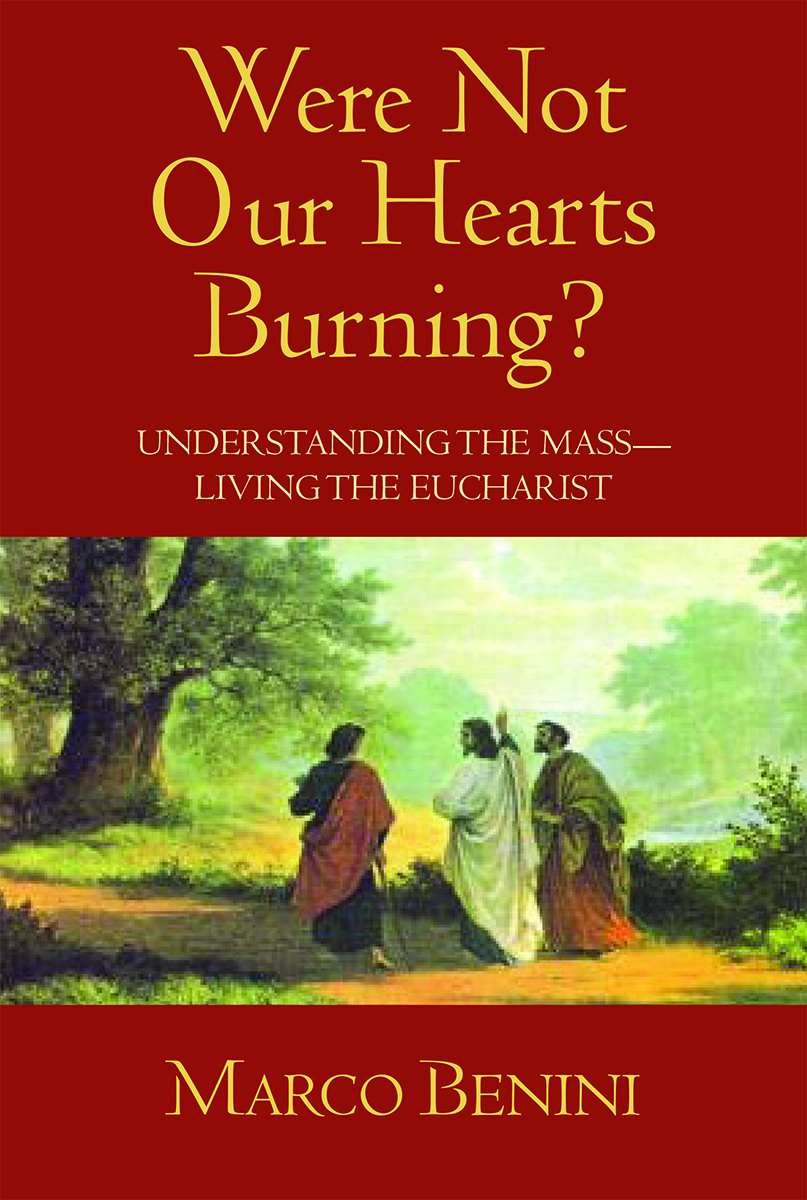
From: Marco Benini, Were Not Our Hearts Burning? Understanding the Mass – Living the Eucharist, Paulist Press: New York / Mahwah, NJ, 2026, p. 86 f.
Marco Benini is ordinary professor of liturgical studies at the German Liturgical Institute in Trier and research professor at The Catholic University of America.
Please leave a reply.