
By Fr. Marco Benini, August 7, 2026
In this weekly series, Fr. Benini invites the reader to join him in a prayerful exploration of Eucharistic celebration as a daily encounter with Christ. Used with permission of Paulist Press, www.paulistpress.com.
THROUGH, WITH AND IN CHRIST
Joyful praise is at the beginning of the Eucharistic Prayer (Preface) as well as at its end (Doxology). This framework reminds us that we are participating in the praise of Christ to the Father. The priest sings or speaks the solemn final doxology: “Through him, and with him, and in him, O God, almighty Father, in the unity of the Holy Spirit, all glory and honor is yours, for ever and ever.”
The expression “through him” emphasizes Christ’s role as mediator between God and us (see 1 Tim 2:5). It is through him that we have access to grace: “Such confidence we have through Christ toward God” (2 Cor 3:4; see Rom 5:2). “With him” emphasizes communion with Christ, which becomes literally visible and tangible in the Eucharist. He is Immanuel—“God is with us” (Matt 1:23). And we are with him, his body, members of him (see 1 Cor 12:12ff.).
To be “in him,” according to St. Paul, underlines the way of being and attitude to life of the baptized: we may understand ourselves as people “living for God in Christ Jesus” (Rom 6:11). Jesus himself promises in the parable of the vine, “Whoever remains in me and I in him will bear much fruit” (John 15:5).
The great praise at the end of the Eucharistic Prayer is expressed in the indicative (is) for a reason: Here and now, as the Church gathers around the Risen Lord at the altar and makes present her devotion to the Father, God does indeed receive all glory and honor. Appropriately, the consecrated gifts are raised, not to be displayed as in the institution narrative, but as an act of praise and worship. The Holy Spirit, who works throughout the Eucharistic Prayer to transform the gifts and ourselves, enables us to truly worship the Father (see John 4:23).
A closer look at the biblically rich final doxology reveals that it is not just a liturgical prayer, but a way of life. To live the Eucharist is a great gift: through, with, and in Christ we are and live in the power field of the Holy Spirit—to the praise of the Father.
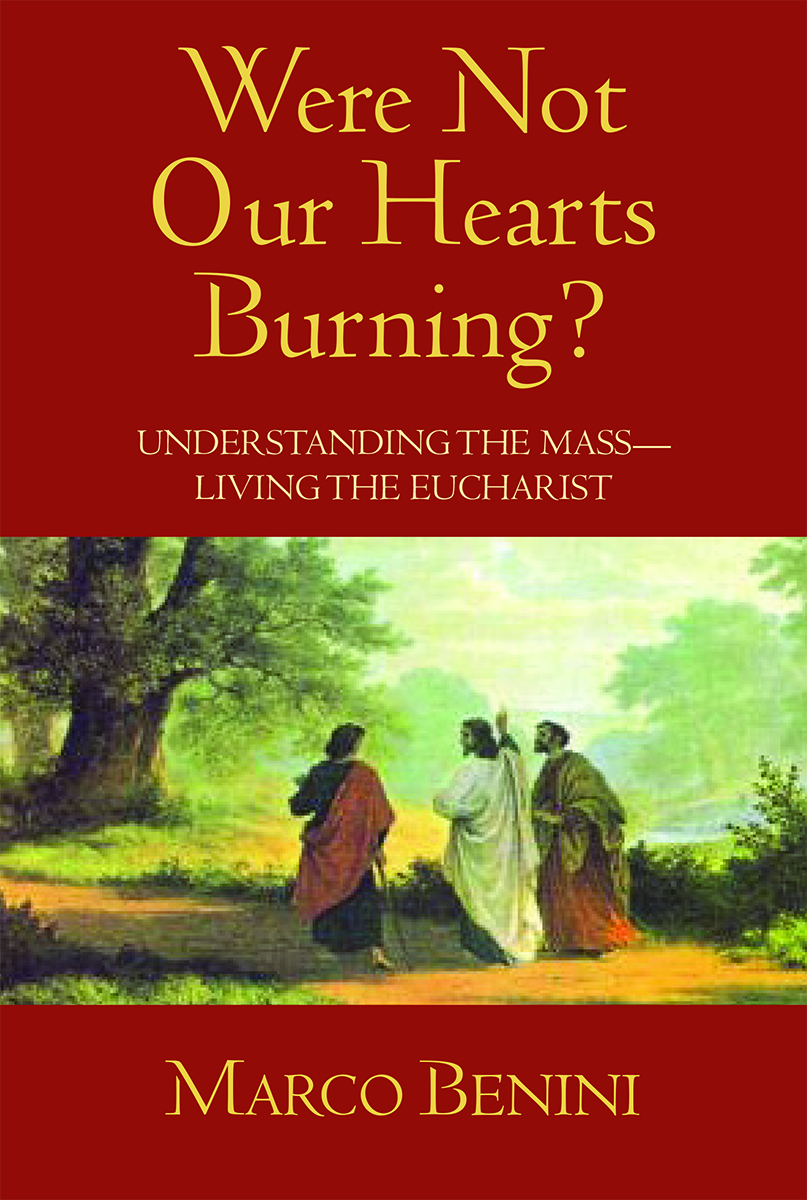
From: Marco Benini, Were Not Our Hearts Burning? Understanding the Mass – Living the Eucharist, Paulist Press: New York / Mahwah, NJ, 2026, p. 67 f.
Marco Benini is ordinary professor of liturgical studies at the German Liturgical Institute in Trier and research professor at The Catholic University of America.
Please leave a reply.