
By Fr. Marco Benini, July 17, 2026
In this weekly series, Fr. Benini invites the reader to join him in a prayerful exploration of Eucharistic celebration as a daily encounter with Christ. Used with permission of Paulist Press, www.paulistpress.com.
CONSECRATION
The core act of the Holy Mass is the consecration—first of bread and then of wine. Theologically, the doctrine of transubstantiation has been developed for this: the substance, the essence, changes while the exterior remains the same. The host and the wine look the same before and after the consecration. But the bread ceases to be simply bread because it is completely absorbed by Christ and becomes his body through his word, through the Holy Spirit, through the whole of the Eucharistic Prayer. The same is true of the wine. Christ spoke powerfully: “This is my body/blood” (see Matt 26:26, 28). He did not say: “This means/stands for…,” but “is,” in order to express his real presence.
When the priest by virtue of his ordination repeats these words in the person of Christ as Head of his Church, there is a difference in these words. Of course, it is not his personal body, but he lends his voice to Christ, who makes his body and blood present. Christ is the principal celebrant. On the other hand, however, these words also speak of an identification since the priest proclaims the words of Christ. In this way, the goal of unity with the Lord is kept literally before his eyes.
But the words of institution are central for everyone. The Mass is more than the consecration of bread and wine. It is ultimately about one’s own transformation, about a “personal transubstantiation” through the Eucharistic celebration.
Christ’s words are deliberately spoken aloud so that we can make them our own. We can speak them inwardly like Jesus and to him: “Here is my body. Here is my blood. Take it.” The outside may remain the same before and after Mass: the tasks of daily life, family, work, and so forth. “But what I am, my body and blood, that is, my thinking, my will, what I bring from my life to the Mass, accept it, take it, and deify it.” Our activities remain the same. But what can change is ourselves. We take part in the consecration, in the transformation!
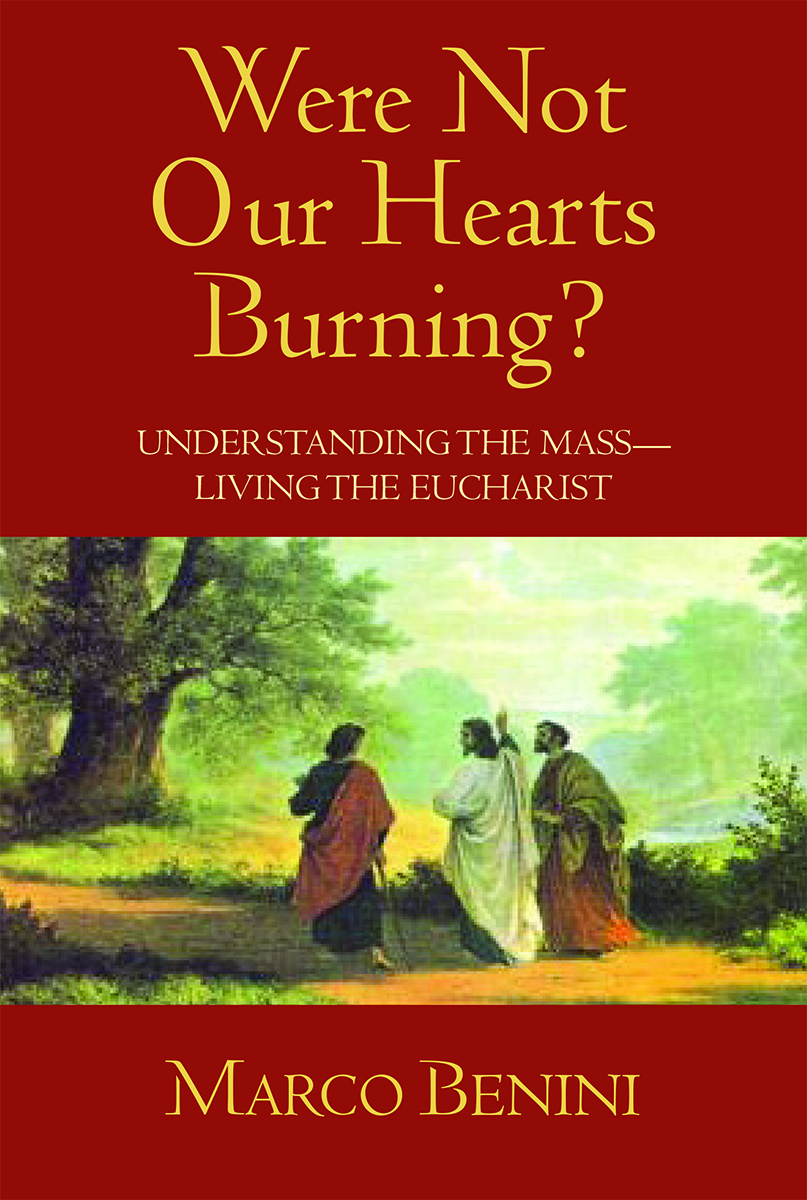
From: Marco Benini, Were Not Our Hearts Burning? Understanding the Mass – Living the Eucharist, Paulist Press: New York / Mahwah, NJ, 2026, p. 57 f.
Marco Benini is ordinary professor of liturgical studies at the German Liturgical Institute in Trier and research professor at The Catholic University of America.
Please leave a reply.