
By Fr. Marco Benini, July 10, 2026
In this weekly series, Fr. Benini invites the reader to join him in a prayerful exploration of Eucharistic celebration as a daily encounter with Christ. Used with permission of Paulist Press, www.paulistpress.com.
STAY TUNED
Leonardo da Vinci’s famous fresco of the Last Supper is exciting in many ways. Like a snapshot, it captures the scene when Jesus tells the disciples, “One of you will betray me” (John 13:21). Everyone is excitedly discussing who it might be. The empty plate in front of him presents Jesus himself as the Passover lamb (see 1 Cor 5:7).
The artist deliberately chose the Savior’s gestures and facial expressions: with one hand Jesus seems to grasp something, with the other he gives. His mouth is slightly open. This depicts three of Jesus’s actions at the Last Supper, which also characterize the three parts of the Eucharistic liturgy: he takes the bread and wine (preparation of the gifts), says the blessing (Eucharistic Prayer), and gives his body and blood (communion). Just as the speaking Jesus is at the center of the painting, the words of institution form the center of the Eucharist. The Eucharistic Prayer is “the center and high point of the entire celebration,” says the General Instruction of the Roman Missal.
Our own participation, on the other hand, may reach a low point during the Eucharistic Prayer. As the texts are always the same, it is easy to switch them off. Apparently—except for the acclamations—only the priest is active. Only communion with the following prayer is perceived by many as a personal and deep encounter. We do indeed have a communion piety. But as good as it is that communion is important to many, it is important to rediscover a spirituality of the Eucharistic Prayers, that is, to hear the richness and depth of the Eucharistic Prayers, and even more: to participate in this richness. As the following chapters will show, in the Eucharistic Prayers we participate in the praise of Christ, in the singing of the angels, in the consecration, in the offering of Christ, in his death and resurrection, in the gift of the Holy Spirit, in the prayer of the Church. Even if the priest recites the Eucharistic Prayer alone on behalf of the congregation, it is phrased in the “we” form, because it is meant to be prayed by everyone. Participation begins with conscious listening—and inner silent cospeaking.
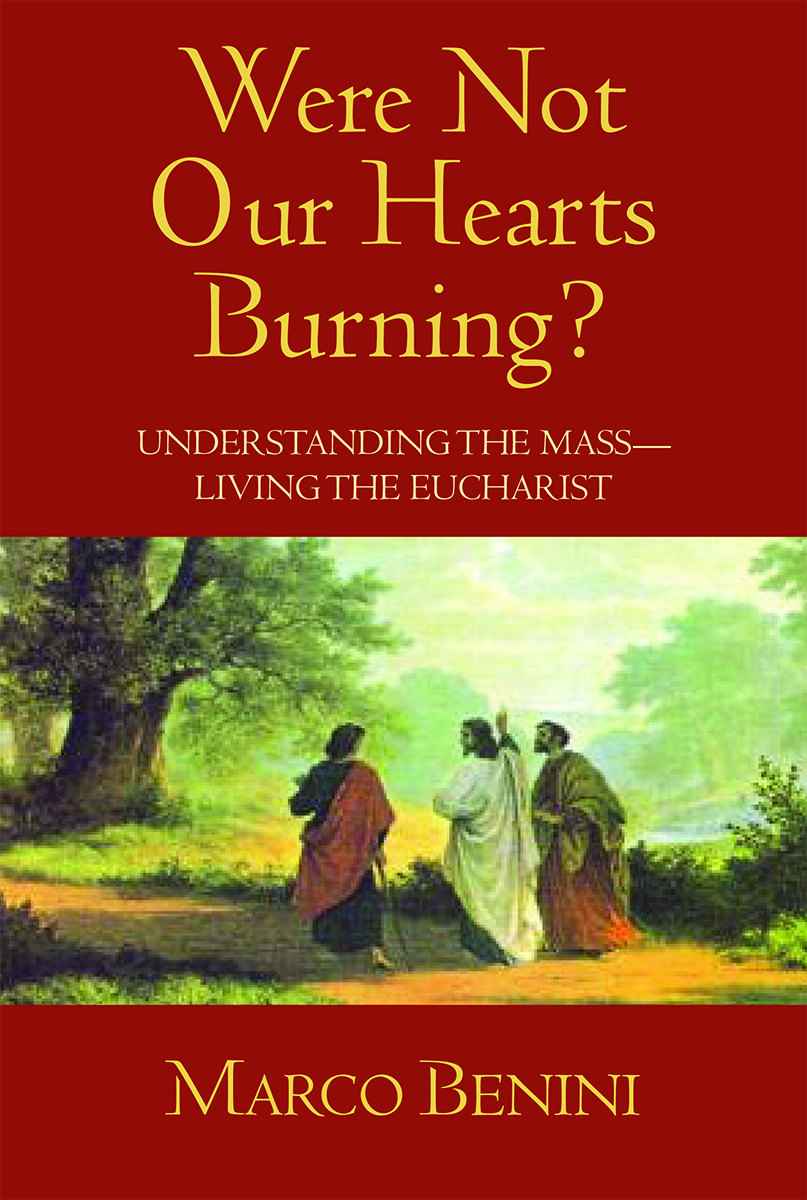
From: Marco Benini, Were Not Our Hearts Burning? Understanding the Mass – Living the Eucharist, Paulist Press: New York / Mahwah, NJ, 2026, p. 53 f.
Marco Benini is ordinary professor of liturgical studies at the German Liturgical Institute in Trier and research professor at The Catholic University of America.
Please leave a reply.