
Today there is a tendency to see the many changes in the manner liturgy was celebrated in the second half of the twentieth century as being radical. However, for many who lived through the period these were simply common sense. The fact that they were so obvious to those that lived them, has contributed to the lack of contemporary writing about them. Today, critics of the reforms often emphasize the lack of documentation on the new practices as being evidence of disobedience. But I think it is important to simply accept that these reforms had a very broad support from the vast majority of Catholics across the spectrum accepted them as being a good idea and the best way forward to meet the pastoral; challenges the Church faced in the difficult post-war period. Before the changes were introduced, many forerunners could be found in different places and even promoted by individuals that might surprise us.
In this post I would like to share a small example that I have recently come across. In an article in First Things last year, Fr. Jarosław Kupczak, O.P. writes about the pastoral practices of the future Kohn Paul II when working with the young people entrusted to his pastoral care. Here Fr. Kupczak says:
On the summer kayaking trips that have entered into legend, Wojtyła would give everyone a small bilingual missal in which it was possible to follow the entire text of the Tridentine Mass in Polish. Mass was celebrated every morning wherever the group spent the night: in forests, in meadows, on the shore of a lake. The altar was built every day by the students from whatever was available: branches from the forest, even the kayaks themselves. Wojtyła usually celebrated Mass facing the students, reading the liturgical texts in Latin and preaching in Polish.
In one of his earliest published works, written for the Polish pastoral review Homo Dei in 1957, Wojtyła emphasized that active holidays in the bosom of nature—in the forest, by the lake, or by the sea—are an ideal way to introduce the mysteries of the faith, especially to the young. “An altar on oars, an altar on snow, an altar on backpacks—living nature (not only the product of human art) takes part in the sacrifice of the Son of God. Holy Mass becomes a morning prayer and the first thing we do together after waking up. A few words: a thought for the whole day.”
For English-speakers George Weigel’s Witness to Hope is the most accessible source for the life of Karol Wojtyła. Chapter 3 mentions these Masses with young people and the Saint’s adherence to the best of the Liturgical Movement. However, it doesn’t mention that these Masses were often celebrated versus populum. So, I reached out to Fr. Kupczak for more details and he kindly put me in contact with Professor Teresa Malecka, former Rector of the Krakow Academy of Music, who, together with her husband, participated in the trips in question. She confirmed the details for me and provided me with a photograph of Fr. Karol Wojtyła presiding one of the liturgies in question.
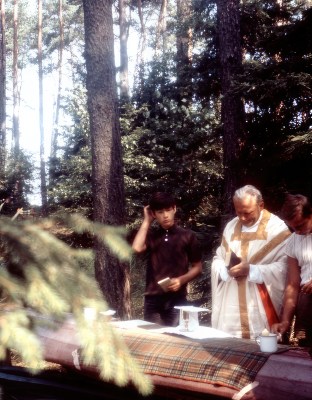
I share this image with her permission, not to enter polemics, but to share this example of what was happening liturgically in the difficult pastoral reality of Communist Poland with one of the most important pastors of the twentieth century.
Please leave a reply.