
Editor’s Note: We were delighted to receive a note from Georgian iconographers and instructors Philip and Olga Shalamova in response to a post in our Obsculta Preaching Series. We invited them to share more about their work and mission!
Describe why your studio was founded. Has your mission evolved over time?
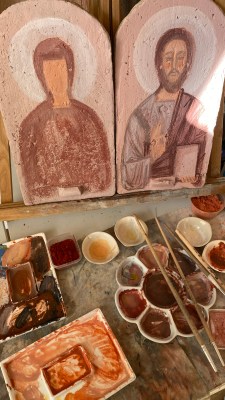
Our Studio was founded by my wife, Olga Shalamova, and myself. We decided to create icons and frescoes for churches, using our common Masters in art theory/history and 6 years of my practical experience at my dad’s icon studio.
Our mission did evolve: firstly we were hoping to naturally fulfill orders for all kinds of images for churches like all our colleagues. However, we soon realized that the demands of the market were far removed from what we were passionate about creating. Grounded in our knowledge of medieval Christian art and its principles, we wanted each image to be a visual sermon, conveying a unique and thoughtful message to the beholder. Yet, what our professional market demanded were nice and accurate copies from most famous icons and murals with maximum use of gold.
Thankfully, our education enabled us to develop a system for teaching iconography as an academic discipline, and this has, over time, become our primary mission. Since the start of COVID, we’ve expanded our reach with several online programs.
Yet we continue painting icons with and without commission in our free time.
2. Who is your main “audience”? Whom do you hope to include in the future?
The primary audience for our iconography courses consists of individuals who have previously attended other icon courses, where they only learned to trace and copy models. They come to us seeking a deeper understanding of the principles and a way to work independently.
Those who take our icons are individuals who want them to be the product of research, not mere replicas. Over time, we hope to receive more requests for larger projects, particularly those involving architecture, as it offers an opportunity for images to truly resonate. We’ve worked on several such projects in the past, and while they are extremely demanding, they are also deeply inspiring. Transforming a stark architectural space into a thoughtful liturgical environment—one that evokes harmony and wholeness—is truly the kind of work I dream of.
3. What initiatives are you focused on at present? If people want to become involved/attend, how would they do so? Whom should they contact?
At present, we are focused on teaching iconography and working as artists in various mediums. In addition to icons, we are involved in book illustration, vestments, mosaics, and sacred utensils. We also record interviews and conferences with professional iconographers and are producing a documentary on Georgian frescoes, a work in progress.
If people are interested in becoming involved or attending, they can reach out to me. Our team consists of just my wife, Olga, and myself, and I handle most of the communication. The easiest way to contact me is via email at phildavydov@gmail.com. I try to respond to all emails within 1-2 days.
4. How are you unique, or well-positioned, to contribute to the life of the church?
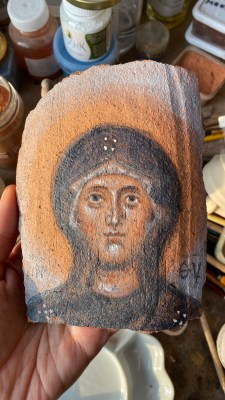
I will dare to say that it happened that we have a rare combination of both knowledge of history and theory of art (Christian art in particular) and a number of skills to work practically as artists. This allows us to share our knowledge by educating artists who want to work in this field today. We introduce them to the core values of traditional Christian art, and while we share the principles we’ve distilled from the tradition, we also encourage each artist to remain true to themselves in applying these principles.
In short, I would say that we produce and teach authentic Christian visual art that enhances prayer and the liturgical experience.
5. Anything else you would like readers to know about your work or current trends?
The main issue we seem to encounter everywhere in the Christian church (and the world around us) today is that images are assessed based on their iconographical or conceptual values, leaving their visual aspects totally ignored. The problem is that implying any specific conceptual/theoretical (literary) meaning on an image mangles its perception, reducing its role to an illustration.
This interview was conducted via email with Philip Davydov.
Visit Sacred Murals for full gallery and latest news.
