
“I saw you under the fig tree.”
Eye contact is one of the most significant ways that we connect with another person. People become familiar to us when we encounter them face-to-face. We notice their facial expressions – sometimes we learn them and adopt them as our own, we imitate them, we remember them.
No one has ever seen God (Jn. 1:18).
God’s nature is unknown to us. God is almighty, uncontainable – we cannot fathom God. Using the word “nature” itself is awfully bold – associating God with nature brings God into the material realm.
God’s nature is so overwhelming that it changed Moses’ face when Moses spoke with God on Mount Sinai (Ex. 34:29). The disciples experienced something similar when Jesus was transfigured on Mount Tabor (Mk. 9:2). Divine light shone from Jesus and it was so overwhelming, the disciples could not bear it.
The Disciples See Jesus
The Gospel of John opens with several references to people seeing Jesus. Jesus passes by and St. John says, behold, the lamb of God (Jn. 1:29). Look, the lamb of God passing by before you. John saw Jesus and was able to tell his disciples, look – there he is.
When Philip ends up telling Nathanael about Jesus, and Nathanael expresses some doubt (how could anything good come out of Nazareth, Jn. 1:46), Jesus has a dialogue with him and tells him he saw him (meaning Jesus saw Nathanael).
I saw you while you were still under the fig tree (Jn. 1:48)
God, Looking at Us
Ponder this for a moment. Jesus looked at Nathanael – he saw him. And his statement about Nathanael sitting under the fig tree prompts Nathanael to confess his faith in Jesus. This episode in the Gospel of John reveals the heart of Christian life. It is not only a matter of the confession of faith of Nathanael, which is one part of the equation – but it is the reality that Jesus – the Lamb of God, whom the Baptist John invited his disciples to see – the divine word and only-begotten Son of God, proclaimed in the Prologue of the Gospel of John – approached, encountered, and chose Nathanael and the other disciples as his own.

The Meaning of the Triumph of Orthodoxy
Today’s feast of the Triumph of Orthodoxy is not primarily about the fact that we paint icons, hang them in church, in our homes, offices, vehicles, while also carrying them in processions. The feast is all about God creating and renewing the covenant with us when he took human flesh and dwelled among us. Saints John, Andrew, Peter, Philip, and Nathanael were able to look at the divine word of God, who also looked at them and made them his disciples – and as we will learn later in this same Gospel, his companions and his friends (Jn. 15:14)
Face-to-face with the Son of God
We cannot underestimate the significance of these facial interactions. God took on a face by becoming human. The personal interactions between Jesus and his disciples, along with everyone he encountered, created permanent relationships.
We know these dynamics intimately. How many of us can tell stories of parents, siblings, grandparents whose facial expressions and voices impressed and formed us into the people we are today?
When we gather for the panikhidas after the liturgies, we are sustaining existing relationships by confirming our faith that the departed servants of God are very much alive – they are alive in Jesus Christ, the author of life who destroyed death and who provides us with the living water for which we all thirst. They are alive because their memory is eternal in God – the same God who sent Jesus Christ to us, and who renewed an everlasting relationship with us by looking at us.
Together, with the Saints
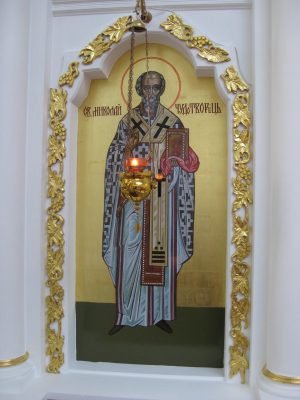
As a final word, consider the reality of the faith we are actually confessing on this feast of the Triumph of Orthodoxy. Whether alone or together with others, when we stand in front of an icon, it is not one-way communication. Yes, the saints on the icons are often written to look at Christ, showing us whom we are to worship. But praying before an icon is two-way communication, and a deep one at that. We are looking at the holy fathers and mothers who constitute one church of God’s people together with us. In looking at them and hearing the hymns the Church sings in their praise, we are invited into their true space, to learn about who they were on earth, and who they are now in heaven.
Singing the Thrice-holy Hymn
But, dear brothers and sisters – the holy fathers and mothers are looking at us as well, even now. And when we pray before icons, we are not only inviting them to be here among us, but we are joined together with them, the all-holy Spirit bringing us together, forming one choir, of both heaven and earth, singing the thrice-holy hymn:
Holy, Holy, Holy Lord God of Sabaoth – heaven and earth are full of your glory – hosanna in the highest!
in this space.
We are Not Alone
Today’s feast teaches us that we are not alone. The holy apostles, prophets, martyrs, ascetics, monastics – they are here, with us, praying for us, genuinely loving us. As we continue this journey through the challenges of our times, let us be encouraged, take heart, and grasp the sacred boldness that God gives to us to join them in worshipping the only true king, Christ our God, together with his Father who is without beginning, and his all-holy, Good, and lifecreating Spirit, now and ever and unto ages of ages. Amen.
Please leave a reply.