
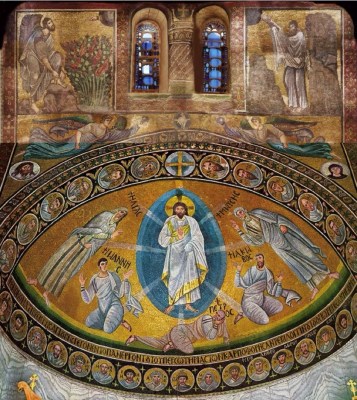
(Sinai basilica apse mosaics [composite] – Index of Medieval Art, Princeton)
The first post in this series problematized preaching as a liturgical art, asserted that sacred arts are media of encounter, and summarized pre-modern iconological theory to help explain how the sacred arts achieve this end. The second post demonstrated that the same mechanism of encounter in iconology was also present in rhetorical theory.
What does iconographic preaching look like? If physical images can bear a person’s likeness, which brings the viewer to that prototype; and if ekphrasis can do precisely the same thing, how is this accomplished? Certainly, there are techniques of description, narrative, affective modeling–all of which were present in pre-modern preaching, and which feature in the New Homiletic. Rather than tell, however, it seems appropriate to this theme that I instead show with an example. For this purpose, I have selected a homily that reveals a seventh century community at Sinai to be, in fact, present with the disciples on Mt. Tabor, overawed by Jesus Christ’s transfigured glory.
Anastasios, a monk of the monastic community at Sinai, preached a homily for the monks and pilgrims present on the feast of the transfiguration. Since the 1960s there has been debate on where this homily was delivered–Sinai, or the traditional location of the transfiguration, Tabor? Much of the argument centered on how Anastasios talks about where he and his hearers are, but it quickly becomes confusing as he contradicts himself throughout. He refers to a mountain peak above, but later claims to be on top of the mountain peak. In one passage he describes their location with rich detail as Sinai; in another, he vividly places them on Tabor. For anyone trying to figure out where they were when celebrating this feast, it is highly confusing! That is, until we realize that Anastasios’s homily was doing with words what the Sinai mural immediately above him was doing with color.
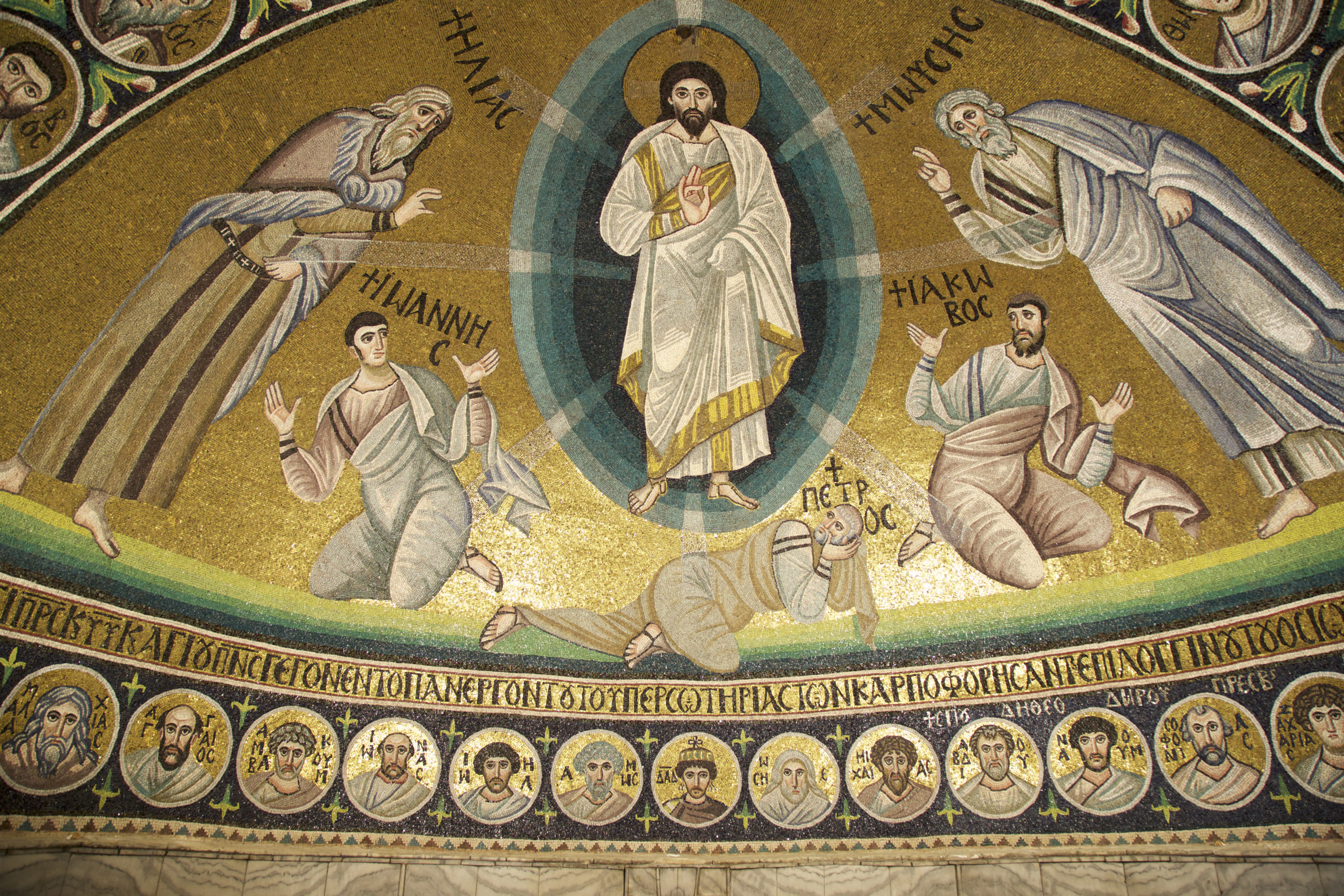
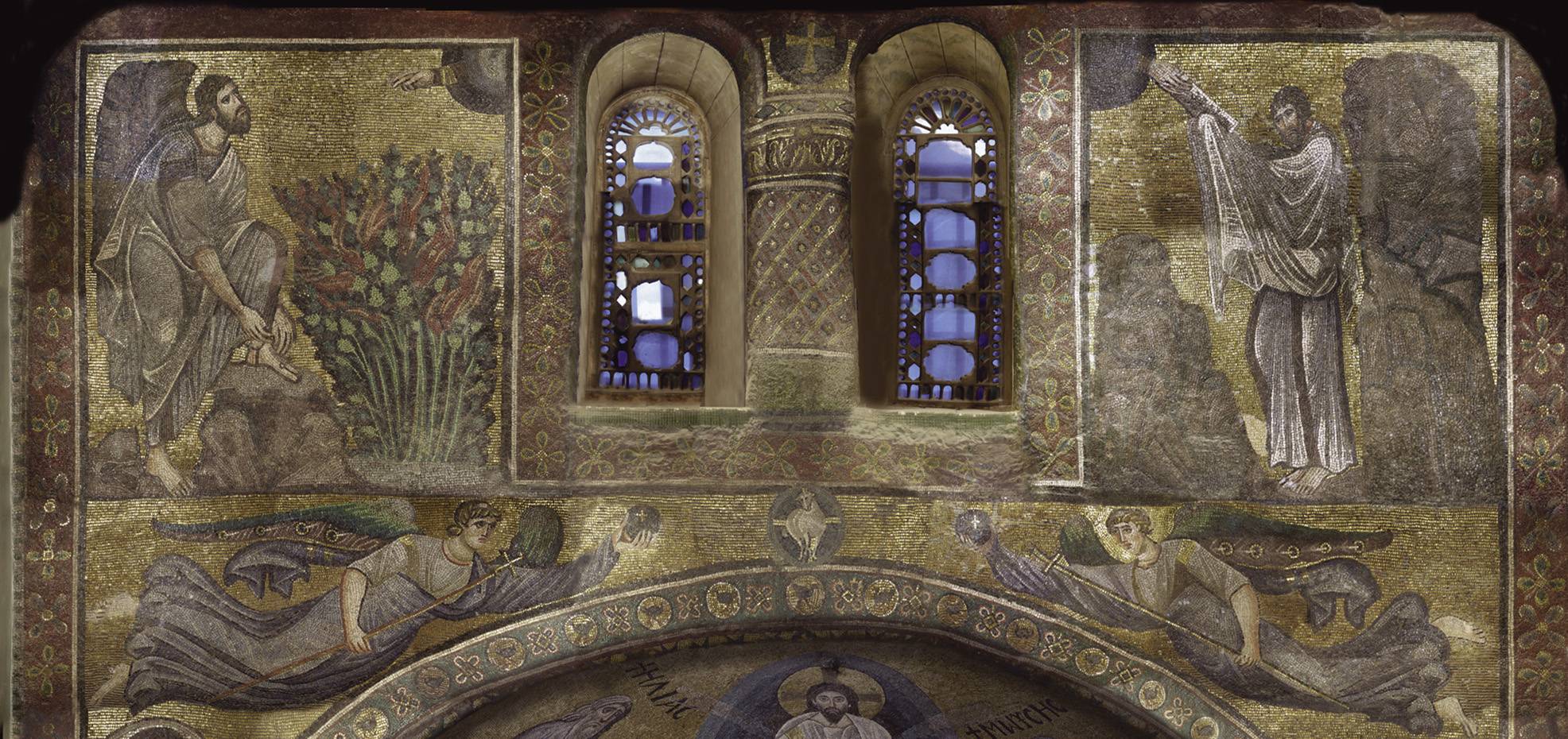
The apse mosaics in the basilica at Sinai include an upper zone with images of the prophet Moses at the burning bush untying his sandals, and another with him in the cleft of the rock while also receiving the tablets of the Torah. This is all to be expected as the locations of these scenes are nearby. But what may seem at first out of place is the composition in the semidome of the apse–it is a scene of the transfiguration of Jesus Christ. Christ himself is centered, in dazzling white, flanked by the prophets Moses and Elijah. The three disciples who accompanied Christ, Peter, James, and John, have fallen to the ground. There is no mountain visible, only a verdant band, because the viewer in the basilica is understood to be on top of the mountain with the disciples. The mosaics fold together the place of Tabor and the place of Sinai, and the homily Anastasios preaches works symphonically with them. He calls all present at Sinai to ascend Tabor, to enter the bright cloud, to witness the light of Christ and be transfigured with him.
Preaching in concert with this mural, Anastasios identifies the community’s ritual location. He does not say to them in didactic, lecturing tones, “We are anamnetically situated both at Sinai and Tabor, because both participate in the same divine reality.” Rather, Anastasios has vividly depicted this trans-geographical place; he has revealed the real location of their festival to those present by showing it to them in brilliant color. They are on Sinai, they are on Tabor, in fact they are on every mountain which figured in divine revelation (he provides a lengthy catalogue!). They have, through icon and homily and ritual celebration, come to a real encounter with the transfigured Christ.
Anastasios and other homilists of this time dramatically paint with their homilies in language more poetic than analytic. They bring the minds of their hearers to the events commemorated: to the very place and time. And their concrete language leaves no doubt that these are not simply pious meditations. For these preachers, the liturgical celebration with its ritual of anamnesis has, in fact, made them participants in the vision of Christ’s divine light. Our ritual even today, with its art, movement, and hymnody brings us into the same real participation. If we will, our own preaching can poetically integrate with the rest of our liturgical arts. We can preach verbal iconography that brings us and our hearers into a true encounter with Jesus Christ.
Photos courtesy of the Index of Medieval Art– Princeton University
Please leave a reply.