
I was on my travels recently and attended Sunday mass in a church I’d never been to before. The liturgy was celebrated with dignity and grace, the sermon was nourishing, the music well chosen, and the assembly welcoming of visitors. One other thing stood out: when priest and people sang the preface dialogue, it was sung faithfully to the notation found in the missal; this was particularly noticeable to me because it is not what I am now used to.
In the church where I usually worship, there is a lack of consensus about the music in the second of the responses (“We lift them up to the Lord.”). On the penultimate word, many people, including the cantor and choir, sing an “a,” as printed:

While many others sing a “g” instead:

I have a hypothesis about how this variant has arisen. Instead of the triple knock on the “a” (“to the Lo[rd]”) the variant creates a sequence, where a three-note falling motif is repeated a step lower, followed by a further curtailed repetition, on “Lord,” at the cadence:

This suggests that the non-music readers are adjusting the notes of the chant to accommodate them to patterns that are perhaps more familiar to the modern ear—patterns that include melodic sequences, and the brief hint of a regular time signature.
This kind of evolution is not surprising and is ubiquitous in the history of church music. Taken to an extreme, one could imagine the endgame of such a process—a somewhat fanciful version of the whole dialogue, with one more sequential smoothing, nestled in triple time:
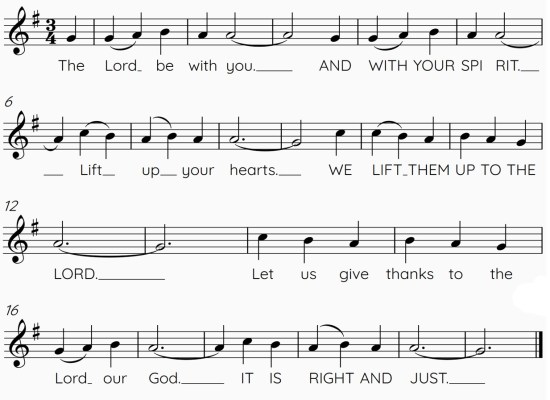
I’d be interested to know if anything like this has been encountered by PrayTell readers.
Coming back to the single-note dissent that is a regular part of my own experience: what, if anything, might be done? There seem to me to be three options:
1. Point out the error to the assembly and teach the correct manner of singing the response.
2. Accept the expression of the vox populi and instruct choir and cantors to fall into line with promptings of the Spirit.
3. Shrug, and add this case to the list of unresolvable musical anomalies, filed under “herding cats.”
This might seem a trifling matter, but it does provide a kind of petri dish for testing approaches that have far wider application.
Michael O’Connor teaches in the Christianity and Culture program at St. Michael’s College in the University of Toronto, where he holds the Bennett Family Chair in Christianity and the Arts. He is a Lay Dominican.
Excerpts from the English translation and chants of The Roman Missal © 2010, International Commission on English in the Liturgy Corporation. All rights reserved.
Please leave a reply.