
This week in my preaching course, I had my students read Luke Powery’s Dem Dry Bones: Preaching, Death and Hope,[1] which tackles directly the need for preachers to preach about death and link it with hope. He argues that only through death do we find hope. He does this through the lens of Ezekiel’s valley of dry bones (Ezekiel 37:1-14), often incorporating in his work and preachings African American spirituals. He draws from and quotes the spirituals in his homilies, arguing that they function as midrashim.
As many of us (for various reasons) feel stuck in the valley of dry bones, Powery’s turn to famous African American spirituals reminds us that with death brings hope and liberation:
For instance, in the spiritual “Go Down, Moses,” as a leader sings, “Thus saith the Lord, bold Moses said,” the community responds, “Let my people go.” The call and response continues until everyone joins in on the refrain,
Go down, Moses,
‘Way down in Egypt land, Tell ole Pharaoh,
Let my people go.[2]
The spirituals provide hope and resistance. They serve as a reminder that with death comes life.
I was at a museum this week and stumbled upon a book at the bookstore on a favorite artist of mine, William H. Johnson. Johnson’s work is known for his expressionism and folk-style. The book I found was based on a recent exhibition of his Fighters for Freedom series from the mid-1940s. The exhibition was organized by the Smithsonian American Art Museum and is currently on tour (https://americanart.si.edu/exhibitions/fighters-for-freedom).
The series Fighters for Freedom felt quite relevant to the current feeling of dry bones that I know many people are feeling. His work Harriet Tubman graces the cover of the book, though the series includes a wide diversity of figures, including George Washington, Abraham Lincoln, Gandhi, and FDR, to name a few.
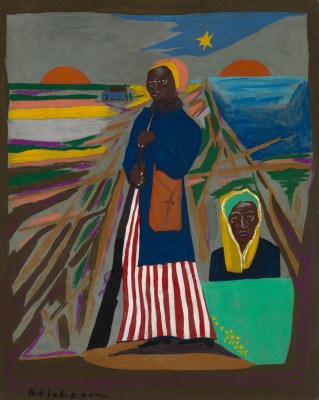
Flipping through the pages, you are overwhelmed by the freedom fighters that have come before us, and you feel compelled to take up their fight.
While a great series, it had me turn to Johnson’s more religious works, which I find particularly compelling. Like Powery, Johnson was inspired by African American spirituals and after the death of his wife from cancer, he increasingly created art with religious themes.[3] One of his more famous pieces, Ezekiel Saw the Wheel was inspired by the spiritual:
‘Zekiel saw de wheel. ‘Way up in de middle of de air.
‘Zekiel saw de wheel. ‘Way in de middle of the air.
De big wheel run by faith.
Little wheel run by de grace of God. (twice)
Wheel widin a wheel. ‘Way in de middle of de air.
Wheel, oh, wheel. Wheel in de middle of a wheel.[4]
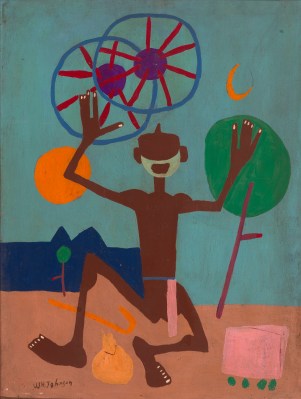
For other examples of Ezekiel Saw the Wheel, see:
https://americanart.si.edu/artwork/ezekiel-saw-wheel-11665
https://americanart.si.edu/artwork/ezekiel-saw-wheel-11666
https://americanart.si.edu/artwork/ezekiel-saw-wheel-11668
Other pieces, like Swing Low, Sweet Chariot, were also inspired by African American spirituals, namely “Swing low sweet chariot, comin’ for to carry me home…,” and his piece Climbing Jacob’s Ladder (see list below) by “We am clim’in’ Jacob’s ladder…”[5] Richard Powell notes that for his time these images were not well received in the African American community and congregations due to their risqué nature or the way the images pushed against traditional Christian imagery of the time.[6] I wonder if that would be the case today?
Powery and Johnson both take up themes of death and hope from African American spirituals to point to our liberation. This got me to thinking, what would it be like to create a preaching that interwove the African American spiritual tradition alongside artistic interpretations of that tradition as seen in Johnson?
Sadly, preaching is not my particular gift, so I will not attempt to provide an example of a preaching that brings Powery and Johnson together. I welcome anyone who would like to do so!
Instead, I would like to offer a list of Johnson’s religious works that I find inspirational. Perhaps they will help those feeling like they are in a period of dry bones or preachers whose background and ecclesial context allows for them to pull together insights from Powery’s use of African American spirituals with Johnson’s artistic interpretations of key events in Christ’s life. They may even be a good source of inspiration for visio divina.
I found surveying Johnson’s more religious art to be liberating and inspiring in a period where I feel we are called to offer up resistance and hope. It also felt particularly important to hear from an underrepresented voice and perspective. Perhaps his art will move you as it has moved me.
List of additional religious works by Johnson
Climbing Jacob’s Ladder
See Powell, Homecoming, #175.
Study for Climbing Jacob’s Ladder
https://americanart.si.edu/artwork/study-climbing-jacobs-ladder-12540
Come Unto Me, Little Children

Sketches of Parable with a Woman; Come unto Me, Little Children; The Temptation of Christ or Get Thee behind me, Satan; Crucifixion
https://americanart.si.edu/artwork/come-unto-me-little-children-11621 (verso)
Lamentation
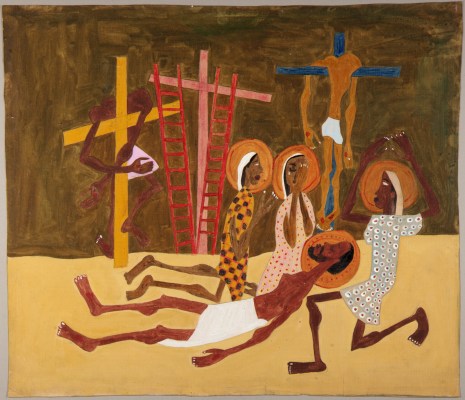
See also: https://americanart.si.edu/artwork/lamentation-11815
Study for Lamentation
https://americanart.si.edu/artwork/lamentation-12407
https://americanart.si.edu/artwork/lamentation-12409
https://americanart.si.edu/artwork/study-lamentation-or-descent-cross-12447
Study of Christ Carrying Cross
https://americanart.si.edu/artwork/christ-carrying-cross-12448
Study of Adam and Eve
https://americanart.si.edu/artwork/adam-and-eve-12408
New Born Babe
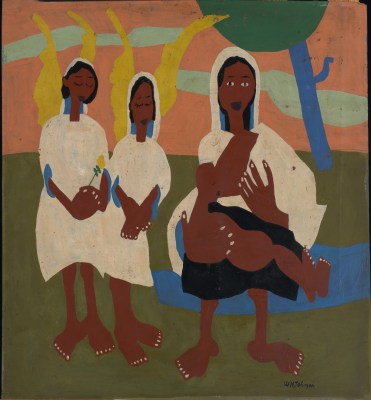
See also: https://americanart.si.edu/artwork/new-born-babe-11899
Study for New Born Babe
https://americanart.si.edu/artwork/new-born-babe-12524
Sketch of Nativity
https://americanart.si.edu/artwork/nativity-12631
Crucifixion Sketches
https://americanart.si.edu/artwork/crucifixion-sketches-12542
https://americanart.si.edu/artwork/crucifixion-scene-12589
https://americanart.si.edu/artwork/crucifixion-12587
https://americanart.si.edu/artwork/crucifixion-12586
https://americanart.si.edu/artwork/crucifixion-scene-12588
Sketch of Pieta
https://americanart.si.edu/artwork/pieta-11939
Sketch of Entombment
https://americanart.si.edu/artwork/entombment-12406
https://americanart.si.edu/artwork/entombment-12544
https://americanart.si.edu/artwork/entombment-12410
David and Goliath
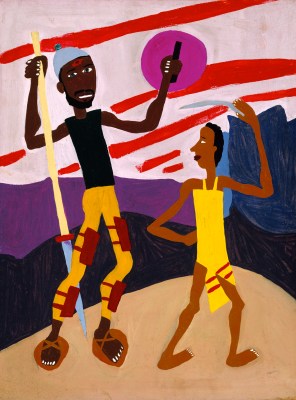
Sketch of David and Goliath
https://americanart.si.edu/artwork/david-and-goliath-12592
https://americanart.si.edu/artwork/david-and-goliath-11646
https://americanart.si.edu/artwork/david-and-goliath-12593
I Baptize Thee
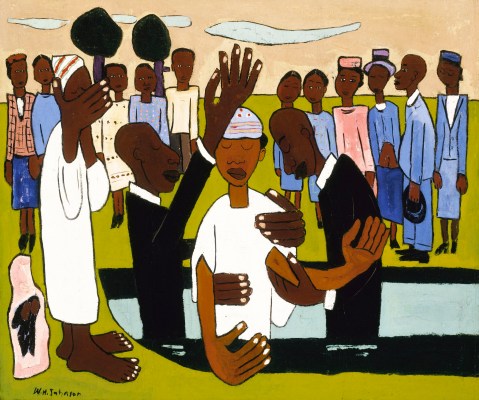
Sketch of Baptism
https://americanart.si.edu/artwork/baptism-12526
Mount Calvary
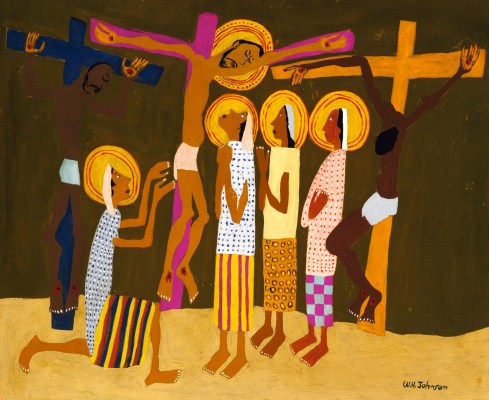
Sketch of Religious Scene
https://americanart.si.edu/artwork/religious-scene-12449
Going to Church
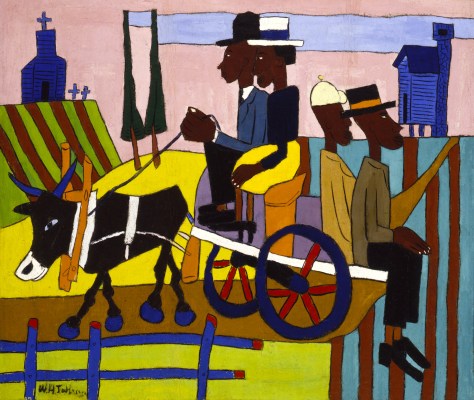
Jesus and the Three Marys
Study of Jesus and the Three Marys
https://americanart.si.edu/artwork/jesus-and-three-marys-12590
[1] Luke Powery, Dem Dry Bones: Preaching Death and Hope (Minneapolis: Fortress Press, 2012).
[2] Powery, Dem Dry Bones, 28.
[3] Richard Powell (ed.), Homecoming: The Art and Life of William H. Johnson (Washington DC: The National Museum of American Art, Smithsonian Institution, 1991), 181-182.
[4] Powell, Homecoming, 183/186.
[5] Powell, Homecoming, 186/189.
[6] Powell, Homecoming, 186/189.
Please leave a reply.