
Today (Sept. 20th) the Roman Catholic Church celebrates a memorial of Korean Saints Andrew Kim Taegon, Paul Chong Hasang and Companions who were canonized by Pope John Paul II in 1984. Catholics in Korea today number approximately 5.8 million; about half the number of Protestants, with whom make up the total number of Christians who are about 30% of the population. Pope Francis visited Korea in 2014 for the beatification of the 124 Korean martyrs, and more recently, the young church of Korea was under the spotlight again when the Roman Pontiff announced Seoul as the host city for World Youth Day 2027.
Catholicism in Korea began at the end of the 18th century, about one hundred years after Catholicism had already been present in China and Japan. The first Catholics were highly educated yangban class. Korean diplomats who were stationed in Beijing came in contact with Christian doctrines in books written in Chinese by Jesuit missionaries. The Korean scholars then translated and taught catechism in Korean to those who were unable to read classical Chinese. Thus, Catholic church in Korea began by lay people who desired and accepted the “western religion,” which taught that one must serve one God who is the Lord of Heaven and serve one another in charity for the reward of eternity in heaven is greater than any pleasures of this life.
It would take another sixty years before there was the first Korean priest, St. Andrew Taegon Kim. Born on August 21, 1821, Taegon Kim was sent to a seminary in Macau at the age of fifteen with two other young men (Thomas Yang-eop Choi and Francisco Bang-jae Choi) at the recommendation of Fr. Pierre Maubant, a priest of the Paris Foreign Missions Society. Kim was ordained priest in 1845 and after multiple failed attempts finally entered Korea. He ministered to the faithful for a short period of one year before being captured, imprisoned, and beheaded on September 16, 1846.
In contrast, St. Paul Chong Hasang was a lay person and a theologian who came from a family of scholar martyrs. The saint’s father, Augustine Chong Yakjong, was martyred by beheading in 1801 during Shinyu persecution. Afterwards, Chong Hasang’s family possessions were confiscated and he, his mother and his sister lived in poverty as they were shunned by other family members who were hostile to the Christian faith. Chong Hasang recognized the dire need for a priest for the faithful in Korea. He went Beijing to secure a priest to be sent to Korea and collaborated with Yu Jin-gil to write a letter of petition to Pope Gregory XVI to designate Korea as a diocese independent from Beijing. Thus in 1831, Joseon (Korea) became a diocese with Bishop Barthélemy Bruguiére, a priest of the Paris Foreign Missions Society. Chong Hasang was martyred on September 22, 1839 during Gihae persecution, along with his mother Yu Sosa Cecilia and Chong Junghye Elisabeth.
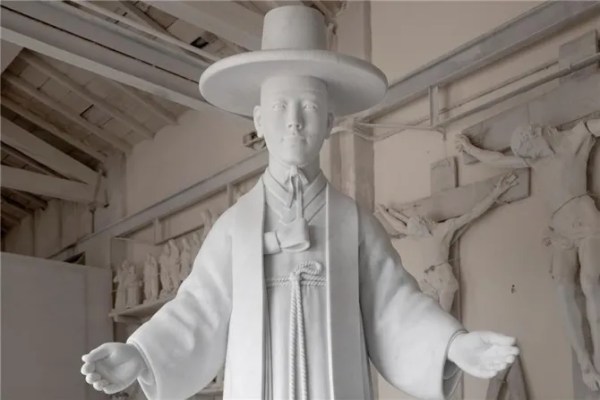
The image that comes to my mind when I reflect on the feast day today is the statue of St. Andrew Kim now permanently placed on one of the exterior niches of St. Peter’s Basilica in Rome. On September 16, 2023, a group of 300 Korean faithful, along with the clergy and Cardinal Lazarus Heung-sik Yu, gathered for the blessing and unveiling ceremony of the statue. St. Andrew Kim, the first priest of Korea, is now the first Korean saint to adorn the church of Rome. May the blood of the Korean martyrs become a fertile soil for faith of all Christians.