
It is often easy to disparage relics that appear to be inventions from the medieval period. Our modern “scientific” minds often want proof that the Shroud of Turin actually wrapped up Christ’s body or that the head of John the Baptist really was his head. The same is the case with holy places. Is this where Christ was truly crucified? But such concerns seem to really miss the point. Of course it is wonderful when we can confirm that these relics and places are exactly what they claim to be. But does it really matter?
When teaching about the Holy Land I always say…Regardless of whether this was the actual site of the crucifixion, the point is that this place allows us to enter into the Paschal Mystery in a unique way. Moreover, we do so along with countless other souls who have come before us. Their centuries of prayers at the spot or at the relic sanctify it.
One of the things I find most beautiful about the Catholic Church is the rich culture of relics. The relics captivate our imaginations, connect the material with the immaterial, link earth and heaven, and forge anamnetic connections between the past and the present. They help us take seriously embodiment in our faith and worship.
The plethora of relics always provides us with unique windows and perspectives into the life of Christ and the church more broadly.
One such relic that has been on my mind of late is the Relic of the Precious Blood in the Basilica of the Holy Blood (Heilig-Bloedbasiliek) in Bruges, Belgium. The relic purports to be a vial of the blood of Christ saved by Joseph of Arimathea after he cleaned Christ’s body after taking it down from the Cross. However the origins of the relic are dubious, and its presence in Bruges is not attested before the 1250’s.[1]
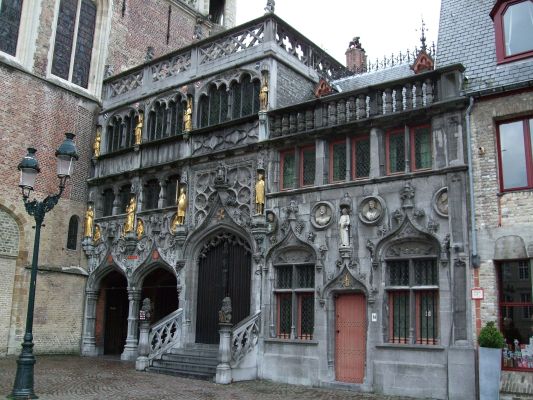
Credit: Jim Linwood. Creative Commons Attribution 2.0 Generic.
Going into the chapel and seeing the relic for the first time I was quite incredulous. Nevertheless, I reverenced it and prayed in front of it.
Over the next few months while I lived in Belgium, I continued to reflect on my experience. So what if it was not “really” the Blood of Christ preserved in the phial. Did it really matter? Was not the whole purpose to captivate my imagination and to help me enter into the Paschal Mystery in a unique way I had not often considered – through a focus on the Blood of Christ? In fact, hadn’t it done just that!
Bruges is a must-see city for every tourist going to Belgium, so as friends came to visit and I took them to the city, I insisted we go see the relic. Each time I fell more in love with it and more convinced that whatever its origins, it was really or truly a relic of Christ’s blood.
Blood is the life force within us, generated in our bones and carrying oxygen, other nutrients, and the building blocks that sustain us throughout our bodies, as well as carrying our immune system to help protect us against all forms of illness and disease. Our bodies are truly an impressive creation. The Relic of the Precious Blood far from divorced from science can provide us with powerful ways of connecting our own bodies and its marvels to our faith in the Holy Spirit’s movement within us, in Christ’s offering (like that of a blood donor) for us, and to connect our mundane experiences, even a small cut or scrape, with Christ’s suffering on the cross.
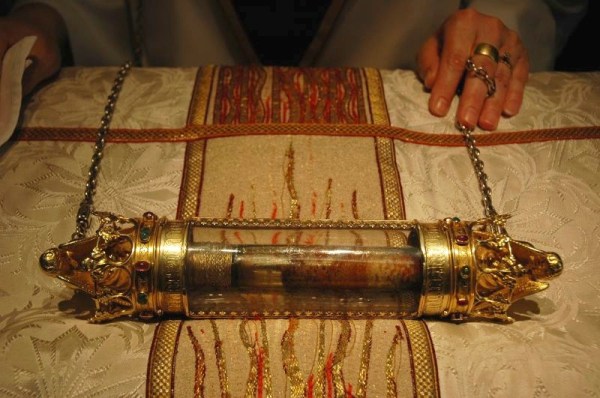
Credit: Matt Hopkins. Creative Commons Attribution-Share Alike 2.0 Generic.
It seems fitting that we as Catholics have a relic that allows us to enter deeply into the life and sufferings of Christ, especially for those suffering from any sort of ailment of the blood. Such a relic can serve as a very real way and specific way to enter into Christ’s humanity and his suffering.
So is the Relic of the Precious Blood in Bruges a “true” relic? It is for those in the city and for those who resonate with it. The same should be the case for all our other “dubious” relics and holy places. This does not mean that we can or should ignore science and history, but rather see these things through the eyes of faith as a way to shape our imaginations and lead us more deeply into relationship with God and one another.
As for me, I am convinced that in Bruges I have seen the Blood of the Lord, and it has shaped and continues to shape my experience of the Paschal Mystery.
[1] Nicholas Vincent, The Holy Blood: King Henry III and the Westminster Blood Relic (Cambridge: Cambridge University Press, 2001), 73.