
At Saint Meinrad Seminary and School of Theology in southern Indiana, a new Institute for Sacred Music has recently launched. I interviewed the director, Br. John Glasenapp, OSB, inviting him to share with the PrayTell audience about this resource for the Church.
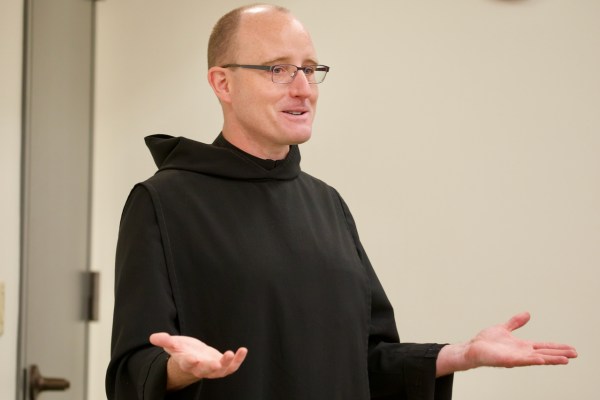
What is the Saint Meinrad Institute for Sacred Music?
The Institute for Sacred Music supports, trains, and connects liturgical musicians at a high standard but one that is open and accommodating to everyone at any level. We bring in top scholars, musicians, and composers to share their expertise with the general public through a variety of programming as well as invite those scholars to discuss how their work might inform the real pastoral situations our participants face in ministry. Saint Meinrad is uniquely positioned both as a Benedictine archabbey with an extraordinarily rich musical tradition stretching back centuries through our Swiss motherhouse of Einsiedeln and as a religious institution committed to education and lay pastoral formation. As with learning a language, no one actually speaks like a textbook. Chant is also that way. It is important to learn a tradition through experience and exposure. The monastic tradition at Saint Meinrad is strongly committed to chant adapted to the English vernacular, and that is a legacy we want to share. The Institute offers opportunities for musicians and musically-minded people to dive more deeply into the Church’s musical treasury and to immerse themselves in its traditions both at our daily liturgies and in our classes.
Can you tell us a bit about your background?
I studied music as an undergraduate in Chicago before entering the monastery after a brief stint working in administration for the Chicago Symphony Orchestra. When I approached solemn vows, the abbot told me, almost verbatim, that Saint Meinrad had a long history of sacred music and that he wanted it to continue beyond Fr. Columba Kelly and those who were nearing the end of their musical careers at the time. Chant studies require some special skills, such as reading medieval handwriting, so I first completed an MA in Medieval Studies at Fordham University before continuing my PhD at Columbia University where I graduated in Historical Musicology in 2020. My dissertation focused on a particular manuscript that recorded a 500-year-old chant tradition in a single abbey. I was interested in why chant changed when it did and especially how a particular chant that was perfectly acceptable the day before (and often explicitly placed there in a previous reform) was suddenly deemed “corrupt,” “inauthentic,” or “undesirable” the next day, so to speak.
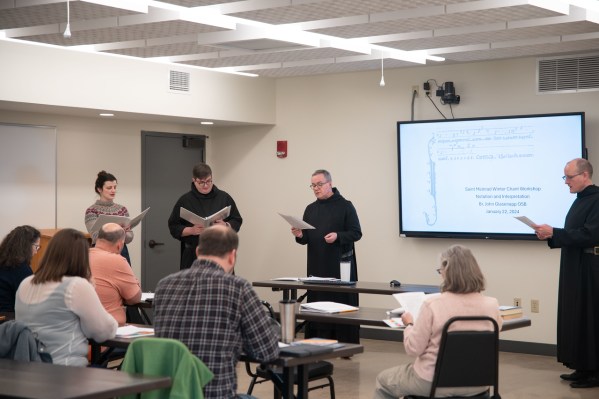
What are some of the things the Institute has done so far?
In October 2023, we finally opened a new dedicated multimillion-dollar music space designed perfectly for the needs of liturgical musicians. We have a large classroom/rehearsal space acoustically engineered specifically for singing chant, practice rooms, offices, and a manuscript reading room so that scholars finally can have access to our medieval collection. To celebrate, we organized a concert https://www.youtube.com/watch?v=mxSXKLaI9Nw with program notes and explanations available here https://www.saintmeinrad.edu/sacred-music/. This performance brought together professional singers from the Cleveland-based ensemble Trobár, the monastic schola, and our soprano-in-residence and frequent guest cantor at monastic liturgies, Sr. Jeana Visel, OSB, to explore the place of Saint Meinrad within the larger musical tradition of the Church over the last thousand years. A few months later, we also brought leading scholars from institutions such as University of Notre Dame, Columbia University, and Indiana University to present to the public on previously unstudied liturgical manuscripts in the library collection. It was a wonderful and unique opportunity for anyone to come, handle our precious and one-of-a-kind manuscripts up close, and hear about their contents and fascinating backstories from the top experts in the field.
What are your hopes for the Institute?
We live in an almost unprecedented time for liturgical music. The Second Vatican Council threw open the doors to new musical and artistic possibilities, including the revival of earlier repertoires. There was an initial burst of creative energy. I hope to keep that burst warm and glowing and not simply settle on a de facto canon of familiar, easy, and accessible hits that can form over time. The first step is to understand the Church’s musical tradition as dynamic, vibrant, and diverse. Then, we must continue to reflect on the ideals and instructions in the Church’s documents on music, which frequently depend upon context and interpretation. With that background, we begin to arrive at that elusive state of mind known as the “sensus ecclesiae.” Lastly, we need to incorporate the expertise of musicians, directors, liturgists, musicologists, theorists, composers, pastors and other voices in conversations about creating what the documents call “true art” that enhances and extends the prayer of the liturgy celebrated in all different times and places. The hope for the Institute is a broad vision for sacred music generally.
Practically, we intend to realize that goal by expanding our week-long summer and winter chant workshops, which may now be taken for graduate credit with some additional work, and develop a slightly shorter (3-day) workshop devoted to simple a capella polyphony featuring the English settings by our Fr. Tobias Colgan. They are easy to sing, beautiful, and the texts are familiar! There is little of that repertoire out there, even though polyphony is especially esteemed in the church documents on music. We will soon launch a calendar of online sessions during the 2024-25 year that will cover a range of musical topics from the practicalities of singing recitation and Psalm tones to the more theoretical theology of beauty and why we bother to sing at all. I am also excited to announce that the Grammy-award winning Fisk Jubilee Singers will perform here at a free and open-to-the-public concert on February 27, 2025 followed by a post-concert discussion with Archbishop Shelton Fabre of Louisville and Dr. Karen Shadle as part of a course on Sacred Music and Race offered in our School of Theology.
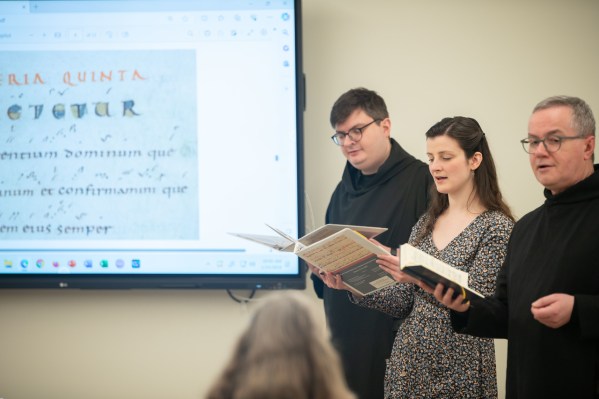
Who might your offerings serve?
Everyone! Monastics and religious, “nones,” professors of music, volunteer choir members, recent converts interested in exploring Catholic music and art, seasoned music directors and organists, and distinguished scholars of liturgy. Music generally, and chant in particular, brings everyone together in a single voice, and so “everyone coming together in a single voice” is quite sincerely our target audience.
Where can our readers find more information?
Resources, upcoming programs, registration links, and the sign-up form for our e-newsletter can be found at https://www.saintmeinrad.edu/sacred-music/.