
A while back I wrote a post about the need for the renewal of devotions in the Catholic Church today. I thought I would try to provide some more substance by looking at the practice of adoration. This seems especially important in light of the Eucharistic revival and in light of the call for further formation and catechesis outlined in Desiderio desideravi. Also, there is a new and wonderful book out on adoration by Ed Foley: Edward Foley, Eucharistic Adoration after Vatican II (Collegeville: Liturgical Press, 2022).
My central concern is how one might renew and foster this practice in a way that is authentic to the spirit of Sacrosanctum Concilium.
Eucharistic adoration has become, in many cases, a bit of a hot potato. The practice is frowned upon in certain circles, while in others, it appears to take on more importance than the reception of communion itself. At the same time, this practice – which is considered deeply Catholic – remains a fruitful devotion and source of identity among younger Catholics. Kimberly Belcher in a recent study on adoration has highlighted this trend:
“Within the Roman Catholic Church, especially among a younger generation that seems to value older practices, ‘traditional markers of confessional identity’ include eucharistic adoration and other embodied tokens of belief in the Real Presence.”[1]
Often liturgists are worried about a few things with adoration: 1) that it will become more important than mass; 2) that it will lead to a decrease in the reception of communion; and 3) that it is inherently anti-ecumenical. In her qualitative study of Catholic college students, Belcher asked some of the same questions:
“I wondered if adorers would find they preferred adoration to Mass, or whether they would receive communion less frequently because of excessive scrupulosity. This was far from the case among students I interviewed…every student interviewed said unprompted that mass was more important than adoration.”[2]
She also found that while adoration could pose challenges for ecumenism, it was not inherently anti-ecumenical. Belcher’s study is well worth a read.
If some of our assumptions about adorers are misplaced, then the question is not whether we should be encouraging this Eucharistic piety, but rather how we should be cultivating it in a thoroughly post-conciliar way.
In his seminal study Cult and Controversy, Nathan Mitchell remained cautious of adoration, but noted that when properly understood and oriented toward the liturgy, the practice can highlight key dimensions of Catholic Eucharistic piety and theology: “If it is authentic, eucharistic devotion always leads the believer back to the Lord’s table, back to the celebrating assembly, back to eating and drinking the food that survives even when the meal is ended.”[3] The practice of Eucharistic adoration must flow out of and back to the liturgy.
Mitchell described this another way:
“[E]ven the reserved eucharistic species are destined to be eaten and drunk by God’s people. Here one can see that the relation between action and object in the eucharist comes full circle. Action (liturgy) produces object (the sacramental species); but the object is destined once more for action (eating and drinking by God’s people). The eucharist is never destined to remain an object of adoration and piety; it is always returned to the people in the form of spiritual food and drink.”[4]
He represented this flow from the liturgy and back in the following chart:[5]
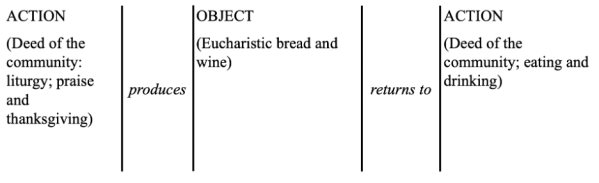
This core connection articulated by Mitchell between the Eucharistic action – adoration – and communion seems to be ingrained in the Catholic college students Belcher interviewed. (A big shout out to those doing good catechesis!) The practice of adoration, then, is not itself something to be concerned about. In fact, it can serve to strengthen Catholic piety as well as serve as a marker of Catholic identity.
At the same time, given the rise in the popularity of adoration, it is central that we continue to do good catechesis on this devotional practice, as well as make more concerted attempts to connect it to the liturgical life of the Church.
There are ways that we can continue to support the connection between adoration and the whole Eucharistic celebration – Eucharistic prayer through reception of communion. We also need to embed this practice within the communal liturgical life of the Church. A number of possible practices that show the link between adoration and communal prayer are spelled out in the Order of the Solemn Exposition of the Holy Eucharist.[6] These include benediction within the context of the Liturgy of the Hours and other communal services.
The practice of communal adoration with benediction reminds us of the corporal dimensions of adoration, directing us back to the whole celebration of the Eucharist in a way that gives the liturgy primacy over devotional practice.
[1] Kimberly Hope Belcher, “Eucharistic Adoration and Ecumenical Dialogue: Ritual Practice and Authority among Catholic College Students,” Questions Liturgiques 99 (2018): 3–4.
[2] Ibid., 7.
[3] Nathan Mitchell, Cult and Controversy: The Worship of the Eucharist Outside Mass (New York: Pueblo Publishing Company, 1982), 348–49. Readers may also want to consult Nathan Mitchell, “The Amen Corner: Eucharistic Adoration Revisited,” Worship 83 (2009): 457-471.
[4] Mitchell, Cult and Controversy, 347.
[5] Ibid.
[6] Order for the Solemn Exposition of the Holy Eucharist (Collegeville: Liturgical Press, 1993).