
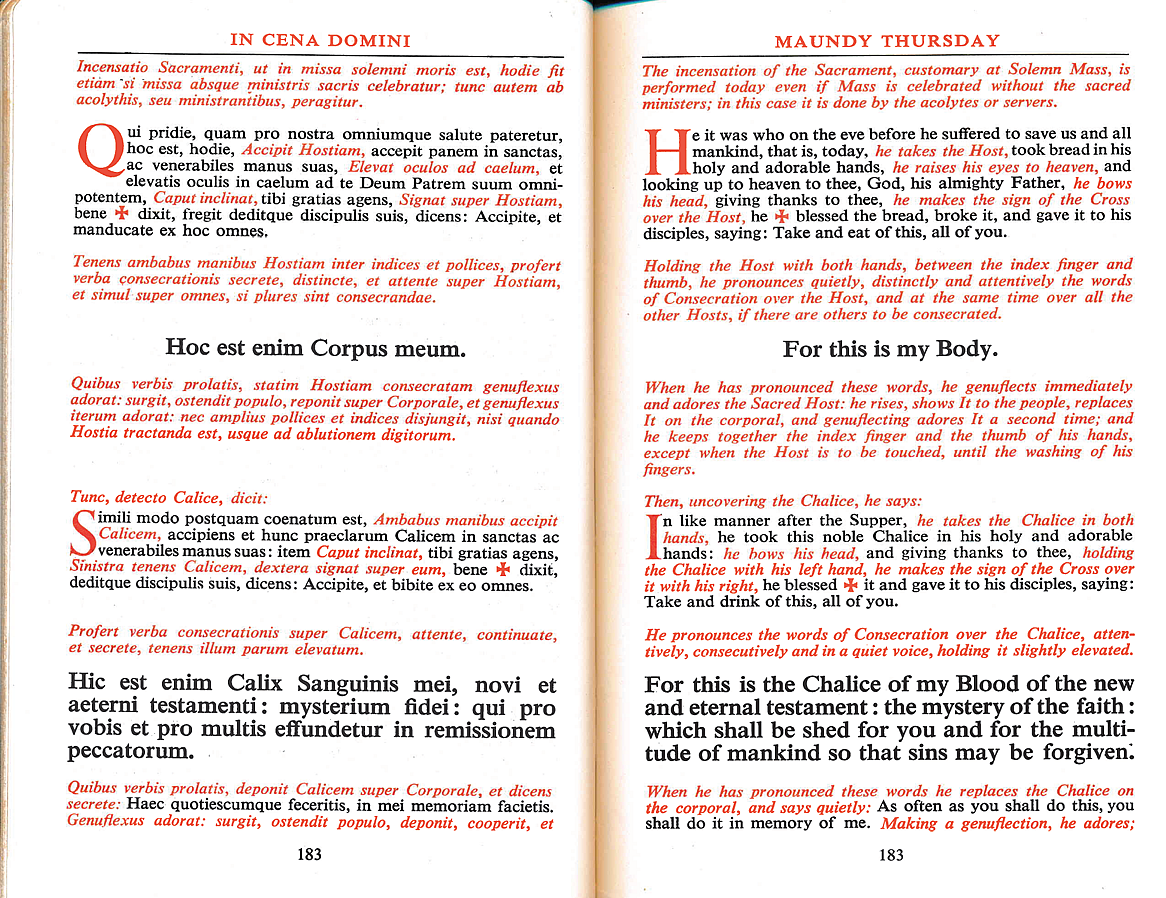
This morning I attended Mass in a major English-speaking city at a church well known for its very traditional liturgies. Though the Mass according to the 1962 Missal is celebrated daily at this church, this Mass was celebrated in the vernacular according to the liturgy as reformed after Vatican II. The general approach, however, seemed to be to assimilate things as closely as possible to the 1962 Missal. For the most part the rubrics were followed (with some extra signs of the cross and genuflections in the Canon), but the Mass was celebrated ad orientem and in general the priest’s gestures followed as closely as possible pre-conciliar practice (including the “twirl” at the “pray brethren…”).
What was most notable to me, however, was that the priest prayed the vernacular text of the Mass as if it were Latin. What I mean by this is that he did not speak the words as if he had any expectation of communication taking place with the assembly, but as if they were sacred words that were an element in a ritual incantation. Even the words addressed to the assembly were said with no eye contact or other indication that we were the ones being spoken to. Yes, I could understand what he said; but the words were uttered in a way that mainly communicated the message, “these words are not for you.” This became particularly striking during the canon, when he lowered his voice so that, while just barely audible, the effect of the Latin “silent canon” was approximated.
I found this distracting (but then I am almost always distracted when going to Mass in some new place). In my distracted state I found myself thinking about how there is a kind of incongruity in hearing my native tongue spoken in such a non-communicative way. In one sense the Mass may as well have been in Latin; indeed, this would have been less incongruous than hearing a language I know spoken in a way that seemed to subvert the very purpose of language.
I do think liturgical speech is something different than every day speech–which is why I have no problem with chanted dialogues and prayers and dislike the emcee approach to presiding. There is a sense in which liturgical speech is ritual incantation. But, at least in the reformed liturgy, speech is also communication among human beings and, it seems to me, this should be reflected in how thge liturgy is celebrated.