
Liturgical Art and Scandal

Headlines in the Catholic media have recently focused on a series of scandals related to Fr. Marko Rupnik. Rupnik is perhaps the most famous living artist who specializes in the decoration of Catholic churches. Since 1995 he has been the director of the Spiritual Arts division of the Aletti Center attached to the Pontifical Oriental Institute. Rupnik has become synonymous with their style of iconography and mosaics in particular. These iconographical projects of massive dimensions were made famous by their 1999 commission to decorate the Redemptoris Mater Chapel in the Vatican’s Apostolic Palace.  Since then, they have installed mosaics in the Basilicas of Fatima, San Giovanni Rotondo, Lourdes and are currently being installed in the Brazilian national shrine of Aparecida. Along with these many other churches have commissioned mosaics from them (their website lists 219 churches that they have decorated).
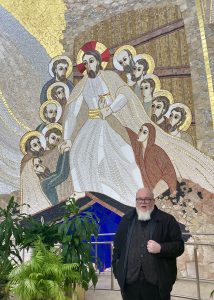
Photograph of me in the Chapel of Sacred Heart University, Fairfield, CT


Personally, I have been impressed by the works of the Aletti Center that I have seen, particularly in the Irish College in Rome and in Sacred Heart University in Fairfield, CT.  And for those who have not seen any of these mosaics in person, I must point out that they don’t always photograph well and are much more impressive in person, than in their photographs.

Pauline Books and Media have stopped selling the three books that they published by Rupnik.  However, what happens to the churches that he worked on is much more complicated. The question is whether churches with commissions from the Aletti Center ought to do something to acknowledge the scandals that have come to light about Rupnik? It is not as if the mosaics can be whitewashed over or the churches locked up until the case is resolved. These artworks are far from inexpensive and I am sure that many churches that installed them are still paying for them and can ill afford to replace them.

This is not the first time that a public and serious sinner has had their art in a church. Caravaggio is reputed to have murdered someone in a duel, yet I have never heard anyone having problems with his art being in famous churches. I am sure that the readers and commentators will be able to point out many other artists who lived scandalous lives, even while their work graced many churches.  Indeed, the beauty of the art seems sometimes to be almost in inverse proportion to the goodness of the artist’s life. This afternoon I was looking again at the photographs that I took at Sacred Heart in CT and I still think that the art is impressive. I am sure that the majority of people who enter that church will have no idea of the scandals currently swirling around Rupnik. Yet what is the best way forward? How do we balance the beauty of the art with the need to atone for the artists’ sins? How do we publicly acknowledge the newly problematic nature of the art without fanning the flames of scandal?

Fr. Neil Xavier O'Donoghue

Neil Xavier O’Donoghue is originally from Cork, Ireland. He is a presbyter of the Archdiocese of Newark, NJ who has ministered in parishes on both sides of the Atlantic. He has spent many years as an academic mentor to seminarians. Neil currently serves as Programme Director for Liturgical Programmes at the Pontifical University and as Acting Director of the National Centre for Liturgy. Since 2020 he has also served as the Executive Secretary for Liturgy to the Irish Catholic Bishops Conference. He has studied at Seton Hall University (BA, MDiv), the University of Notre Dame (MA), and St Vladimir’s Orthodox Theological Seminary (MTh). He holds a Doctorate in Theology (Ph.D.) from St Patrick’s College, Maynooth and is in the process of completing a second doctorate (D.D) in the Pontifical Facultad de Teología Redemptoris Mater in Callao, Peru. Neil has published a translation of the Confessio of St. Patrick: St. Patrick: His Confession and Other Works (Totowa, NJ, 2009), as well editing the third edition of Fredrick Edward Warren’s The Liturgy and Ritual of the Celtic Church (Piscataway, NJ, 2010). In 2011 the University of Notre Dame Press published The Eucharist in Pre-Norman Ireland an adaptation of his doctoral thesis and in 2017 the Alcuin Club published his Liturgical Orientation: The Position of the President at the Eucharist. His articles have appeared in The Irish Theological Quarterly, New Blackfriars, The Furrow and Antiphon. He writes a monthly article on some aspect of the theology of Pope Francis in the Messenger of St. Anthony and blogs regularly at PrayTell.

Please leave a reply.

Comments

24 responses to “Liturgical Art and Scandal”

  1. Allan J. McDonald

    The much dreaded issued of clericalism is present in this case and reaches the highest levels of the Jesuit order. But with that said, one wonders if clericalism will give Fr. Rupnick’s art an advantage that a lay Catholic in a similar situation would not received. This is a headline concerning David Hass:
    “Catholic Churches Drop Hymns After Accusations Against Composer
    David Haas, a composer known for “Blest Are They,” “We Are Called,” “You Are Mine” and other favorites, has been accused of sexual abuse and harassment by multiple women, an advocacy group says.”
    Of course it is easier to ban hymns than to rip out liturgical art, but there is a precedent for ripping out art in our churches, just think of the art that was destroyed in the aftermath of Vatican II’s renewal of the liturgy and what progressive liturgists and renovating companies thought should happen to pre-Vatican II churches and cathedrals. Art was ripped out. Iconoclasm is a tradition in the Church and perhaps should be applied equally to discredited artists be they musicians or artists, sculptors, etc, lay, religious or clergy.

    1. Michael H Marchal

      Far too many of the churches of my youth were filled with kitsch, not art. Mass-produced, plaster-of-paris, polychromed images of saints were their devotional decor. Though mistakes were made, this kind of faulty generalization is a logical fallacy.
      A bit of history: the liturgical movement had aesthetic as well as historical roots: I grew up reading Jubilee as well as Worship.

      1. Allan J. McDonald

        It’s all a matter of opinion; one person’s kitsch is another person’s art. The same can be said of liturgical music. In my humble kitschy opinion, the artwork removed from Milwaukee’s Cathedral to create the new look now there was hardly kitsch. But I am sure others will disagree with my assessment.

    2. Karl Liam Saur

      The different level with a composer’s work whose misdeeds are current is that congregants are being directed to sing it themselves. Not just listen to it.

    3. Paul Inwood

      The difference between the Rupnik case and the Haas case is that David Haas actively used his music as a grooming tool to aid his abuse. To date a total of 58 women have come forward and made public statements, but there are many, many more women who have not yet felt able to do so. The actual total certainly runs into the hundreds if not the thousands, representing serial and concurrent predation over a period of more than 40 years, including victims who were underage at the time of the offences.

      The fact that Haas used his music as a grooming tool means that anyone who knowingly continues to use Haas’s music is actively colluding in his abuse. This may not be the case with Rupnik — I have not heard that Rupnik used his art as a means for grooming his victims. But I can imagine that some abuse victims might nevertheless find Rupnik’s mosaics to be a trigger if they are aware of what he is alleged to have done.

      1. Keith Ainsworth

        In addition, of course, the buying of Hass’s music and the paying of royalties for it’s printing and live-streaming mean that music used to facilitate abuse is continuing to generate income for the abuser – if we allow it to.

  2. Fritz Bauerschmidt

    OSV has what I think is a good (and very Thomistic) piece on this issue: https://www.oursundayvisitor.com/what-do-we-do-with-father-rupniks-art/

  3. Luke Thorp

    One has only to think of the stations of the cross in Westminster cathedral and Eric Gill and the later fallout regarding his personal life. Surely with the passage of time the artist’s own personal life becomes something of a footnote. That’s not to downplay the seriousness of the problem. How that is approached presently is certainly challenging. Perhaps we need to distinguish between the art and artist. For what it’s worth I still find much solace in Henri Nouwen. Somehow their flawed characters ask us to question more deeply their works and our response. Art and life are a messy business.

  4. Fr. Jack Feehily

    I am scandalized by the “cancelling” of David Haas and of the present effort to cancel Father Rupnik. We are all sinners whose personal histories may well have included grave wrongdoings. But all of us who have been baptized into Christ’s saving death and resurrection are candidates for the fullness of God’s redemptive mercy. I am able to make a clear distinction between the liturgical compositions of David Haas and the harmful acts he is accused of by those who have come forward. I have been a victim and so I can identify with their deep pain and anguish. I can understand that they would be unable to be uplifted by the use of his music in liturgical settings. But to have stripped him of his livelihood by acts of banishment by publishers, bishops, pastors, and music directors strikes me as a punishment that deprives the vast majority of worshippers who have no idea who he is or what he is alleged to have done of the beauty of so many of his compositions. Although I have met him on a number of occasions he is not a friend. But he is a brother in Christ whose personal maladies led to actions that brought great harm to others. He is a sick man who needs the healing balm that our Redeemer offers to all who are willing to repent. I still love much of his music and believe it ought to be available. Thank God no one has yet suggested that Fr. Rupnik’s works of art ought to be whitewashed or torn off the walls of chapels and churches.

    1. Karl Liam Saur

      One of the other problems in the case of Haas that his publishers, sponsors and his close colleagues have not exactly been forthcoming about what they were aware of and when, and how much they were willing to avert eyes and ears. (It’s not like bishops are a special category of human being uniquely predisposed to such aversion.)

      Then again, I don’t really hear a mass of people in the pews complaining they miss his music, either.

      1. Fr. Jack Feehily

        How could they since most of them would have no idea who he is and what he has been accused of doing. But some might know enough to wonder what happened to “You Are Mine” especially at funeral Masses. He also composed dozens of responsorial psalms which were used so often as to wonder what happened to them.

      2. Paul Inwood

        Whenever people have requested Haas’s music for weddings and funerals, and have been told that this was music used to abuse and do they really want to have that music on this occasion, they have usually immediately said No, they didn’t realize and certainly don’t want it sung.

        The problem is that some feel that the sensitivity of the occasion, for example if it’s a funeral, means that musicians and clergy should give way to the wishes of a family. They don’t attempt to tell them what this music is. But they should.

    2. Margaret Hillman

      Fr. Fehily,
      To date nearly 60 women have come forward. Nearly five dozen women who suffered sexual and spiritual abuse at the hands of David Haas. It is not canceling, it is accountability. Many of us are cantors, music directors and choir members. Continuing the use of the music is traumatizing on many levels. Those arguing for the continued use of the music also cause further trauma. It is profane to bring music that causes flashbacks of sexual assault into Mass.

    3. Keara Parciak

      This is not cancelling. This is holding the person who has done the actions accountable for what they did. As it was said in a comment above, David Haas used his numerous songs to groom, abuse and prey on women. The separation is moot. He used his words and words of scripture to commit these acts, therefore his music should be removed. The words have become harmful. The melodies have become harmful.

    4. Paul Inwood

      Jack —

      You and I will have to disagree about this — respectfully, I hope. Yes, we are all sinners, and we all have flaws, some of them serious. I really admire your pastoral concern for all God’s people, and also certainly appreciate “hate the sin but love the sinner” and the argument that we should not be depriving people of works that helped them spiritually. Normally I might agree with you that we should not necessarily rush to judgement.

      However, as I said above, the significant difference between Haas and other abusers is that with other abusers, their art is almost incidental, a by-product of their personality, and perhaps even an expiation of their behavior. With Haas, much of the actual music was cold-heartedly used as a tool for grooming his victims. That makes all the difference. By using his music, we collude in and perpetuate that abuse. I personally am not prepared to do that.

      If you knew the horrible details of a number of his offences, details that have not yet been made public (although there is already more than enough horrible detail at intoaccount.org), you would agree with me that the man is a monster. I’m sure you wouldn’t say that we should stand by and do nothing about monsters. There has already been too much standing aside in recent times.

      1. As more details emerge about Rupnik and one victim speaking out in a thorough interview, his art may not be incidental to his abuse. Getting back to the post on him and his art, I am reluctant to cancel the good people do because of the overwhelming bad they have done. But mercy run amuck which then enables ongoing abuse is problematic, especially in this case. In the south of the USA where I live, some beautiful artwork of “heroes” of the Confederacy are being removed due to their racism, etc. I don’t like iconoclasm of Church art and abhor what was done in an abusive way to churches and Cathedrals in the aftermath of a progressive liturgical agenda. But I am more and more inclined that Rupnik’s art should be removed at least from prominent locations in the Vatican and USA.

      2. Karl Liam Saur

        “some beautiful artwork of “heroes” of the Confederacy are being removed due to their racism, etc”

        It’s also relevant that a fair portion of such artwork was erected in a propaganda campaign in the Jim Crow era as an explicit message of white supremacy. (The Daughters of The Confederacy were considerable handmaidens in these efforts.) For example, when the statue of Bobby Lee was dedicated in Charlottesville nearly a century ago, it was accompanied by a grand march by the KKK through the downtown … and around the nearby Black ghetto (called Vinegar Hill – which was razed during urban renewal after World War II….)…with a giant cross burning atop a hill overlooking downtown, as well as a festive re-running of The Birth of A Nation in a movie palace downtown. This was not some sober, quiet memorial to the stoic personal heroism of a military leader; but a public campaign reflected in the local newspaper of record at that time. (Thought experiment: Imagine Rommel winning the Battle of Britain for Germany and having his statue put atop Nelson’s Column in Trafalgar Square as a definitive statement of who won and who was in charge thenceforth.) This is hardly the only instance of this. While for the White communities these campaigns represented a reinforcement of their preferred order, they were of course a reinforcement of *disorder* for non-White communities; perhaps the period of time when these monuments were left to look scabrous with graffiti served to invert this effect for that time.

        A secular token of the first shall be last, the last shall be first? Who cancelled whom first?

        And consider that when we place a crucifix at the head of a formation of Christian disciples, we are using ancient Rome’s signature device of socio-political terror, as if Black Americans were to embrace a noose on a tree as their royal banner, as it were. It’s such a profound inversion that most Christians don’t appear to recognize it for what it was and is. The mothers and fathers of Palestine in the time of Jesus certainly were at least as well acquainted with the message crucifixions intended to convey as Black Americans have been of lynchings in American history.

  5. Jeffrey Armbruster

    Creative people tend to be those who are in touch –besieged, from a better perspective–with their aggressive and destructive tendencies. Often, their art is made as a form of reparation. The best art includes the dark elements of all of our existence, even in non apparent ways, that make the whole ring true. Art escapes being schlock or kitsch precisely because the pain and cruelty of our actual lives enters into it. I’m reading Jonathan Franzen’s newest novel, Crossroads. He has a long chapter that brings the reader into the descent into breakdown of one character. It’s doubtful that Franzen himself has experienced this–just as he hasn’t experienced a great deal of what his other characters have been through. This is Keatsian “negative capability” at work. But it does indicate that Franzen has been in touch with something very disturbing that’s common to us all. Many artists lead disastrous lives.
    My point isn’t to defend the horrible actions of Rupnik. One person’s aggressions spread out to have ruinous effects on many lives. We justifiably hate sin, our own and its damages that cascade down on us every day. Beauty rising up from all of this manure? Well, yes. We see it in ourselves too.

  6. Corr Oosterhuis

    The interview of a victim published in The Pillar details sufficiently systematic and abhorrent targeting of victims to warrant removing all his art. The man used his status as an artist and a priest to groom his victims. His art studio and the confessional were locations of seduction, manipulation, sin and grooming.

    His art isn’t even that good. Faces are creepy. Rip it all out.

    The man should be defrocked, as well.

    1. Anthony Hawkins

      I agree the faces are creepy, I always found the logo for the Jubilee of Mercy quite repellent. It gave me the creeps right from when I first saw it.
      I have only skimmed through this interview : http://www.30giorni.it/articoli_id_17906_l3.htm
      but I think it may also be unsettling in the light of current revelations.

  7. How do I reconcile the good fruits of the Spirit evident in profound works of art with the moral character of the artist who makes them? As an amateur artist myself I know I must start with myself, and avoid hiding from others my own scandal that has harmed anyone. Must I avoid depending overly on the example of others to anchor my faith and communion? Jesus himself called us fortunate if we do not fall apart because of him. It seems that some artistic idol’s despicable behavior is uncovered every year. What a dangerous balancing act we all have!

    I often repeat sage advice: Cast down your buckets where you are. Others before me have decried the search for magic bullets that can be imported into a body of believers for the purpose of enhancing their experience of faith. Gifted artists like Rupnik deserve recognition for their achievements, though at the same time we know that their work is a potential aid to faith and that we grow and blossom in the soil where we are planted. Too often we take Isaiah 35 and its transformation promise too literally; a flourishing cactus has its own beauty.

    Importing art or music or any other feature that purports, by its own installation, to enhance the worship of a body of believers may fail entirely. Icons have proven their efficacy in providing a pathway to the divine for millions of worshipers, as long as these are ready to receive them for that purpose. St. John’s Abbey decided for immense stones and limited stained windows, and the result is awesome though it can lead people away as much as toward the glory of God. O Emmanuel, come!

  8. Allan J. McDonald

    The Pillar has a must read commentary on the topic of this post as to what should happen to Rupnik’s art. The last paragraph is what a victim of sexual abuse (not from Rupnik) thinks should be done with his artwork:
    https://www.pillarcatholic.com/rupnik-mosaics-stand-in-us-chapels-amid-priest-artist-abuse-scandal/

    I would also recommend that the Jesuits be ordered by the
    Vatican to reimburse all those who purchased Rupnik’s art if they choose to remove it and replace it with something else. This rests with authorities in the Church and in high places in the Jesuit Order and the Vatican, not just Rupnik. The sex abuse scandal is not just about abusers but also enabling Church authorities.

  9. Living in the Minnesota, I am especially aware of the use of certain music which may well be an occasion of suffering for a person who might happen to be at my church. Cancelling? The practice certainly has recent legs: activists urging the disinvitation of certain public figures at public events, and bishops obedient to their wishes. Theologians consigned to a limbo of not teaching, not publishing. Is it a matter of orthodoxy? Of poor behavior? Of bitter jealousy?

    If a person dares to be critical of cancelling, they might look to their own cheerleading days and certain favorite pastors who felt beholden to such interests.

    Marko Rupnik certainly wasn’t on my radar as an artist before last week. I think the judgment on him needs to be focused on his misdeeds. The side comments on his art and genre are silly. We might as well criticize him for eating with his mouth open, for leaving the toilet seat up, and for feeding his dog kibble full of grain and additives.

    What to do with his art? Ask the people he tormented; see what they suggest. I’d be concerned also with those who enabled the man. On that note, GIA and LAREC and other such organizations still operate under a cloud in my view. At minimum, there needs to be institutional acknowledgement. I was the one who had to speak with the mother of a teen girl who was significantly bothered by the culture of MMA. Publishers and conference organizers would do well to come clean, and not to me or other consumers as much, as to the survivors.

  10. John Wadeson

    I’m not a fan of the music of Haas nor the art of Rupnik. But I think that art will survive not on the character of the artist but rather on its inherent beauty . Perhaps it is fortunate that we don’t know more details of the lives of other artists otherwise we might have to cancel many of what we call masterpieces. In time, what is beautiful will remain and the rest will eventually be labeled kitsch and then, long forgotten.


Posted

in

, ,

by

Tags:

Discover more from Home

Subscribe now to keep reading and get access to the full archive.

Continue reading