
“A good theologian is always one preposition away from heresy.”
When I was studying at the University of Notre Dame, this maxim circulated around the liturgical theology department—attributed to Edward Kilmartin, SJ. (I’ve turned it into something of a personal motto: God is in the prepositions.)
The aphorism came to mind during the recent weeks of furor over the priest in Arizona who altered the baptismal formula “I baptize you…” to “We baptize you…” It was reported in both the secular and religious press.
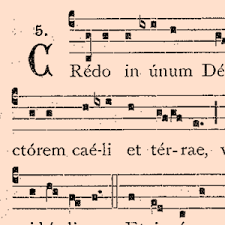
I also couldn’t help but recall a similar I/We ruckus over the beginning of the Creed (“We believe in one God…” vs. “I believe in one God…”) that emerged during the revision of the English translation of the Mass a decade-plus ago. “Here we are again.”
Both controversies illustrate what lies beneath Fr. Kilmartin’s saying: small words—even single-letter words—like the tongue/rudder of James 3:4, can steer an entire ship in a new direction.

In regard to the Arizona baptism situation, I know for sure that many, many people have been hoping a liturgical musician with a rudimentary background in liturgical theology would weigh in, as sooooooo many (often with rude, not rudimentary, backgrounds) have done, particularly on social media. The spectrum of responses there has been sort of status quo, with the bulk of them clustered around one end or the other.
On one end of the spectrum, Jesus/God doesn’t care about these things, and this is precisely the sort of legalistic pharisaism that Jesus opposed; it is, of course, the thing that is driving people out the parish doors. This is a viewpoint that has some merit—though if God doesn’t care about this, then exactly where/when does God begin to care? At the spectrum’s other end we find the insistence that only these words and precisely these words convey valid baptism, because God has entrusted this to the Church (often Matthew 28:19 [or 18–19] is referenced); only a return to this strict adherence will refill the pews. Again, this is a viewpoint that has its merits (even if the Matthew passage doesn’t indicate a pronoun).
Back to I/We baptism and I/We Creed. On the surface, it may seem that the two I/We circumstances really have nothing in common other than a coincidental word pairing. It can be offered that in the baptismal situation the issue was a priest not following the ritual text, while the matter of the 2010 translation of the Mass was actually a return to a true following of the [Latin] text. (Scholars have pointed out that the earlier Greek pisteuomen—we believe—was later rendered incorrectly in Latin as credo—I believe.)
The words I/We, in my view, lie in the overlap area of a Venn diagram of Christology and ecclesiology, which has implications for both the sacraments and for liturgy.
I’ve been criticized a number of times for saying/writing that, at the eucharistic liturgy, the gathered baptized assembly acts in persona Christi. Usually I’m corrected (anywhere from dismissively to angrily to charitably) by somebody pointing out that the priest/presider is acting in persona Christi. To which I’ll reply “in persona Christi capitis.” (A nuance introduced by the Second Vatican Council.) The priest/presider (a deacon, for example, at a baptism or wedding outside of a eucharistic celebration) stands at the head of the baptized assembly—the Body of Christ gathered in and through the power of the Holy Spirit. So it can be held as a legitimate view that when Christ baptizes, it is the whole Church who does so. It is “we” who do so.
A continued and deeper conversation about these matters—or a deeper reflection on them—will eventually raise some thorny issues about both Christology and ecclesiology. The Roman rite accepts innumerable people baptized in other Christian traditions as being baptized validly, even from traditions that don’t begin the formula with any pronoun whatsoever. As is often pointed out, this is why we don’t refer to those validly baptized in other denominations as being “converts,” since they are already Christians, and fully redeemed members of the Body of Christ. Perhaps thornier is the matter of all the invalid Roman rite eucharists celebrated mid-twentieth-century in various prohibited vernaculars. Yet it can be posited that these invalid eucharists are, in part, what led to the authorization of vernaculars later on. (Eugene Walsh, SS, would muse about all the invalid eucharists during those centuries when Greek gave way to Latin as the official liturgical language.)
For those who believe that everything ecclesial is a straight line drawn from Jesus of Nazareth to institutional Roman Catholicism, the point will be made that an individual priest does not have the authority to make the decision to alter the rites; I accept the latter part of this as true. I reject the former as false. The former does not allow for an awareness or acceptance of the way in which doctrine and ritual develop and change, and the various modalities of authority within the Body of Christ, the Church. (I am indebted to the book “By What Authority?” by Richard Gaillardetz for broadening my own understanding of this.)
I truly believe that words matter. Yes, God is in the prepositions and the pronouns. But we must resist the very human failing to deify them, and mistakenly think that prepositions and pronouns ARE God. (Our era tends to be overly-glib about scriptural warnings concerning idolatry.) Yes, God does care about our rites and how we celebrate them in the ongoing process of revelation. God likewise cares about how we live our lives, and how we treat one another during ritual skirmishes, because they are all part of one doxology, one act of praise. It is, ultimately, in any of those numerous acts of doxology that we will find God.
Please leave a reply.