
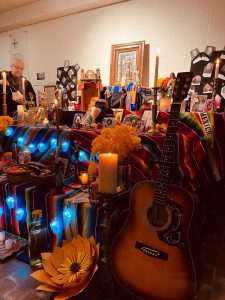
At Saint John’s Abbey today, the feast of All Souls, there was a short prayer service after morning prayer for the Día de los Muertos at the altar several monks set up. Pray Tell’s Fr. Anthony Ruff visited with Fr. Efrain Rosado OSB, monk of St. John’s, about the day.
What is the Día de los Muertos?
An important celebration for Mexican and Latino people, in which we remember, honor and pray for our loved ones who have passed away. It is celebrated between October 31st and November 2nd. People in Mexico make richly decorated altars in their homes, cemeteries and churches, to remember and to pray for the souls of the faithful departed. The deceased loved ones are remembered with offerings of food, drinks, photos, and objects that the person enjoyed in life. These things are laid out on the altar table. These altars also include images of Christ, Our Lady, and diverse saints. Religious and popular songs are played and sung. And a joyful party with food and drinks always follows.
 How is it different from Halloween?
Dia de los Muertos always includes prayers and religious components like incense and images of Saints. Food is offered for the enjoyment of the souls of the dead, not just for the people attending. Altars for the remembrance of the dead are always included.
Is it mournful and sad?
It has a small sorrowful component: we pray for the eternal rest and our dead ancestors. But the rest of the celebration is joyous and cheerful: we know that our deceased loved ones intercede for us and come to say hello. We honor them with joy and partying.
Where did it come from, and where is it celebrated?
The pre-Columbian peoples of Mexico were doing similar festivals from time immemorial. With the arrival of Catholicism to the Americas in the early 16th century, these celebrations merged with the All Souls liturgies of the European friars and colonizers. It is celebrated mainly in central and southern Mexico, where Aztec, Purepecha, Totonaca. Toltec and Mayan indigenous peoples are more present.
What happens at the ofrenda (altar)?
Prayers always include the Rosary and the use of incense and votive candles.
Is it about remembering the dead or about praying for them?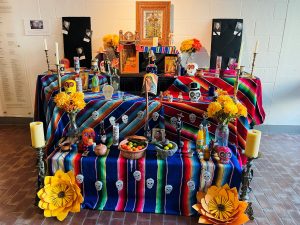
Both things happen. We are proud of the cultural legacy and good deeds of our ancestors. We pray for them and with them.
What about the skulls?
The pre-Columbian peoples kept and decorated the skulls of important persons, as mementos to honor their feats. Just as Catholics keep the bones of their saints as relics. Today skulls are made with ceramics, but mainly with sugar and chocolate. They are intended to be a treat for the souls and a gift for little kids.
What’s your favorite memory of the Día de los Muertos growing up?
Praying with my granny and grandpa at the altar and listening to the stories and deeds of my ancestors. And, of course, eating the candy and chocolate skulls when the festival was over.
What’s it like to celebrate it up here in Minnesota?
Many Minnesotans love this festival and join us in these important celebrations.
Photographs by Br. Felix Mencias, OSB.

Please leave a reply.