
Over the past few weeks, we have looked at the setting for the church to gather in a number of posts. Anthony has commented on the Lay-led house churches in the Church of England and I posted on the Fr. Len Black’s Shed of the Year as an alternative setting for the Church to gather.
I think that the future will see a variety of settings for liturgical gatherings, as unsurprisingly there have been a similar variety over the last two millennia. One particular setting for the Eucharist that has recently been making something of a comeback in Ireland is the Mass Rock.
During the time of the Penal Laws in Ireland, Roman Catholic worship was prohibited and all the churches passed to state ownership and were either secularized, destroyed or continued in religious use as under the auspices of the Church of Ireland. Catholic worship continued in private and often outside with the Eucharist being celebrated on a rock or large stone. As these assemblies were illegal and sometimes led to arrest and even martyrdom of those attending, it is not surprising that Mass Rocks tended to be located in out of the way places.
After Catholic Emancipation (1829) gradually Roman Catholic churches were allowed to be built again. Mass Rocks fell from the common consciousness and were often forgotten about. In recent years people began to mark their locations from both a religious and folkloric concern.
Recently Aid to the Church in Need Ireland decided to organize a Mass Rock campaign. As they explain on their website:
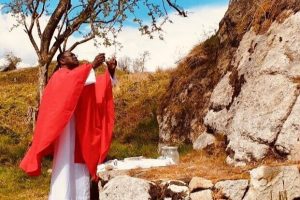
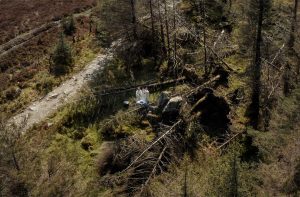
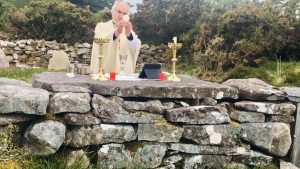
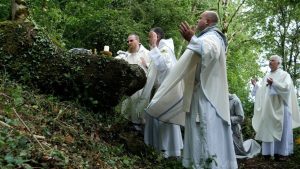
There is perhaps no tradition as unique to the Irish Catholic Church as Mass Rocks. Aid to the Church in Need Ireland has organised for a Holy Mass to be celebrated at a Mass Rock in each of Ireland’s 26 dioceses in the lead-up to the Feast of the Irish Martyrs on 20 June [2021]. These Holy Masses were offered for the renewal of the Faith in Ireland through the intercession of the Irish Martyrs.
While not explicitly mentioned, this happened during a stage in the lockdown where Catholic worship was again illegal and no public Masses (other than very limited funeral Masses) were allowed to be celebrated in the Republic. In the popular imagination the penal times were equated with the COVID-19 governmental criminalization of Catholic worship. Here is not the place to enter in polemics regarding the Irish government and their lack of respect for those who publicly practice their faith. Neither is it about the liturgical mannerisms of the priests who participated. I provide photographs as an illustration many more (and a video) are available on the Aid to the Church in Need website. Please note that the photographs do not have many lay people in them, as at this stage it was illegal for anybody to be present when the Eucharist was being celebrated.
The main point I am trying to make in this post is that our future will probably see different assemblies celebrating in very different places and that the Catholic Church will not necessarily meet in a parish complex with a purpose-built church. And this decreased physical footprint could be due to a decrease in regularly practicing parishioners as much as any persecution. But the answer to this has to be creativity and a willingness to share the joy of the Gospel and not simply resignation and condemnation of the evils of the present world.


All photographs used by permission of Aid to the Church in Need Ireland.
Please leave a reply.