
In honor of the Season of Creation (September 1 – October 4), Pray Tell is running a series of posts on how the liturgy can help us to appreciate the wondrous gift of Creation, and how it can challenge us to care for Creation. Each post will reflect on one of the seven days of Creation described in the first chapter of Genesis.
“Then God said: Let the water teem with an abundance of living creatures, and on the earth let birds fly beneath the dome of the sky. God created the great sea monsters and all kinds of crawling living creatures with which the water teems, and all kinds of winged birds. God saw that it was good, and God blessed them, saying: Be fertile, multiply, and fill the water of the seas; and let the birds multiply on the earth. Evening came, and morning followed—the fifth day.”
Genesis 1:20-23

In October 2018 the journal Marine Policy published a report on pollution in the world’s oceans. Scientists were shocked to find a plastic bag at the bottom of the Mariana Trench, some seven miles below sea level. One scientist highlighted the gravity of the find saying it was as if an astronaut arrived on Mars and the first thing found was plastic pollution. The problem is not simply that trash is ubiquitously present fathoms deep, but that it kills marine life. The decaying plastic releases toxic chemicals, it entraps sea life, and it is eaten. From small sea-life to whales with 88 pounds of plastic inside their stomachs, pollution is killing the creatures of the deep.

The situation is just as serious for the birds of the air. One of the greatest threats is change in climate patterns. Warming temperatures, shifting seasons, changing precipitation, and rising sea levels are disrupting the behavior of our feathered friends and the ecosystems that support them. Migratory birds follow temperature by instinct, and as such, are being driven to move by rapid temperature fluctuations. On both ends of the migratory paths, birds are arriving too soon before food is available, and seasonal temperatures stable, leading to mass die-offs.
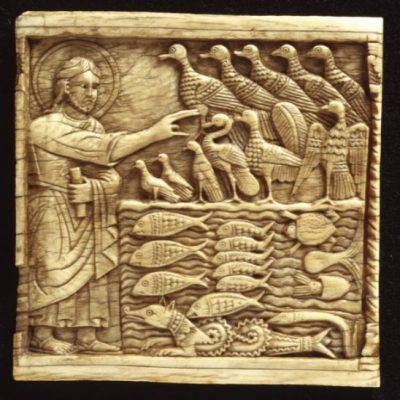
Water creatures and birds of all kinds are being destroyed at our hands. I agree with Laudato Si’ that we are committing “a crime against the natural world” which is “a sin against ourselves and a sin against God” (16). And yet it seems to me something more needs to be said. What is happening is also a sin against creation, not because we are passively threatening our existence, but because creation has its own redemptive journey that intersects and is co-terminus with the human species (See “A Service for the Blessing of Animals”, The United Methodist Church, 1992). Sins against creation don’t seem to rest upon human actions of consumption, greed, and wastefulness (cf., LS 11), as much as it seems to be a question of a ‘theological sin’ whereby we inhibit creation’s praise of her creator. We interrupt God’s salvific acts played out in the world in which the sea monsters and birds of the air play their part. It seems to me that something of this priestly character of creation is reflected in the Roman Eucharist Prayer IV. The prayer explicitly states that all of creation is brought into being to be “filled with every blessing.” Within the Cosmic Thanksgiving it is humanity’s role to give “voice” to the praise of creation. This priestly image is echoed as well in the Collect for Monday Morning Prayer in the Church of England’s Common Worship: “Lord our God, as with all creation we offer you the life of this new day” […]. It is a highly patristic perception of creation; Through the hierarchy of being what nature does intuitively and by ‘evolutionary instinct’ humanity does through conscious behaviour, having rationally encountered the living God (See Boutenff, Ancient Christian Readings of the Biblical Creation Narrative). Yet nature nonetheless really does participate in a reciprocal playing out of redemption.

One of the best places to see this theological proposition expressed is in the art-historical record which recounts the salvific deeds of the animals of the deep and the birds of the air. In the hope-laden catacombs of the early church Leviathan in shown fulfilling the work of the Lord by bending the intransigence of Jonah to the will of God. Through the filter of the New Testament, Leviathan becomes a prophet of resurrection.
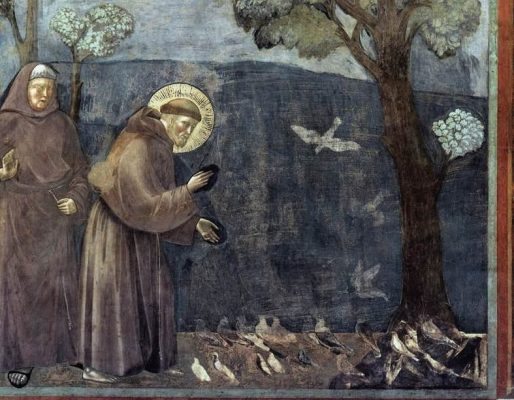
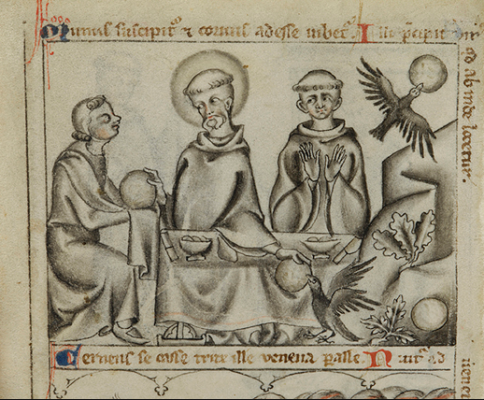
A favorite theme in Proto-Renaissance art is Saint Francis preaching to the birds. In Giotto’s famous visual account in the upper basilica in Assisi, a flock of birds have descended from the trees to listen to the Gospel. Francis’ friar companion gestures in disbelief as Francis speaks to the birds as if they are they endowed with reason. “He went right up to them and solicitously urged them to listen to the word of God, saying, ‘Oh birds, my brothers and sisters, you have a great obligation to praise your Creator, who clothed you in feathers and gave you wings to fly with, provided you with pure air and cares for you without any worry on your part.’…The birds showed their joy in a remarkable fashion: They began to stretch their necks, extend their wings, open their beaks and gaze at him attentively” (Salter, Holy and Noble Beasts). Indeed the hagiography of various saints report the companionship or interventions of animals. Benedict’s raven steals away poisoned bread and spares the life of the saint.
It seems to me that if we fail to find the theological validity of such stories it is because we have succumbed to the disenchantment of nature extolled by Max Webber; We have agreed to the intellectualizing and rationalizing of the material world as the only legitimate epistemological approach to physical reality (See Ellis, God, Value, and Nature). Perhaps we are forced to accept a non-Narnian universe, but I think the post-enlightenment world-view that sees the creatures of the deep and the birds of the air as things, rather than beings intimately involved in the unfolding of theirs and ours salvation, has helped shape the ecological disaster we face. I see the Christian art-record not as proposing a pre-microscope naïveté, therefore, but as a theological treatise on the priestly nature of creation.

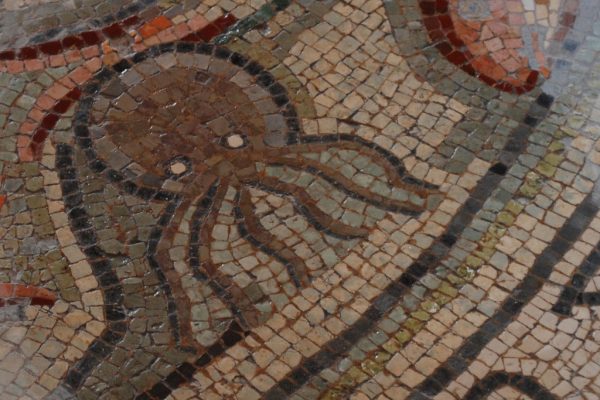
The early apse carpet mosaics of churches in the trans-Jordan depict fish and birds surrounding the altar not simply because this is how humans have envisioned paradise, but because animals are members of it. They are promised blessedness appropriate to their being.
In a similar fashion the birds and fish, flora and fuana, of medieval cathedrals, cling to the walls and vaults not as decoration, but as stand-ins for their biological counterparts swimming and winging it before the Lord.
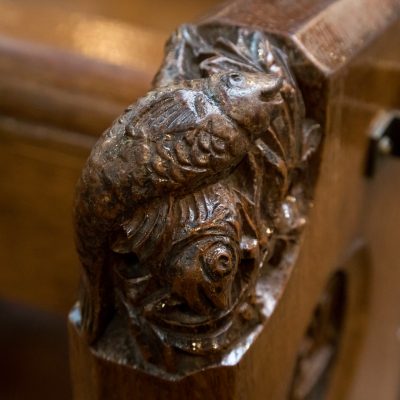
If disenchantment rendered the natural world “empty of meaning” perhaps the Christian task today is to replace that expelled magic with theology – to refill the story of creation with God’s saving action and thereby highlight nature’s rights and values and humanity’s abusive actions. Perhaps in this way, human consciousness and consciences will be rendered malleable to the meaning of creation once more. Something of this reality seems to underpin LS# 243 when Pope Francis concludes that “Eternal life will be a shared experience of awe, in which each creature, resplendently transfigured, will take its rightful place and have something to give those poor men and women who will have been liberated once and for all.” What this reality looks like is certainly highly divergent from scenes of plastic choking the seas and birds falling dead from the sky. Perhaps art cannot save our oceans and skies single-handedly, but I absolutely believe the words of Matthew Arnold: “Art still has truth, take refuge there.” So ultimately I ask myself, if we are to sing the great hymn of praise in the name of every creature under heaven, is this reflected in our art and buildings today? Our churches too have a fundamental role in rendering hearts malleable and pricking conscience. To this end, churches like that of the Community of Jesus, give me hope, both for creation, and for our worship.

Click on the links below to see other posts in the series on Creation: Fritz Bauerschmidt on Day One, Rita Ferrone on Day Two, Jill Crainshaw on Day Three, Alan Hommerding on Day Four
Still to come: Katie Harmon on Day Six, and Teresa Berger on Day Seven.

Please leave a reply.