
In honor of the Season of Creation (September 1 – October 4), Pray Tell is running a series of posts on how the liturgy can help us to appreciate the wondrous gift of Creation, and how it can challenge us to care for Creation. Each post will reflect on one of the seven days of Creation described in the first chapter of Genesis.
“Then God said: Let there be a dome in the middle of the waters, to separate one body of water from the other. God made the dome, and it separated the water below the dome from the water above the dome. And so it happened. God called the dome “sky.” Evening came, and morning followed—the second day.” Genesis 1:6-8
The first Creation narrative in Genesis is commonly described by Scripture scholars as belonging to the “Priestly” author. It should not surprise us, therefore, that the quiet drama this text offers — the narrative describing how God assembles each element and characteristic of Creation over the course of seven days — has all the stately elegance of an unfolding liturgy.
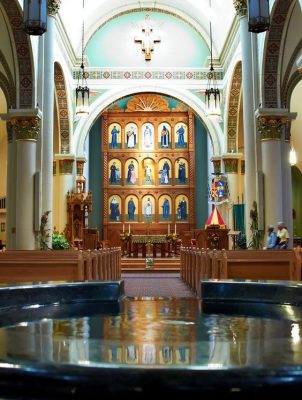
The world that God creates and holds in being is precisely fashioned, day by day, to become the place from which God’s praise issues forth. The world, like a glorious temple, has a dome, it is adorned with lights, and supplied with all beautiful and wonderful things, and, in the center, the human creature made in the image and likeness of God draws our attention to God himself.
Our work as liturgists bears a kind of metaphorical relationship to Creation, in that we are preparing a space in which the praise of God may resound. Formed by the liturgy, the faithful may then go forth to praise God with their lives. Liturgy invites and empowers us for the work of changing the world, so that all of Creation may become the temple of God’s glory.
In terms of their content, several of the days of Creation seem to awaken our praises naturally, because amazing things are described within them. Sun, moon, stars; plants, animals, sea creatures, birds; human beings — these things inspire delight and awe. Within the full biblical witness, the Psalms are foremost expressions of praise for these gifts of Creation. These days of Creation readily find a response in our hearts because we are dazzled by their wonders.
Yet what is going on in Day Two? This day seems a bit more puzzling. The separation of one body of water from another, one above and one below? The sky? Not things *in* the sky, but the sky itself? Well may we ask how these elements of the created order will lead us into praise.
Woven into this question is the additional assumption that our way of life, and not only our voices and gestures, offers praise to God. How might our lives give praise for . . . the separation of waters, and the sky?
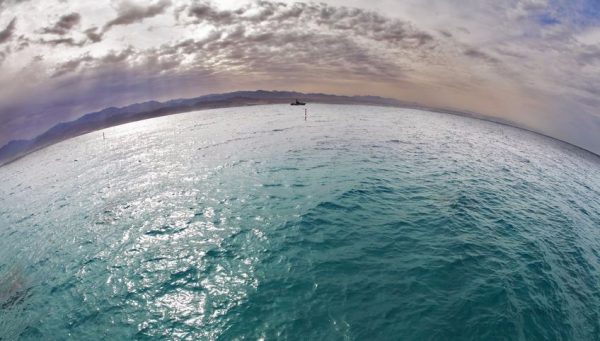
As I see it, there are two avenues into this question that may be fruitful for us as liturgists.
The Setting of Boundaries
First, it is helpful to remember that in the biblical view, Creation is more an event than a thing. Genesis describes a movement from chaos to cosmos, from a world “without form, and void” to a world beautifully formed and abundantly filled with good things. The event of Creation unfolds in response to God’s will, which is mysterious, yet at the same time full of blessing.
Within this act or event of Creation, the setting of boundaries is important. Indeed, the whole balance and integration of Creation depends on there being boundaries that are put in place and sustained by God for some particular purpose. Without boundaries, the world would collapse again into chaos.
Thus the separation of day from night, and the separation of the waters above the sky from the waters below it are essential movements in this event of Creation. As Gerhard von Rad observed in his masterwork, Old Testament Theology, “God lifted the world out of the formless, and over its own abyss he holds it unceasingly.”
Liturgists, in their own way, both navigate and honor boundaries. The rites of initiation, the act of joining two people in marriage, the rites belonging to the order of Christian funerals — to name but a few — are ways we mark the boundaries of life and death. Deeply personal though these life transitions may be, when we acknowledge them in the liturgy they become public occasions that resound with praise and thanksgiving.
Boundaries are important in the world of nature. One of the reasons why the story of the Great Flood in Genesis 7 is so horrifying is that, in it God seems to roll back the restraints that were set upon the waters in Creation. God has the sovereign freedom to withdraw blessing as well as give it. The deluge ensues with terrifying force when all the floodgates of the skies are opened.
We rely upon that second day of Creation more than we admit.

Which brings us to the current threats to the equilibrium of nature that we face on earth. We are living in a time when the polar ice caps are melting, and the rising seas threaten to overwhelm coastal areas and islands, while storms on land increase in severity and destructive power. The boundaries of the waters are becoming increasingly unstable. This should sober us all.
Within a liturgical framework, do we hear a call to ecological conversion?
To See the Sky
Second, liturgy, rightly celebrated, can become a training ground in how to become more intentionally present to the mystery of God’s work, simply by demonstrating and reminding us of the value of a slower pace of life than contemporary civilization affords.
Liturgy invites us to “see the sky” so to speak — to raise our faces, to look up from our toil and troubles, and see beyond them.
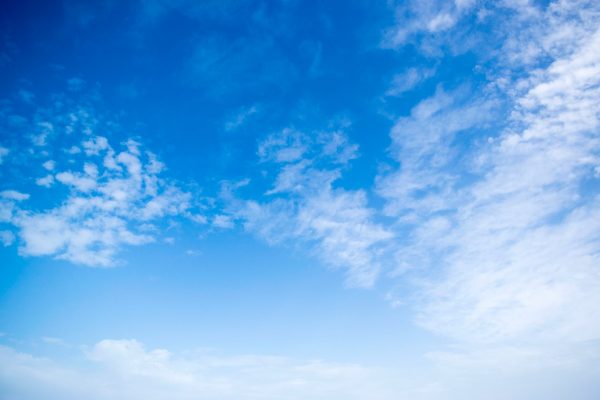
Liturgy invites us into a posture of receptivity — receptivity to beauty, to goodness, to love. “Nature is filled with words of love, ” Pope Francis wrote in Laudato Si’, “but how can we listen to them amid constant noise, interminable and nerve-racking distractions, or the cult of appearances?” (LS 225). The celebration of liturgy can be a time to put aside the tyranny of the clock, and to become present to the moment and to the people with whom we have gathered.
As Francis observes: “Many people today sense a profound imbalance which drives them to frenetic activity and makes them feel busy, in a constant hurry which in turn leads them to ride roughshod over everything around them” (LS 225). He recommends instead a spirituality that is “a return to that simplicity which allows us to stop and appreciate the small things” (LS 222). As liturgists, we might ask ourselves, are our celebrations a true oasis from the frenetic pace of life?
The sky can’t really be considered a “small thing,” yet it may truthfully be regarded as one of the beautiful and neglected things that “a return to simplicity” might help us to rediscover.
_____
Click on the links below to see other posts in the series on Creation:
Fritz Bauerschmidt on Day One, Jill Crainshaw on Day Three, Alan Hommerding on Day Four, James Hadley on Day Five, and Katie Harmon on Day Six and Teresa Berger on Day Seven.

Please leave a reply.