
No congregational singing, that is. In the diocese of St. Cloud, where Saint John’s Abbey is, this is the regulation. The same is true in many places around the world.
Up until now, our monastery liturgies have been closed to the public. With just the monks in attendance, we have been singing everything like always – with monks 6 feet apart in the choir stalls and wearing facemasks. But when, starting this past Sunday, we wished to begin inviting the public to our Sunday Mass again, we held ourselves to the diocesan regulations prohibiting congregational singing. Though now only cantors can sing, we still wanted the liturgy to be as festive and participative as possible.
Here’s how we did it. (Here’s the leaflet.)
- Entrance antiphon: Two cantors sang the
 proper antiphon of the Sunday in English chant from English Chant Propers (Liturgical Press, 2015), with one psalm verse and the doxology Glory to the Father… But we put the verses in Spanish – a nod to the increasing numbers of Hispanic monks joining our monastery. In these parts, we Catholics sing like Lutherans on organ-based congregational hymns, and it’s no fun having to give that up. But we have gradually introduced introits in Latin or English on special occasions over the years, so it doesn’t feel totally weird to have cantors alone do the processional chant.
. - Gloria: In Hymns, Psalms, and Spiritual Canticles (Boston Archdiocesan Choir School, 1972), Theodore Marier wrote an intriguing recto tono Gloria setting
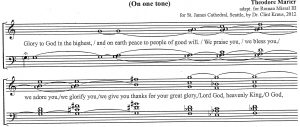 in which the congregation sings the entire text on one pitch while the organ plays increasingly tantalizing chords. In 2012, Dr. Clint Kraus at St. James Cathedral in Seattle handily adapted it for the new missal text. It worked just fine (not least with our newly expanded Holtkamp-Pasi pipe organ) to have everyone recite rather than sing the text.
. - Responsorial Psalm:
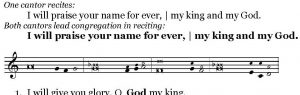 Congregation recited the refrain while the organ played Marier-like organ chords. Cantors sang the psalm verses in two-part (harmonized Meinrad psalm tone).
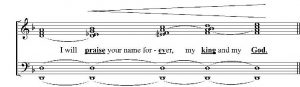 .
. - Alleluia: I recall many years ago a British abbot remarking that he supports the liturgical reform and the involvement of the congregation, but truly misses the old Gregorian alleluias. The alleluias in the Graduale Romanum don’t fit the reformed three-year lectionary as well as the new cycle of texts, and I made my peace with never using the Graduale alleluias in this life. Until COVID-19. Only cantors can sing now? Make hay while the sun shines!
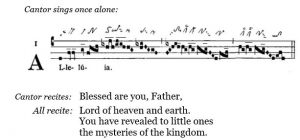 The cantor sang the florid chant Alleluia unaccompanied. Then he led the congregation in reciting the Gospel acclamation verse – flip it, and find a new way to involve the congregation! Then, to make the lead-in to the Gospel reading just a bit more “up,” the cantor was accompanied by the organ on the repeat of the chant Alleluia. Incoherent compromise? Or best of both worlds? (I only played organ chords, not the melody, freeing the cantor to sing with semiologically free rhythms.)
. - Eucharistic Acclamations: Recited by all. For the Sanctus (music below), one monk played wood block on the word stresses, which made it a bit like the Hebraic “sprung rhythm” of the Gelineau psalm tones. Until the “Hosanna in the highest,” which had a
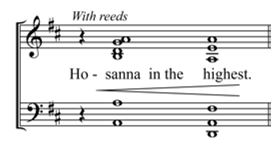 big crescendo of an organ chord along with a tambourine shake – both ending with a bang. Fun! Simple recited MemAcc. Then, the congregation recited the Amen six times – two groups of three – with increasingly loud organ chords on the last syllable of each Amen, plus a bit of a musical exclamation mark at the end (music below).
. - Agnus Dei: recited by all in Spanish. It’s high time we start incorporating more Spanish into our monastic liturgies – we’re massively behind the curve on this. COVID-19 is a good opportunity to begin at the easier level of recitation.
 Then someday, when congregational singing comes back, we’ll be ready for sung versions of various Mass acclamations in Spanish. Somehow, reciting it in Spanish made it more interesting and engaging – at least for me.
. - Communion: no more Psallite refrains with congregation, alas. One cantor sang the English antiphon and verses from English Proper Chants. Then another cantor, who went to Communion first, sang the same antiphon in Latin chant from the Antiphonale while the first cantor went to Communion. What’s the Latin for tag team?
. - Postcommunion hymn: The hymn text “I Heard the Voice of Jesus Say” was perfect for the 14A readings. All stood to recite the text: cantors on stanzas 1 and 3, everyone on stanzas 2 and 4. Organ played light background accompaniment. This text is most often sung to KINGSFOLD. I didn’t want to play that melody directly, lined up with the text, for that could make it seem like singing to that tune was intended. Rather, I sustained chords and played little, suggestive melodic snippets here and there from the hymn tune to evoke its ethos.
. - And then, blessing, dismissal, and a loud organ postlude.
Reviews were generally positive, but mixed. (This is a monastic community!)
We’ll run it again this coming Sunday, with a few variants. Our Vietnamese student monks will sing the entrance chant in Vietnamese. At prep we’ll have organ and percussion improvisation on the Latin chant Qui manducat. That’s the proper communio in the Graduale this Sunday. Like last week, it will be sung in English and Latin … and, because one of the Vietnamese monks is now in my online Gregorian chant class, also in Vietnamese! The recited post-communion hymn will be “Almighty God, your word is cast.” That text is sung to so many different tunes, I’m not yet sure what the soft underlying organ accompaniment will suggest, if anything, by way of a tune.
awr
Music: Eucharistic Acclamations

Please leave a reply.