
My flight arrived in Kyiv early on the afternoon of Friday, September 20, 2019. After hotel check-in and a brief rest, I made my way up and around a long, steep hill to St. Michael’s Cathedral. I had not visited Kyiv for three years, so I forgot the shortcut that would have saved me three minutes. I consoled myself by imagining that I had followed a route to Church taken by faithful of several generations.
My powers of observation finally booted up after a momentary emotional delay. I arrived at church a bit late, and walked in as the choir was singing the evening hymn, phos ilaron (Gladsome Light). They sang the setting composed by Kyrylo Stetsenko, who adapted a folk motif for the pattern melody.
The moment overwhelmed me. I heard a song composed for liturgy that I learned from immigrants who preserved a living tradition that was at risk during the Soviet era. This cathedral was full with urban worshipers for the Vigil service on the feast of Mary’s birth – on a Friday evening!
Once I came to my senses, I began to observe. The service seemed like the community had been frozen in time, from the 19th century. Women, old and young, moved about quietly, heads covered with scarves, lighting candles. Men and children stood at attention. The 21st century interrupted the time freeze when people wandered in, taking photos with their phones.
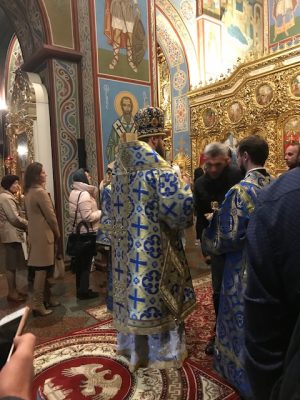
As a lifelong student of Liturgy, I wondered: would this community select music that the people themselves could sing? Would the presiders recite some of the prayers aloud? Would the choir director use visible gestures, inviting the people to join in?
Music from “on high”
Sophisticated choral music coming from an invisible gallery high in the nave dominated the service. Even the litanies were sung by the choir to wide harmonies with melismas the ordinary Svitlana and Volodya would struggle to sing.
I searched for obvious signs of active participation in vain. At no point were the people invited to sing. Throughout the service, they wandered somewhat randomly throughout the nave, forming a tight circle around the bishop when he came to the middle of the nave to sing the megalynarion.
Wanderers and “unofficial” liturgies
The next day, on the day of the feast itself, I returned to St. Michael’s for the festal liturgy. I left early, and walked a few miles to St. Volodymyr’s Cathedral where I spent most of the Liturgy. The liturgical aesthetic at St. Volodymyr’s was similar to the one at St. Michael’s, with one significant difference. The Cathedral is home for the relics of St. Barbara the Great Martyr and St. Makarios of Kyiv, so many of the people present were celebrating a secondary, unofficial liturgy during the Eucharistic offering. They lit candles and stood in chaotic lines to venerate the holy relics, bumping into one another (with no harm done). Many of the wanderers gazed at the icons hanging on the walls, venerating them and offering their prayers.
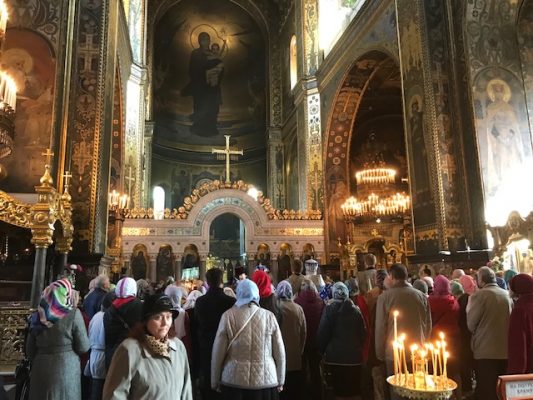
Participants in the unofficial liturgy came and went, sometimes leaving the Church only to return. Participants in the Divine Liturgy formed a tight circle around the presiding bishop. I noticed that this inner circle of liturgical participants remained stationary for the entirety of the Liturgy. St. Volodymyr Cathedral had two choirs: an invisible one in a high gallery (they sounded professional), and an amateur choir gathered on a kliros near the front of the Church. The amateur choir sang simply melodies in responding to the litanies – not once did I notice the people singing along.
In the evening, I ventured into a parish near my hotel, St. Illia Church, a smaller structure. I couldn’t see the choir because they were assembled around a corner to my right out of my line of sight. They, too, were amateur, but sang competently and clearly, using easily “singable” melodies. Nevertheless, no one sang along.

(I started to sing along, but stopped since I was sure other participants were glaring at me – I was worried that my singing was disrupting their prayer!).
The clergy sang the customary Hymn of the Resurrection (“Having beheld the Resurrection of Christ”) with the choir (quite beautifully!), but the people were quiet – even when the protodeacon with an impressive basso profundo faced them while intoning the prokeimena (responsorial psalmody, at Vespers and Matins). Anyone could sing the melody he intoned – only the choir responded.
The presiders intoned the ekphoneses of the prayers – the last line of each prayer, an exclamation, usually in praise of the Holy Trinity. The bulk of each prayer was recited sotto voce.
Assemblies that don’t sing
In summary: the liturgical-architectural setting of three of the four churches I visited separated the main choir from the people. The people did not sing the acclammations and responses appointed to them. The only time I noticed the people singing was during the Creed at the Divine Liturgy – one of the deacons led the singing from the ambo, facing the people. They wandered around the Church, and in one case, many of them observed their own unofficial liturgy of venerating icons and holy relics.
My story would seem to present a classical case of urban liturgy ripe for reform for the people’s active participation. But there was one element that united the diverse Churches I visited.
Non-vocalized bodily responses
In each Church, for every litanic petition intoned by the deacon, the people made the sign of the cross and bowed at the waist. The people responded to each intoned prayer with bodily gestures. In other words, the people actively participated in the call-and-response liturgical component through their bodies. They performed this gesture of response during the exclamations of the prayers, as well.
This kind of active liturgical participation is dialogical. The deacon intones the prayer, completing it with “let us pray to the Lord,” or some similar bidding. The people hear the cue in the bidding: “let us pray”; “bow your heads”; “let us ask,” and so on. The communal response of bodily gestures amount to their responses and acclammations. Participation is quite active – it is simply non-vocalized in these instances.
What do we make of the absence of the people’s singing the responses appointed to them? The people sing the parts of the Liturgy according the the established custom. In these Kyivan Churches, they sing the Creed, and join in the singing of “Many Years” and in special hymns of the liturgical year. This feature of Kyivan urban liturgy does not apply everywhere. It is much more common for the people to join in the singing of acclamations, litanies, and other responses in rural and village parish life (a topic for another post on the power of chant for those who’d like to bury it forever).
Observations
A few final observations from my brief immersion into the urban liturgy of Kyiv.
- Communal bodily gestures are significant, constituting the people’s response to invitations to pray, and representing active and conscious participation in the liturgy;
- The absence of communal singing does not necessarily mean that the deacon’s intonation or the musical selection was not compatible with the assembly’s ability to sing;
- The parallel performance of unofficial liturgies of venerating relics and icons while wandering throughout the interior space of the Church is significant.
Concluding Hypothesis
And to conclude, a hypothesis for further discussion:
- Unofficial popular liturgies of wandering and veneration are permanent fixtures of Christian urban liturgy. No amount of catechesis and liturgical law can eliminate the unofficial liturgies of veneration. Furthermore, these unofficial liturgies neither threaten the celebration of the Divine Liturgy, nor diminish it. Unofficial popular liturgies are problematic only when they blatantly interfere with the appointed rite.
Please leave a reply.