
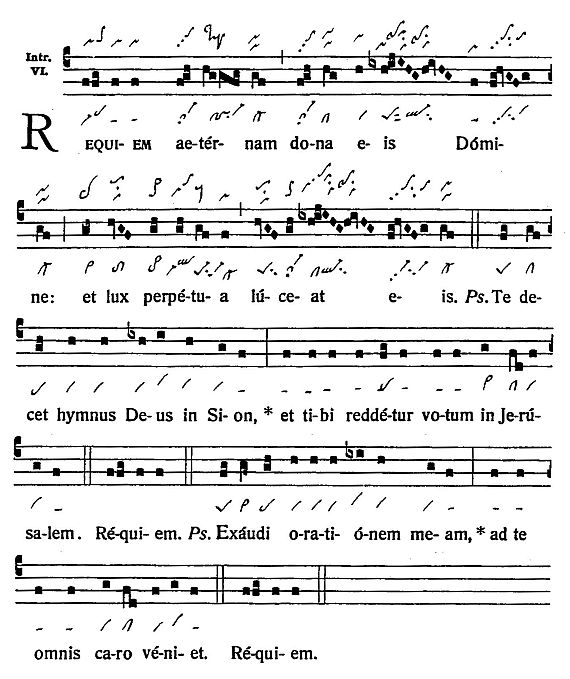
Requiem aeternam dona eis Domine: et lux perpetua luceat eis.
“Eternal rest grant them, Lord, and everlasting light may shine on them.”
Click here to listen to an audio of the chant, sung by Liborius Lumma, Innsbruck (Austria).
Requiem aeternam is one of the best-known pieces in Gregorian Chant, although it was not included in all of the oldest manuscripts (the lower neumes in the excerpt from the Graduale Novum do not exactly accord with the melody as they had to be taken from a later manuscript that knew a different verson of Requiem aeternam): It was used in masses for the deceased, but it had no regular place in the liturgical year.
Over the centuries Requiem aeternam has inspired numerous composers. My personal favorite among all those versions is the Requiem op. 9 by Maurice Duruflé (1902—1986) for choir and organ.
This introit is a composition in the 6th mode which generally expresses safety, maturity, and peace. You probably would not expect that around the topic of death and sorrow. But this is the Christian message: We need not fear death. Death is fulfillment of life: It was the fulfillment of the people before us, it will be our own fulfillment. Death means eternal rest, eternal peace, eternal life.
All this is given by God, hence we ritually ask for it (“grant them, Lord”). But as Christians we believe in a God who is absolutely trustworthy, loving, and a friend of life, hence we can sing Requiem aeternam calmly and confident in the 6th mode.
Please leave a reply.