
This fall we’re running the “Introit Project” for Sunday Mass at Saint John’s Abbey. Three monks of St. John’s (Br. Jacob Berns, Br. Ælred Senna, and I) are joined by Br. Wolfgang Sigler of Munsterschwarzach Abbey and Br. Amadeus Mhagama of Hanga Abbey, Tanzania. We practice every Saturday after lunch for about 15 minutes and sing the Introit at about 10:27 am before the opening hymn of the congregational Mass. In the leaflet we bill it as: CALL TO PRAYER (Introit).
In fact we’re not doing the “real” introit from the Graduale Romanum (i.e. the one we post at Pray Tell every Monday morning). Rather, I’m taking either the Benedictus or the Magnificat antiphon from the new Antiphonale Monasticum, whose texts of these are taken from the Gospel readings of the three-new post-Vatican II Mass lectionary. This was in part a pragmatic decision, because I’d rather do an easier chant well than struggle with a more difficult one. It’s important to me that the singers and listener’s have a good experience of this new thing. As we singers get in sync with each other after singing regularly for a longer period, perhaps we can look at the more challenging Graduale introits. Maybe in Advent? Or in Lent?
We sing the antiphon three times. For the first “psalm” verse I’ve elected to grab the text from the Gospel Acclamation verse of the Mass rather than the Psalter. This means that we sing this text in Latin, then later the cantor sings it in English. (There is precedent for singing Psalm verses from the Gospels in medieval communio chants.) My thought was that this Gospel Acclamation text ties in admirably to the Gospel-based text of the antiphon. Also, it saves me the bother of having to figure out which Psalm verse would best fit (though as a Benedictine I ought to know the Psalter quite well). After the second iteration of the antiphon, we sing the Gloria Patri and then the third and last antiphon.
Part of me actually finds these shorter Gospel canticle antiphons preferable to the Graduale propers, precisely on liturgical grounds.
As much as I love the “real” propers and would appreciate being in a community that sings these annually in their (mostly) one-year cycle, the fact is that they bear only occasional connection to the Scripture readings. They didn’t necessarily connect thematically to the old one-year lectionary cycle, either, but at least they were always associated with the same readings. One would sing these propers and hear these readings because today is the Xth Sunday after Pentecost, even if they didn’t connect up thematically with each other.
Since we’re using the Introit as a call to prayer, it works well liturgically to sing these Antiphonale antiphons which are proper not in the official-canonical sense, but in the strong liturgical-thematic sense.
To be honest, I wish there were a Graduale Simplex that gave for every Sunday of the year one proper Mass antiphon (either Ben or Mag) from the Antiphonale, useable at prelude, entrance, offertory, or communion. As it is, the Simplex in effect gives “commons” stolen from the Liturgy of the Hours that can be used at Mass any Sunday within a season or within Ordinary Time, so the precedent is there. I predict that such a resource would contribute mightily to the use of Latin chant in parishes and communities at Sunday Mass.
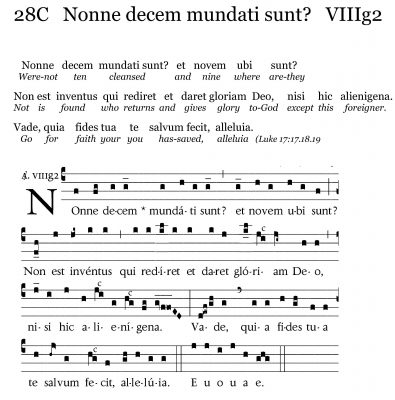
Here is what the score looks like that I prepare weekly. In cases where the antiphon is found is ms SG 390-391, from Hartker c. 1000 AD, I include a graphic from the online manuscripts of St. Gall. I also add neumes to the antiphon (these are not present in the most recent Antiphonale, alas) based on Hartker. It looks like this:

Please leave a reply.