
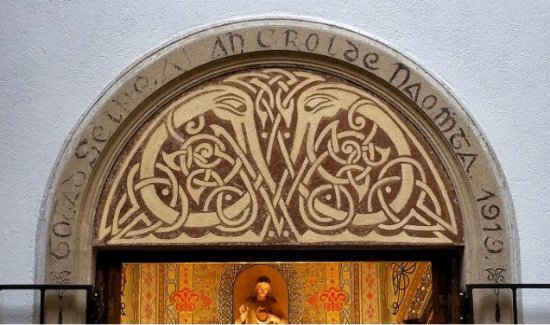
As I shared a few weeks ago with Pray Tell’s readship, I had the privilege of attending the 50th anniversary celebration of the Irish Church Music Association Summer School 1-5 July 2019. My host for the celebration, Fr. Paul Kenny, is pastor of the Church of St. Michael in Dun Laoghaire, Ireland, and we made that our base of operations in the week after the summer school. The high point of that week’s activities was a visit to the Oratory of the Sacred Heart, a short walk away from the St. Michael’s rectory.
Originally part of a large Dominican convent complete with a school and various outbuildings (all of which have been demolished to build a shopping center), the Oratory of the Sacred Heart is a small chapel, built in 1919 in thanksgiving for the conclusion of the First World War, externally marked only by a tympanum over the door. The plainness of chapel’s exterior does not prepare one for the vibrant splendor of the Celtic art covering every inch of the four interior walls of the chapel.
From 1920 to 1936, Sr. M. Concepta Lynch, O.P. (1874-1939), having been trained by her father, Thomas Joseph Lynch, in the intricacies of Celtic manuscript illumination, combined her studies of ancient Irish non-representational art (inspired by the Books of Durrow and Kells, the Tara Brooch, the Ardagh Chalice, and the Cross of Cong) with new designs of her own to produce a masterpiece of devotional art.
In addition to the swirling geometric figurations, knots and wheels typical of this art, Sr. Concepta delighted in depicting birds squawking, serpents wriggling, and seated humans. I think it would be safe to say that Sr. Concepta’s art here bespeaks an entire God-ordered universe, always in movement, mysteriously yet benevolently organized.
Even the conventional statue of the Sacred Heart, donated by a French village in honor of Irish soldiers who lost their lives in “the Great War,” that dominates one wall of the oratory is swept up in the vividness of the rest of the chapel, perhaps suggesting that divine mercy is the mysterious power that holds this universe together. In addition to the statue and murals, the oratory also contains stained glass windows from the famous Harry Clarke Studio.
Concerning the palate Sister Concepta used in decorating the oratory, Etienne Rynne observes:
“One of the outstanding qualities of her art is the warmth and richness of the colouring, for Sister Concepta had apparently an unerring eye for good taste in the exploitation of strong colours. In other hands the use of such varied colours might easily have resulted in garishness, but without fail she has successfully managed to counter-balance the power of her oranges, greens, whites and reds with more muted browns, purples, blues and blacks. One is comfortably absorbed into the decorated Oratory, rather than overwhelmed by it.” (A Shrine of Celtic Art: the art of Sr. M. Concepta Lynch O.P. [Dublin: Irish Dominican Sisters, n. d.] 8).
I was left with three topics for further inquiry.
- First, was the oratory used for Mass? The fact that there is an altar beneath the statue of the Sacred Heart suggested that it might have been used for celebrations of the Eucharist; there is even a notice on the back wall to the right of the door stating “MASS and prayers for all who contribute to this Oratory 1919” that would support the use of the oratory at least occasionally for the celebration of Mass. On the other hand, there is no sacristy that I could find, nor evidence of a tabernacle.
- Second, was the oratory used for the Liturgy of the Hours/Divine Office? The original floor was of bare cement and the floor covering of parquet blocks arranged as dark interlocking crosses arranged against a lighter background was only completed in 1958. (This floor design is based on the exterior pattern of the Shrine of St. Patrick’s Bell.)” No pews, prie-dieus or chairs appear in the present chapel, whether arranged facing forward toward the statue or facing each other (i.e., antiphonally).
- Finally, was the oratory intended for private prayer? The impression I got was that the oratory could only hold between 10 to 15 people comfortably, so perhaps individual or small group use was the norm.
2019 marks the centenary of the construction of the Oratory of the Sacred Heart. I strongly recommend that those who are interested in issues of liturgical inculturation in art treat themselves to engaging this chapel, whether in person or through the internet:

Statue of the Sacred Heart and Altar

Side Wall with Wheeled Cross (symbol of the 1932 Eucharistic Congress)


Please leave a reply.