
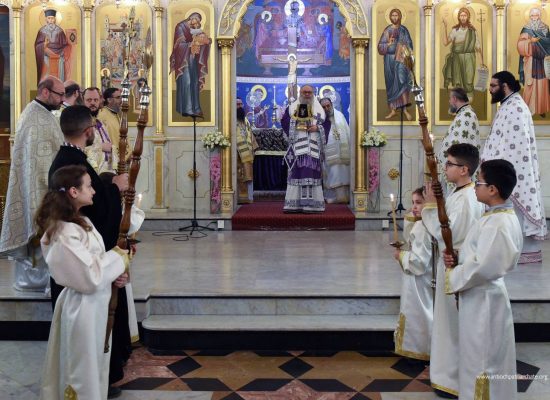
One of the most debated liturgical practice and pastoral issues of our day is the opening of formal roles for women and girls in the liturgical assembly, especially in the Roman Catholic and Orthodox worlds.[1] In some places females actively serve in their parishes as choir members (and directors), chant leaders/cantors, readers/lectors, homilists, altar servers/acolytes and Eucharistic ministers, just to name a few of the many ways that they participate in the liturgical celebration. In other places, the (formal) participation of women is more limited. In keeping with my series of posts on the female diaconate, albeit diverging a bit, I would like to focus this post on the diaconal ministry of the altar server or acolyte.
One of the most debated liturgical practice and pastoral issues of our day is the opening of formal roles for women and girls in the liturgical assembly, especially in the Roman Catholic and Orthodox worlds.
Christian West – Acolytes
In the Christian West, the acolyte was among the historical “minor orders” of ministers (i.e. acolyte, porter, exorcist, and lector.) The original function of the acolyte was to light the candles around the altar and supply light for the priest to read.[2] At some point, it became one of the “stepping-stones” to eventual ordination to “priesthood”/presbyter. In 1972, Pope Paul VI reduced the number of minor orders to two—lector and acolyte, letting the others fall into disuse. According to the 1983 Code of Canon Law in the Roman Catholic Church, females cannot be “installed” as lectors or acolytes, a designation that implies a path to ordination, but they can fulfill their functions. Since 1994, the Vatican has officially allowed females to serve as acolytes and today their presence is widespread. Still, there are parishes and entire dioceses that resist the inclusion of girls in this ministry, often citing its connection to the presbytery and the need to groom boys for that role.
Christian East – Altar Servers
Strictly speaking, the Christian East does not have a tradition of acolytes. Early manuscripts only have ordination rites (cheriotonia) for the major orders of bishop, priest and deacon as well as an appointment or blessing (cheriothesia) for sub-deacons and readers.[3] It was the sub-deacon who was generally in charge of lighting the lamps for the service and assisting the deacon. Today, altar servers (usually boys) are allowed to fill this role. In the Christian East, females do not usually serve in the altar area, outside of women’s monasteries. However, they are beginning to do so in certain areas of the world (e.g. the Middle East and Western Europe in the Byzantine tradition as well as in the Armenian tradition). Still, they are generally barred from doing so in parishes in the United States. The popular reason for this is that it is a function for boys since they “might become priests some day” or “if we let girls participate in this ministry, they will want to be priests.” It is true, that serving in the altar connects one to the liturgical celebration more strongly, but I would like to push back on this reasoning. It not only diminishes the ministry of the altar server as a ministry in and of itself, but it also fails to realize that it is diaconal in nature and not sacerdotal. It is a ministry of service, of assistance; it is not (or should not be) a training ground for priests. For that, we have seminary where the candidate learns more than just the rubrics of the service. Another reason for excluding females from altar service is tied to the belief that women’s menstruation makes them ritually “unclean” and unfit to enter the altar area. This is problematic on many levels, a discussion of which is beyond the scope of this short post. (For a good summary of the topic, I refer the reader to an article by Dr. Sr. Vassa Larin, Ritual Purity. It can be accessed here). In order to decouple the issue of altar access and service, some parishes allow females to perform similar functions, but outside the altar area. However, even that practice is sometimes attacked as “conflating the genders.” The reasoning is that there are certain functions for boys/men and certain functions for girls/women and somehow doing similar things conflates this distinction. Personally, I find that argument spurious. Boys and men don’t cease to be male and girls and women don’t cease to be female just because they both might carry a candle.

Why allow Females to Serve
The purpose of this post is not to dissect all the reasons why such a service might be prohibited or discouraged for women and girls. Most theologians argue that there is no good reason for the exclusion of females in this ministry. (For instance, properly understood, access to the altar area is for those who have a reason for being there and a blessing.) My focus here is to suggest reasons for the inclusion of females in this ministry. How can the Body of Christ be strengthened by allowing the participation of women and girls? I would like to suggest four immediate reasons.
My focus here is to suggest reasons for the inclusion of females in this ministry. How can the Body of Christ be strengthened by allowing the participation of women and girls?
- It is an important catechetical opportunity for the server. They learn by doing—an example of experienced based learning for any educators that might be reading this. They learn about the structure, flow, and the theology of the liturgy through, among other things, handling its symbols. For the Orthodox in particular, serving can increase the understanding of and connection to a celebration that is done for and with all believers but, because of the iconostasis[4], one in which many of the liturgical actions are rarely, if ever, seen or experienced by those in the congregation. It is important for everyone to read about the liturgy and to participate as a member of the assembly. But one can get a richer and deeper understanding of the service when they are able to observe and participate within the altar area.
- Not allowing girls and women the opportunity to serve can have an adverse effect on their spiritual lives. This is especially true of girls who want to serve and are told that they are not allowed to do so just because they are female. Not only do they miss an intimate connection with the liturgy, but they are told that the gifts they offer are not welcome. In as much as the Church can be the community within which we experience God, this rejection, which can be quite painful, may become an impediment to the growth of that relationship. Furthermore, by seeing girls and women serve, girls who have not considered their own connection to and participation in the liturgy are drawn into it and can see themselves as part of the celebration rather than as categorically excluded from it.
- Strengthen the integrity of the Church. (Here, I direct my remarks to the Orthodox Church in particular, although the main point can be extrapolated to other contexts as well.) In the Orthodox world in the United States, altar service is generally open to any and all boys, often regardless of ethical or moral considerations. Despite rhetoric calling all to holiness and service, the implicit (or even, explicit) message is that maleness is the primary criterion for service and participation instead of what is valued in the faith. At times, the “good” girls are left to wonder why they are not worthy of such service. Re-evaluating the criteria for altar service can help to address this shortcoming.
- The last reason that I will offer in the context of this post is that limiting altar service to males can also be spiritually unhealthy for boys and men as well. It can lead to a false sense of entitlement that is antithetical to the Gospel message of humility in service to Christ and His Church.
Altar service is just that—service. It is a form of diaconal ministry that assists the celebrant during the liturgy. By doing so, the server can learn about the liturgy and experience it on a kinesthetic level. The liturgy is then written onto their bodies. It is reductive and can be pastorally harmful to think that the only or primary criterion for this service is that the candidate be male. My prayer is that the Church will come understand the value of opening this service to all who wish to serve in this manner. May it be so.
[1] This is less of an issue in the Anglican realm and many other Protestant communities as well as some other faith traditions, thus the focus on the Roman Catholic and Orthodox traditions, in particular.
[2] https://www.thecatholictelegraph.com/what-happened-to-the-minor-orders/53555. Accessed on 7/29/2019.
[3] Paul Bradshaw, Rites of Ordination: Their History and Theology (Collegeville, Minn.: Liturgical Press, 2013), 82. The technical distinction between cheriotonia (ordination to major orders)and cheriotheia (appointment or blessing to “minor” orders) developed over time. A discussion of this development is beyond the scope of this blog post.
[4] The iconostasis in Orthodox churches is a screen of icons (whose height and transparency may vary) that separates the nave from the sanctuary—what is usually called the “altar area” or just, “the altar.”
Please leave a reply.