
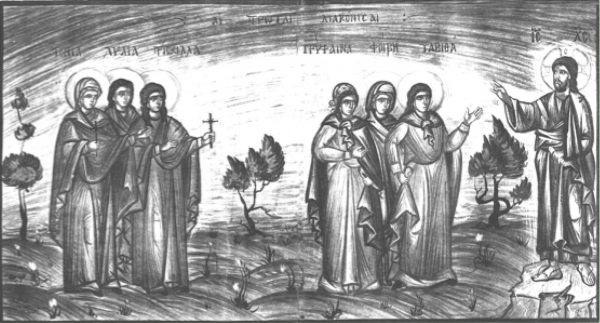
Female deacons in the Roman Catholic Church? Female deacons in the Orthodox Church? Historically, we know there were deaconesses in the early Christian church in both East and West until sometime in the Medieval period (with the presence and exercise of the order differing by locale.) In the modern period, the question of ordaining women as deacons (again) in the Roman Catholic Church was raised as early as Vatican II, some fifty plus years ago. In the Orthodox world, this question is over a hundred years old. Notably, a pan-Orthodox consensus was reached to revive the order (although no action taken) at an international conference convened by the Ecumenical Patriarch (Demetrios I) in Rhodes, Greece in 1988. (For a list of calls for the revival of the female diaconate in the Orthodox Church in the modern era, see here.)
Lately, the topic has generated renewed interest. In 2016, Pope Francis established a commission to study the issue of the female diaconate. In the Orthodox world in 2017, the Patriarch of Alexandria took a small step towards ordaining women to the order by consecrating a few women as deaconesses to help with catechesis, services, and mission work in Africa. And yet, in both cases, a more definitive “answer” to the question of the revival of the female diaconate remains elusive.
In the Roman Catholic world, the commission that Pope Francis set up to study this question did not reach an agreement on the question of female deacons. According to the Vatican dispatch, one of the outstanding questions seems to be the “sacramental” nature of their ordination. (I am unclear of the full implications of what that means or implies, so I will leave it for now.) In the Byzantine world, the work of Evangelos Theodorou (Greece) more definitely answered the question of the ordination of the deaconess. In his 1954 landmark study ‘H Cheirotonia ‘H Cheirothesia twn Diakoniswn [The “Ordination” or “Appointment” of Deaconesses] he showed that, according to Byzantine liturgical texts, the female deacon was ordained during the celebration of the Eucharist/Divine Liturgy and in the same place in the service as the male deacon. The rite included two prayers, one of which called God’s divine grace upon the candidate. She was ordained at the altar by the bishop, received the orarion [stole], and later in the service, received Holy Communion at the altar with the other clergy. All of these are marks of the higher order of clergy.
In the modern period, the question of ordaining women as deacons (again) in the Roman Catholic Church was raised as early as Vatican II, some fifty plus years ago. In the Orthodox world, this question is over hundred years old.
One of the outstanding questions surrounding the possible ordination of women to the diaconate is to what extent was the role of a female deacon interchangeable with that of a male deacon. From early church documents, we know that the female deacon helped with the baptism of women and continued to minister to them, instructing those new to the faith, providing pastoral care to the faithful and taking communion to the infirm. She also supervised at Liturgy, participated in processions and served as an agent of the bishop entrusted with carrying out philanthropic and hospitality tasks. (For more information, see: Didascalia Apostolorum, Apostolic Constitutions, and Canon 40 of the Council of Trullo.) In general, she ministered to women much as the male deacon ministered to men in what was a highly segregated Byzantine society. However, her ministry was relegated more to the private sphere as that was the arena in which women participated in society whereas the ministry of the male deacon was more public.
One of the outstanding questions surrounding the possible ordination of women to the diaconate is to what extent was the role of a female deacon interchangeable with that of a male deacon.
The question for today is, in a society that is more integrated in public life, would a future female deacon also exercise similar public functions, especially in the gathered assembly? In some ways, the question is easier to answer in the Roman Catholic realm as women are already serving in many public capacities (e.g. lectors, presenters of the gifts, Eucharistic ministers) whereas in the Orthodox world, the participation of women in the liturgical assembly in public ministerial roles is not as ubiquitous and can be quite uneven. Furthermore, presenting the gifts and distributing the Eucharist are limited to the clergy.
So, how can this question be “resolved”? In general, I think there are two fundamental issues that need to be understood more fully to move this debate forward—the meaning of ordination, per se, and the role of the diaconate in the three-fold ministry of Christ, in particular. In other words, what does an “ordination” mean and how is the diaconate different from the presbytery/episcopacy? I would like to offer some initial thoughts on these questions.
What does an “Ordination” mean?
In general, an ordination is a setting aside someone for ministry, usually for a particular function within the church. But is it just a functional designation or does it have ontological import? Is it an objective designation or one that is more relational? For the Orthodox Church, Metropolitan John Zizioulas has proposed a third way to understand ordination—between a purely functional understanding of ordination and one that confers an objective ontological change, emphasizing that an ordination establishes a new relationship within the community between the ordained and the community.[1] On a more practical level, an ordination assumes that the (soon-to-be) ordained are trained to do their ministry. It also sets up a reciprocal relationship between the Church and the ordained. The ordained carries the authority (and support) of the Church, but they are also held accountable to Her. (i.e. There are no “loose wheels.”) Their gifts are enlivened by the descent of the Spirit during their ordination in the Eucharistic celebration and their ministry is tied to the Eucharist as its source and summit. In other words, they connect people to the sacramental life of the Church.
The Diaconate
But, how does an ordination to the diaconate connect someone to the sacramental life of the church? How is the diaconate fundamentally different than the presbytery? Are deacons just “mini-priests,” merely “liturgical functionaries” and/or “exercisers of a nebulous, temporary ministry on the way to the priesthood/presbytery” or do they have a distinct (and, possibly, permanent) role within the three-fold ministry of Christ? Historically, the diaconate was a ministry (often, permanent) that connected worship and service; it connected our cultic celebration with the liturgy of our lives more particularly. (Only the ministries of the presbyter and bishop were and are sacerdotal.) The duties of the deacon included pastoral care of the faithful, philanthropic outreach, reading the Scriptures (and, at times, preaching), and other forms of liturgical service (e.g. preparing the offering of the people, leading the petitions of the concerns of people, taking communion to the sick, etc.), as well as ecclesial administration. In particular, it was grounded in the way the church meets the world. However, if we only see male deacons today as “mini-priests,” “liturgical functionaries,” and/or, in many cases, exercising their ministry merely as training for becoming “priests,” it is hard for the faithful to imagine women in this role without the usual stumbling block questions/concerns—i.e. that ordaining women to the diaconate would automatically lead to ordaining them as presbyters, etc.
So, where do we go from here? What can we in the Christian East and West learn from one another as we (hopefully) move forward on this issue? I hope to examine this issue further in subsequent posts, but, in the interim, would welcome your suggestions.
[1] See: John D. Zizioulas, Being as Communion (Crestwood, NY: St. Vladimir’s Seminary Press, 1985), pp. 209–246.
Please leave a reply.