
Each year, as we enter Holy Week, I inevitably recall two individuals for whom I continue to have a great amount of admiration. Both were RCIA participants, and both—a few days before the beginning of the Paschal Triduum—declined to be baptized, and left the process. These two were separated by years and geography in my life, but I recall that both said they couldn’t, in all honesty, publicly state that they held or accepted or believed everything that Catholic church teaches. In one case, I know it went deeper—one participant couldn’t accept the claims being made about Christ, and the normativity and/or exclusivity of belief in Christ.
My admiration for them comes from their refusal to be dishonest or hypocritical. Clearly they understood this was a huge step they were about to take (a credit to those RCIA teams), and couldn’t bring themselves to commit to something so important when they truly didn’t want to or couldn’t keep that vow. I know that at least one of them was in RCIA as a marriage preparation “hoop” to go through, and the failure to be baptized ultimately led to the marriage not occurring. That individual would have ended up at the marriage rite in the category of “baptized non-believer” (which I’m sure any of us involved in marriage preparation have encountered).
In my admittedly limited experience with the RCIA, the majority of those seeking Baptism or full communion were in the process either prior to a marriage, or (in fewer instances) after having been married a while. It is my understanding that roughly half of RCIA participants seeking either full communion or Baptism do so because of a future or current spouse, forming something of a link between the sacraments of initiation and vocation.

This initiation/vocation link was brought to the foreground again a couple years ago when I was speaking with the college-aged child of a friend—another baptized non-believer, who referred to having been baptized as an infant as “unjust,” and compared it to an arranged marriage. I shared recollections about the 1960s and 70s, a time that I was around the same age, when the atheist/activist Madalyn Murray O’Hair gained notoriety for offering “unbaptism” to those who felt it was a decision made for them against their will. I learned during our conversation that there is a site called unbaptism.org still offering unbaptism certificates. All that gimmickry aside, it was our conversation that led to me really reflecting on the sacraments of initiation as sacraments of vocation.
While it was traditional in many cultures (in some it still is) to arrange marriages when children are very young, and it was a custom in Roman Catholic households to promise a child (or two) to holy orders and/or religious profession, in the U.S. these practices have largely ceased. A substantial aspect of the rites of marriage and ordination is that those entering into the sacramental state have made their own decision/choice to do so. It would be the rare exception for parents to make these vocational commitments for their children today. And yet, they do so when it comes to the foundational, lifelong entry into the vocation of discipleship: Baptism.
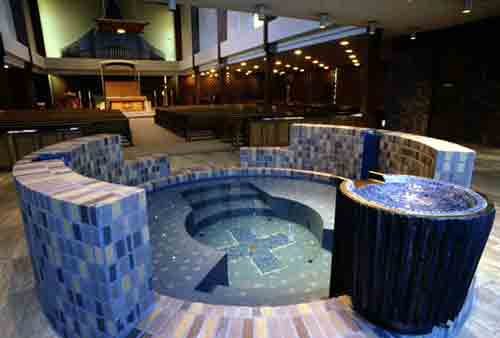
The role of parents (and godparents) in the baptismal rite can be viewed as doing this one among many good and healthy things that are done for children—inoculations, balanced diet, schooling, and so on. The General Directory for Catechesis even states that the RCIA’s baptismal catechumenate is to be the model for post-baptismal catechesis (#90). Yet even this good and healthy formational objective creates something of a conundrum: the process intended to bring an individual to the decision to enter into the Body of Christ through Baptism also becomes the process for those who have had that decision made for them. The goal, of course, is the same—to help shape the lives of disciples to follow Jesus.
Given the difficulties experienced in dioceses attempting to do the restored order of the sacraments of initiation, or the resistance to infant communion even though infant Baptism (and its anointing) is commonplace, I know that to propose postponing all sacraments of initiation until adulthood would be a logistical and orthopraxis near-impossibility. Though children could be raised in an observant Roman Catholic household, part of that upbringing would be celebration of the Eucharist without reception of communion; difficult enough with a six- or seven-year-old, much less a twelve- or thirteen-year old. (You can find posts about the restored order on the PrayTell blog, though the most recent one is from 2015.)
“How flippant are the saved!” wrote Emily Dickinson in an 1875 letter. My intent here is not to be dismissive of the gravity of the sacraments or rites of initiation. Perhaps it would be good to recall that, from its very origins, one of the purposes of the RCIA has been for all of us who are already baptized to re-examine and renew our commitment to the discipleship and membership in the Body of Christ given to us. In a curious way, that memory of two people I mentioned at the outset also does this for me—anamnesis being a strong aspect of the Triduum. Not only do I still admire them, but they continue to inspire me.

Please leave a reply.