
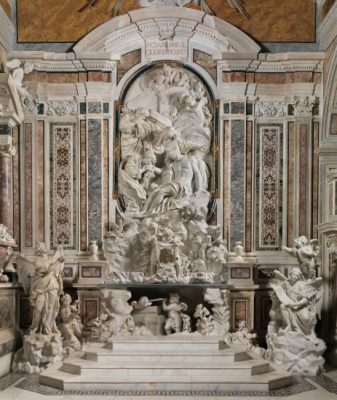
Francesco Celebrano, 1744-1771.
While working on a commission recently in the United States, a bishop sought to inform me that altars are not ‘art pieces’, and inscriptions in liturgical spaces are verboten. His assertion was familiar. It has been a hallmark of the liturgical reform to reassert the ur-character of the Christian altar as a table, lest its connection to the Supper of the Lord be obscured. Considering the historical context of altars before the liturgical renewal in general the observation is fair enough. It is quite clear that often times the gradine and reredos of an altar were more significant than the table itself. Hence, the General Instruction of the Roman Missal (1969) speaks of a free standing table-altar. Likewise the Rite of Dedication of a Church and an Altar (1979) speaks of the symbolism of table and altar. But neither of these documents speaks of what an altar must ‘look like’ other than being a table/altar.

Moncks Corner, SC, USA.
Frank Kacmarcik, liturgical designer and consultant, 1993.
Ted Butler, architect. AIA award for Religious Architecture, 1995.
Yet it should not be surprising that later documents and commentaries began to be more specific. Instructions regarding the decoration of an altar in the GIRM are limited to flower arrangements. RDCA says nothing of artistic design other than a reference to further biblical allusions to altars. By contrast, the American document Environment and Art in Catholic Worship (1979) referred to the altar-table as a symbol of the one Christ who is the cornerstone. In a similar vein, outside the USA, Richard Giles’ Repitching the Tent (1984) speaks specifically of the design of the altar-table. The Anglican author insists that “a superhuman effort to restrain ourselves from decorating the altar table” should be made (184). The reader is instructed that “the material and the form” need to “speak for themselves…” (184). In tracing out the evolution of the liturgical reform, Giles seems to reflect a general shared attitude regarding the proper design of altars in the last decades. But as I have argued for in other posts on PrayTell, this fetishization of material and form, and the elimination of decoration is more the result of the interpolation of Bauhaus, post-modern design theory, along with the exaltation of worker poverty, more than some theological necessity. In North America, the ubiquitous granite slab altar is the admixture of Frank Kacmarcik’s training in graphic design and the 20th century Eladian preference for the primitive. The ubiquitous stalky wooden communion table, the design residue of Edward Sövik.
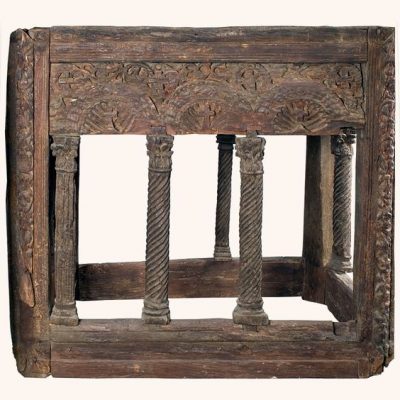
Altar. Pine wood. Church of Sts. Sergius and Bacchus, Old Cairo. 5th century. Coptic Museum, Cairo
In truth, Christian altars have always been art-pieces (for that matter, so have fonts, ambos, and chairs). Even the rare remnants of wooden tables from the first centuries that served the Eucharist are embellished. Romanesque and Gothic altars wow the eye with their polychromatic brilliance and eschatological images. Baroque altars and their scenographic palle often move in sinuous rhythm. What’s more, from ancient Rome, until today, inscriptions have played a significant role in the design and embellishment of altars, both in Eastern and Western Christianity. Altar inscriptions record the acts of dedication, offer prayers, or have a liturgical resonance.
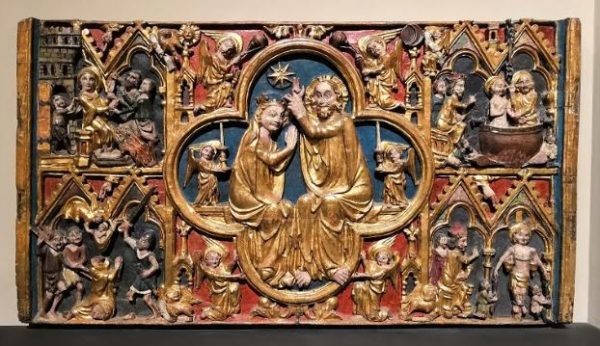
Carved and polychrome altar face, 1310. Galleria Sabauda. Turin, Italy.
The artistic history of Western altars is simply far too broad to assert that altars are not art-pieces. And liturgical history is simply too precise to assert that altars cannot, or should not be, art-pieces. When Irenaeus of Lyon speaks of the glory of the altar it is unlikely that he was speaking only of the Eucharistic act, but the physical nature of the altar as well. In related fashion, some centuries later, when Eusebius of Cesarea describes the greatness of altars in his Histories it is not a novel post-Constantinian development, nor theological allusion, but a physical referent to the impressive visual impact of the table. Not long after, John Chrysostom asserts that an altar should be an object of awe (Homily 20).

While American denominations cling to the delusion that design can and must “speak for itself”, the artists and theological consultants responsible for European liturgical environments seem to grasp the broader possibilities. Especially notable in this regard is the work of the Italian Episcopal Conference and its national office for the building of churches. Causing somewhat of a national stir, the Jesuits responsible for the Basilica S. Maria Assunta in Gallarate, Italy recently renovated the sanctuary of the church.
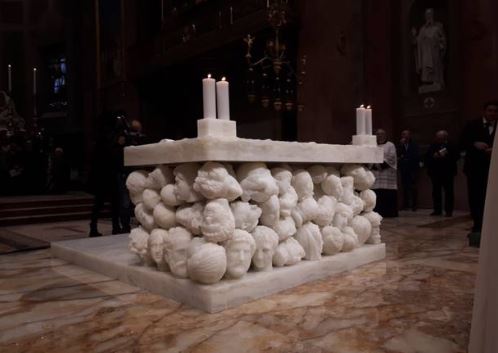
Included in the redesign is a new altar commissioned from the famed contemporary Italian artist Claudio Parmeggiani. Consecrated on 11 November 2018 by the Archbishop of Milan, Mario Delpini, the altar is a composition of 120 severed heads reproduced from statues sculpted by the great masters of art history (from Fidia to Michelangelo, from Bernini to Canova). The intention, Parmiggiani stated, is to create “a table deriving from the juxtaposition of two luminous superimposed marble slabs that hold and protect, almost like the maternal pelican, a multitude of ancient heads; relics and emblems of sacredness, of humanity, of totality”.

While some critics suggested the altar is “macabre” and “unsettling”, the altar’s theological implications concerning the redemption of history is nothing but orthodox and stunning.
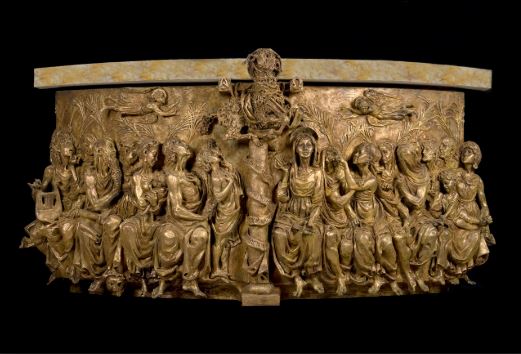
Federico Severino, 2008.
Another recently dedicated art-piece altar was commissioned from the Italian sculptor Federico Severino, and consecrated on 13 May 2018 by Archbishop Angelo De Donatis, papal vicar of the Diocese of Rome, in the basilica of Santa Maria ad Martyres (the Pantheon). According to Father Giuseppe Midili, secretary of the Diocesan Commission for Sacred Art and Cultural Heritage, at the center, in high relief, is the Immolated Lamb and the inscription “Qui vicerit faciam illum columnam in templo Dei mei (The victor will place it as a column in the temple of my God)” taken from chapter 3 of the Apocalypse of St. John. Next to the Lamb is the Virgin Mary who has a broken dagger near her heart that represents Christ’s victory over death. Gathered around the Christ-Lamb, an infinite group of martyrs holding palm branches. On the back of the altar is a peacock, symbol of immortality.
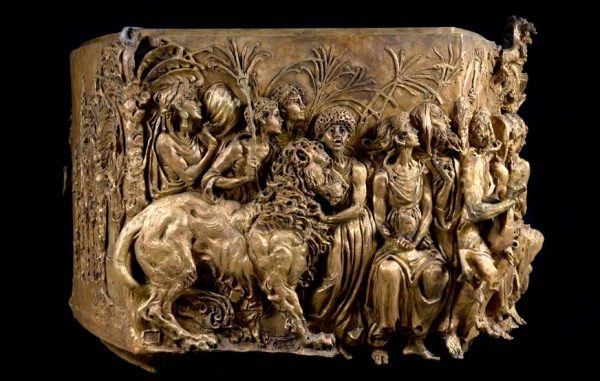
Altar. Santa Maria ad Martyres, Rome, Italy.
Federico Severino, 2008.
How does one account for such divergent artistic conclusions, drawn from the same liturgical documents? – American bishops sure in their ‘form follows function’ diagnosis, and European artists given wide berth in interpreting what represents an altar-table. I would suggest that formal core documents in most denominations are in fact rather prosaic about the nature of appropriate liturgical art and architecture, and as such are in no way prescriptive regarding any particular style or design. Should one insist that liturgical reform means a liturgical environment for worship must ‘look’ a certain way in regard to style, such persons are simply projecting other understandings onto the documents that are not internal to the documents themselves. More likely, such views are interpretive evolutions, and as related to art and architecture, are often the impositions and assumptions of modernist design theory mingled with church reform.
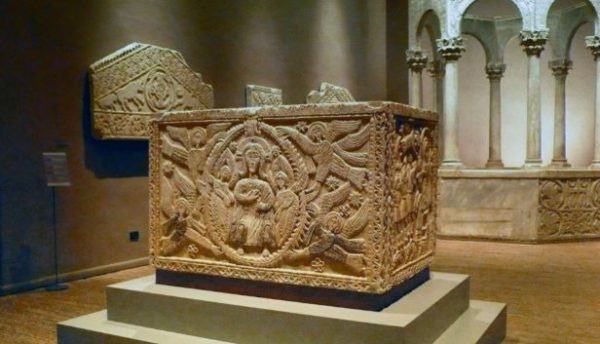
Aside from legalistic interpretive issues regarding liturgical directives, what is as stake, I believe, is a far more fundamental question – that of the multivalence of the liturgy. Ironically, at the same time that contemporary liturgical theology has extolled the multiple ‘layers’ in which liturgical texts may speak (especially represented within the American milieu by such works as Kevin Irwin, Text and Context), modernist and contemporary architectural theory, as well as liturgical building consultation, has been loath to give such a ‘complicating’ voice to art and architecture for worship. In favor rather, is the belief that in a church building, a table is a table, even if all of art history has shown this not to be the case in Christian worship.

The assertion of multivalence as a fundamental dynamic of liturgy implies that within worship there is no one meaning of text, nor art, nor architecture. There may be hoped for and planned resonances, but even source images and texts are mixed, poetic, in what they intend to represent. In his study of medieval altars Søren Kaspersen concludes that altars often shifted between Christological images when viewed up close, and a dematerialized golden glow when viewed from afar. Hence, altars presented a “blurring power of material in the mind” that played on the juxtaposition of artistic and theological themes and paradoxes of material presentation (Decorating the Lord’s Table: On the Dynamics Between Image and Altar in the Medieval Period, 63-64). In a related fashion, the contemporary Roman Catholic RDCA speaks of multiple images of the church: a holy vineyard, assembly, the Body of Christ, the Heavenly Jerusalem; So too the altar: table of the Lord, place of sacrifice, anointed one, cornerstone, oil of gladness, glory of martyrs, heavenly banquet. Insisting that an altar has simply one likeness, one resonance, contrary to the possible horizon of meaning evoked by the liturgy itself, fails to respect the rich symbolic nature of worship.
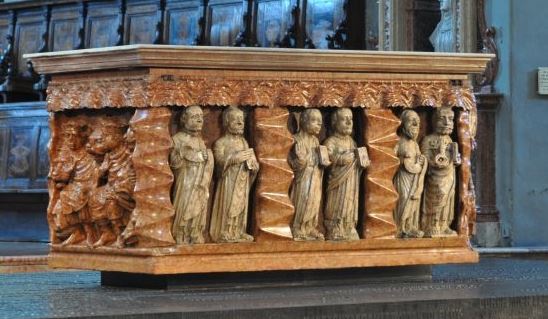
If an altar must ‘look like’ some fixed architype, if one asserts that the altar has but one visual resolution, one impact, such agendas are stylistic assertions, and not based in sound liturgical theology. Moreover, the belief that any individual aspect of the liturgy or environment for worship “speaks for itself” is a rather imprecise and unhelpful premise; Words interpret objects, and objects, words, and inscriptions, altars, and altars, bread and wine, and fire, darkness, and music, silence.
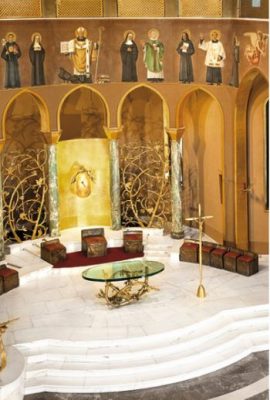
In short, multivalent liturgy requires multivalent art and architecture. And only trained artists, architects, and consultants, who have a breadth of theological and artistic training are capable of creating multi-voiced spaces that our churches need to be. Otherwise we are left with what the art critic Angelo Crespi has called an “omage to the minimal”, spaces and altars that “seem to emerge from IKEA catalogues” (Costruito da Dio. Perché le chiese contemporanee sono brutte e i musei sono diventati le nuove cattedrali, 2017). Mine is once again a plea to set the artist free and enable our places of worship to speak in 1000 tongues.

Altar. Jacques Jacques Dieudonné, 2013. Church of Saint Thomas Aquinas, Paris.


Please leave a reply.