
For the past few years, I have joined friends for the celebration of “Holy Supper” before the yearly anniversary of the Feast of the Birth of our Lord. This is a Seder-like meal, popular in the Slavic tradition. It concludes the Nativity fast and prepares one for the celebration of the Eucharist, usually the next day. (For those Slavic churches that follow the “older” calendar (i.e. Julian), the Supper will be held in about a week. For those of us who follow the “newer” calendar (i.e. revised Julian/Gregorian), the meal has already been held.) Each celebration includes prayers and ritual actions that commemorate the birth of our Lord and His continuing presence in our lives. There is no one standard text so each service might be a bit different and reflect local traditions. The service that we celebrate is based on the text by Bishop Job (Osacky).[1] Although I was raised in an Orthodox household, I did not grow up with this tradition, but have made it my own and would like to share my experience.
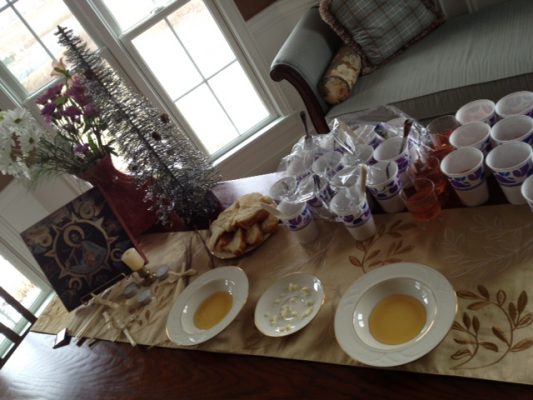
The setting is a festive meal. The table(s) is (are) covered with linen and straw with the Nativity icon, a large candle, and three smaller candles in the center. There is a plate containing small cloves of garlic and a bowl of honey at various places on the table(s) as well as slices of sweet bread. Each place setting includes small cups of koliva or kutya (a mixture of wheat and honey variously spiced) and a small glass of sweet wine. The use and meaning of these elements will be described below.
The service is a “reader” service with each guest reading a prayer and/or initiating a ritual action. It begins with an opening prayer asking Jesus to be with the gathering as we celebrate His Nativity. This is followed by the call and responses sequence that punctuates the entire service—“Christ is Born!” “Glorify Him!” In our celebration, whoever reads the respective prayer initiates the call with the entire gathering giving the response. We then exchange the Kiss of Peace with those present, greeting everyone with this call and response. This reflects the Biblical injunction that we are to be at peace with our brother or sister prior to offering our gifts to God [Mt. 5:23–24]. Although this is not a formal Eucharistic celebration, it is a service of thanksgiving to God for Jesus Christ and all He has done for us—the “taking on of our flesh, the teachings that were given to us and the example that He set for us as well as the ultimate victory over sin and death that He secured for us through His Death and Resurrection.” Structurally, it parallels the Divine Liturgy—beginning with a liturgy of the Word and then an Anaphora-like section that includes a series of prayers to Jesus Christ as Lord, an epiclesis (sending down of the Holy Spirit on those gathered), the commemoration of both the departed and the living, and finally, the breaking of bread.
As just mentioned, the first part of the service includes readings from the Bible. It begins with verses from Isaiah that prophesize the coming of the Messiah (i.e. Isa. 7:14 and Isa. 9:6–7a) with a refrain proclaiming, “God is with us.” The record of the birth of Jesus from Matthew (1:18–23) follows, adding that the child shall be named Jesus “for He will save His people from their sins” and fulfilling the prophecy of Isaiah that they shall call his name, Emmanuel, “God is with us.” This is followed by the reading of the birth of Jesus from Luke (2:7–14) where the angel tells the shepherds that the birth of this child will be for all people. The main candle is then lit proclaiming Jesus as the “Light of the World.”
The next series of prayers (with call and responses) remind us of the scene of Jesus’ birth—“the animals that were present,” His “humble surroundings,” and His “swaddling clothes.” These are symbolized by remembering “the animals that [Jesus] provides for the human race… especially the pets that bring joy to our homes and lives” and by the inclusion of straw and linen on our table. The straw reminds us to be “humble in every aspect of our own lives” and the linen reminds us “of our baptismal garments as we shared in Your death and Resurrection at the time of our Baptism.” At this point the three smaller candles are lit so that we, like the “three Wise Men who followed Your star,” will not walk in darkness, but “in the light of Your life and Truth.” We then call down the Holy Spirit on those assembled and cense the icon of the Nativity that is “central to our celebration” and “inspires us to give thanks for [Christ’s] coming to earth and taking flesh for our salvation” as well as the food for the meal. During the censing the traditional troparion (poetic hymn) of the feast is sung:
Your Nativity O Christ Our God has shown to the world the light of Wisdom. For by it those who worship the stars were taught by a star to adore You, the Sun of Righteousness and to know you, the Orient from on high, O Lord, glory to You.
Following the structure of the Eucharistic Prayer (Antiochene tradition), we then pray for our loved ones who have passed away and bless the koliva (i.e. wheat and honey mixture) connecting what Jesus said about wheat to our own lives—“that the grain of wheat that falls to the earth and dies bring forth a rich harvest… so that our lives may bring forth a rich harvest” [Jn. 12:24]. In the Orthodox tradition, we ask God to grant “rest eternal” to His servants “who have fallen asleep” and ask that they be kept in God’s memory eternally, chanting (in this case, in a evocative Slavic melody), “Memory eternal.”
We then turn to praying for the living—both those of our loved ones “who could not be with us at this Holy Supper” and asking God to “grant them health and happiness, strength for their trials and peace all the days of their lives” and those of us at the meal continuing the “journey of our own lives…” Taking a clove of garlic we ask “our Lord to give us strength and courage to bear faithfully the crosses of our lives…” We then dip our garlic into the honey and pray, “that all that is bitter in life will be overcome by that which is sweet…” And in one gulp, we eat said garlic and honey, hoping that we have covered the garlic with enough honey to allow the garlic to go down without too much trouble 😉
The service continues with the master of ceremonies offering a toast (of sweet wine), praying that God will be with us “in our thoughts, our words, our tears and our laughter…” and that we will all be “together next year to celebrate Your holy Nativity.” We ask for God’s blessing for “health, peace, love and length of days for many blessed years” to which everyone responds with the traditional hymn, “God grant you many years!”
The service concludes with the breaking of the sweet bread, asking God to “bless us …as we break this bread and partake of it together in love and fellowship…and be united with one another in the Holy Eucharist…for the healing of soul and body.” This is followed by the last (of the numerous) call and response exclamations, “Christ is Born! Glorify Him!” and the prayer for the meal and the final singing of the festal troparion.
Dinner follows. This is a traditional Lenten meal, the dishes of which are to local taste. Our table includes borscht, salmon, various types of perogies (potato, sauerkraut, prune), dried fruit compote, and other traditional dishes as well as some (American) greens. After dinner, we usually sit around the table and sing traditional (Slavic or other) Christmas carols in preparation for the Feast before wrapping up the evening allowing us to leave in the “Spirit of the Season.”
Our church family and friends surround the table of our celebration of Holy Supper. For some, they are carrying on the tradition of their forebears. For others, it is a new experience. Over the years our table has included non-Orthodox Christian friends as well, giving our celebration an ecumenical sense. Although the Orthodox Church does not practice open communion,
celebrating Holy Supper together allows us to share our tradition with others and invites them to participate in the celebration in a way that gives us a sense of all communing together in Christ.
As I mentioned at the beginning of this post, I did not grow up with this tradition, so it does not necessarily speak to my identity as an (Orthodox) Christian. However, it has been a tradition that has formed me as one. It has inculcated a sense of gratitude for all the Jesus has done for us, and has encouraged me to be a person of gratitude. It has reminded me to thank God for the blessings in my life and to be mindful of those who are less fortunate. It has also reminded me that during our journey we may experience “pain, sorrow, disappointment, anxiety, failure and fear… but that all that is bitter in life can be overcome by that which is sweet: faith, hope, love, peace, friendship, and joy.” And, finally, it has allowed me to experience the birth of Christ, not only as an historical event, but as one that we can participate in today, continuing to give birth to Christ in our own lives so that, as we say when we light the main candle of our celebration, the light that we receive from Christ may “shine before all people that they may see our good works and glorify our Father in heaven” [Mt. 5:16].
Christ is Born! Glorify Him!
[1] Bishop Job (Osacky) was Bishop of Diocese of New England and then Archbishop of the Diocese of the Midwest in the Orthodox Church in America (OCA). He fell asleep in the Lord on 12/18/2009.
Please leave a reply.