
Now here’s an interesting connection between a medieval papal decree on music and a recent statement of Cardinal Sarah, prefect of the Congregation for Divine Worship.
In the Liturgical Music Seminar I teach to our graduate liturgical music students, we recently studied the famous 14th-century decree of Pope John XXII, Docta sanctorum . It condemned the ars nova (“new art”) and cutting-edge musical techniques of sacred music composers. Wild stuff – using chords with intervals of 3rds and 6ths. John XXII thought they should stay with the “consonant” intervals such as 4ths and 5ths and octaves. And their rhythms – if you can imagine, they were using short notes and triplets.
Everyone ignored the papal decree. Thank heavens. We never would have gotten to Palestrina and Byrd and Victoria (or Mozart and Bruckner and Messiaen) if composers had obeyed the pope’s misguided mandate.
Here’s some ars nova (click to hear) for you, courtesy of Machaut.
I had Docta sanctorum in mind when I came across this news report. Cardinal Robert Sarah recently delivered a message to the Association Pro Liturgia, “From the Silence of the Soul United with Christ, to the Silence of God in His Glory.” Here’s what he said about rhythm:
It is clear that the syncopated rhythm—which consists of starting a note on the weak beat of a measure or on the weak part of a beat and continuing it on the strong beat of the following measure or on the strong part of the following beat—so typical of contemporary music, especially of commercial music, ever since the appearance of jazz, is little suited to meditation that leads from silence to adoration of the living God. Someone who does not perceive this is likely already tainted by this blindness and deafness that are a result of our immersion in a profane and secularized world, without God and without faith, saturated with noise, agitation, and barely-contained fury. Therefore, musical rhythm tends to disclose an undeniable reality: the presence or absence of contemplation. In other words, it is symptomatic of the manner in which liturgical singing flows or does not flow from silence and prayer.
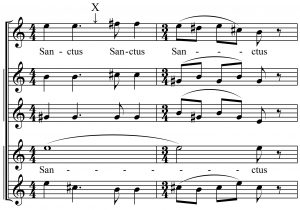 I think my favorite example of sacred music “starting a note on the weak beat of a measure … and continuing it on … the strong part of the following beat” – what Cardinal Sarah objects to – is probably this 1937 Sanctus (click to hear it) by Francois Poulenc. X marks the spot where the “strong part of the following beat” falls.
Or there is the lovely 16th century carol “Lo, how a rose e’er blooming.” In the Praetorius setting that’s been in use since 1609, the bass movement makes it a pretty clear instance of syncopation.
If your theory of sacred music would banish Poulenc and Praetorius from the liturgy, something’s probably gone wrong.
I get it that Cardinal Sarah wants the liturgy and its music to be more worthy, more spiritual. So do I. But I think there is a better way to go about it.
It doesn’t quite work to start with intrinsic qualities of music. One needs a broad foundation, and it needs to be theological. And the theology in this case needs to be functional. And “functional” shouldn’t be a red flag – it doesn’t need to mean less artistic or less holy or less anything. “Functional” simply means that the music functions in accord with the purpose of the liturgy. It means that the music functions to draw people into the paschal mystery made present in the liturgy.
In place of an agenda such as the cardinal’s, which pits holy silence against the evils of the modern world and the people who live in it, and then attempts to draw a musical conclusion apparently valid universally across cultures, one needs a comprehensive reading of all the relevant official documents of liturgical reform. Plenty of trivial, merely entertaining music will not measure up – but for more pertinent reasons.
In evaluating liturgical music, the right kind of questions to ask are not aesthetic-spiritual. They are more properly evangelical, ecclesiological, and missiological. In practical terms, this means asking what kind of music draws people into the rite, empowers them to be agents of the rite, forms them into the Body of Christ, draws them into Christ’s self-gift, empowers them to give their lives for the sake of the world.
Hint: your answers will vary depending upon your cultural context.

Please leave a reply.