
Sometimes, one is able to catch liturgical glimpses of something both very ancient and quite new in the heart of a modern metropolis. I say this as someone who seldom finds herself in a liturgy that easily lures into prayer and nourishes the soul. And being in a big city usually does nothing to help this state of affairs. I typically have to struggle with leaning in to seek the encounter – under liturgical signs and symbols – with the Triune God. Yet this seeking seemed unexpectedly and blessedly easy recently, in liturgies I celebrated in the midst of a monastic community that finds its calling in “unfolding a prayer rug in the heart of the city.”
Founded after the Second Vatican Council in Paris by Brother Pierre-Marie Delfieux, the “Communities of Jerusalem,” as they are called, now exist in several major European cities as well as in Montreal, Canada. There is a monastic branch in the communities, of both sisters and of brothers, as well as lay communities, some of which exists in urban parishes. All share in the spirituality of the “family of Jerusalem”: to seek to live “in the heart of the cities, in the heart of God.” The communities of Jerusalem understand their worship and prayer life as the center of their presence and evangelization of the cities in which they live.
Beginning of Vespers: God, come to my assistance. Lord, make haste to help me. Glory…
I joined in the liturgical life of the sisters and brothers of the Community of Jerusalem in Cologne, Germany, some weeks ago, celebrating Eucharist, Vespers, and communal prayer in silence with the community. This particular community lives and prays in a Romanesque Church (of which Cologne boasts twelve), Gross Sankt Martin, a prominent sanctuary in close proximity to the world-famous Cathedral of Cologne. The atmosphere in both churches could not be more different, though: hordes of tourists in one, few in the other. High Gothic in one, Romanesque clarity in the other. Cathedral liturgy in one, and the distinctive liturgy of the Communities of Jerusalem in the other. Here are some of its features:
In the heart of the city, and surrounded by its bustling life, all liturgies begin with a prolonged time of silent prayer, usually for a half hour. The brothers and sisters kneel on the floor in front of the altar area, the other worshippers are behind them, seated on simple chairs. All liturgies have an explicit pneumatological orientation. Each prayer time begins with a chant to the Holy Spirit, either from the Latin or Byzantine tradition, or with a contemporary composition. At the heart of the Eucharistic prayer also stands a distinct epiclesis, drawing on biblical images: “The Bride and the Spirit say…”
The sonic atmosphere of the liturgy and its chanting are rooted in the work of the French Dominican P. André Gouzes, OP, who himself draws on Eastern, particularly Byzantine traditions of chant, as well as some Latin repertoires. The community in Cologne chants his “Rangueil Mass” (part of his larger Liturgie chorale du Peuple de Dieu) for their celebration of the Eucharist on Sundays.
Eastern influence in worship is visible beyond the chanting. There are icons in the sanctuary, veneration of icons in the liturgy, the liturgical use of the Trishagion in each prayer time, and the practice of methania/metanoia, a gesture of repentance in which the person praying bows to touch the ground. There is also a rich use of incense in worship.
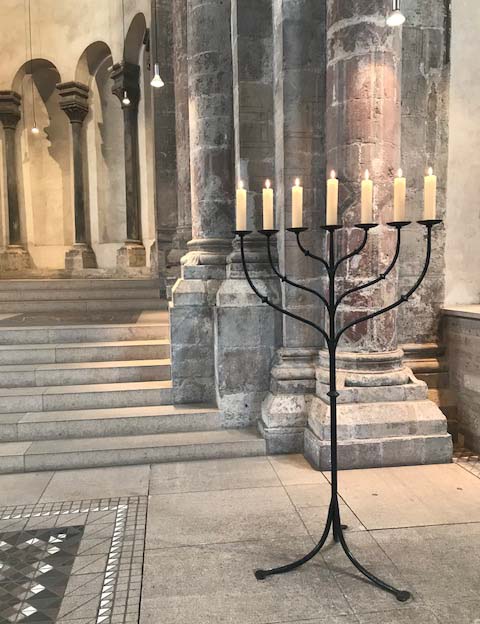 As people who work in secular jobs, in the city, the sisters and brothers of Jerusalem join in prayer three times a day: morning and evening, and mid-day. The celebration of Vespers includes a lucernarium. Intriguingly, the evening light that comes to be ritually lit is a Menorah, prominently displayed in the sanctuary, a symbolic link with Jewish faith and the traditions of the Jerusalem Temple.
Yes, this is a contemporary liturgical “bricolage” (but which liturgies are not bricolage?). And yes, this is a quite distinctive liturgy that matches the particular charism of the communities of Jerusalem. Yet what spoke most to me most directly about these liturgical celebrations was the ease with which I myself was able to enter into the journey, once again, of seeking to encounter the heart of the Triune God, in the heart of a bustling metropolis.
I would love to see brothers and sisters from the Communities of Jerusalem come and seek to live in the heart of God in NYC, or LA, or Chicago. I wonder how their liturgical life would speak to people in those cities.
Please leave a reply.