
by Markus Tymister
For the old Gallican liturgy, which was replaced by the Roman Rite by Charlemagne in the 9th century, there are some interesting witnesses to the manner and place for receiving Communion (cf. G. Nickel, Der Anteil des Volkes an der Meßliturgie im Frankenreiche, Innsbruck 1930, 61-66):
The provincial council of Tours (567) stated its position in its decrees on the use of the altar space:
“Pars illa, quae a cancellis versus altare dividitur, choris tantum psallentium pateat clericorum. Ad orandum vero et communicandum, laicis et feminis, sicut mos est, pateant sancta sanctorum” (“Concilium Turonense”, in Concilia Galliae 511-695, ed. C. de Clercq, [CCSL 148A[ Turnhout 1963, 178).
(That part which is set off at the altar by the grating is open to the choir of singing clerics. But for praying and receiving Communion the holy of holies is open to lay men and women, as is customary.)
Here something significant is said about the place of Communion reception: men and women communicate in the altar space – indeed, at the altar itself.
The report on the miracle at the grave of St. Martin also gives the same information. A girl healed of palsy goes to Communion at the altar:
“[…] dissoluti sunt nervi, qui ligati erant et stetit super pedes suos, cuncto populo spectante, et sic, propitiante Domino, usque ad altare sanctum ad communicandum propriis gressibus nullo sustentante pervenit” (De miracolis S. Martini II, 14, ed. J. P. Migne [PL 71], 947A).
(Her captive nerves were set free and she stood on her own feet in front of all the people, and through the goodness of the Lord she went to the holy altar on her own feet and without help, in order to communicate.)
The reception of Communion took place standing and in the hand. Caesarius of Arles(+542) writes in one of his homilies:
“Omes viri quando ad altare accessuri sunt lavant manus suas et omnes mulieres nitida exhibent lineamenta, ubi corpus Christi accipiunt” (Caesarius of Arles, Sermo 229, 5, ed. J. P. Migne [PL 39], 2168).
(All men wash their hands before going to the altar, and all women hold a pure cloth on which they receive the Body of Christ.)
In the Roman rite the manner of receiving communion was the same, except that the altar space was reserved to the clergy. As the Roman rite was introduced in Frankish lands beginning in the 9th century, it took a long time before this restriction took hold. Reception of Communion right at the altar was too strongly entrenched.
We find further details on the reception of Communion in the Romano-Frankish rite witnessed already in the 8th century at St. Gall:
“Post haec discendit pontifex a sede sua et communicat populum qui manus suas extendere ad ipsum putuerit et revertitur ad sedem suam. Reliquum vero populum communicant episcopi et presbiteri et confirmant semper diaconi.” (Breviarium ecclesiastici ordinis (ORXVII): Les Ordines Romani du hout moyen-age, ed. M. Andrieu, vol. 3 [SSL 24], Louvain 1971)
(Then the bishop steps down from his seat and gives Communion to the people, who extends their hands out to him, and then he returns to his seat. The other people receive Communion from bishops and priests, and the deacons complete it [i.e., give the chalice].”
The bishop who presides at Mass gives Communion to the select ones of the people in the hand. The other faithful receive Communion in the same way from the hand of further bishops and priests. In both cases “confirmant semper diaconi” – deacons extend the chalice. Communion in the form of bread alone was unthinkable at that time.
Only at the turn of the millennium did the transition take place to Communion on the tongue while kneeling. For at least 900 years Christians have received the Eucharist standing and, as a matter of course, under both forms – and for the most part, directly at the altar. The reasons why entrance to the altar space was gradually prohibited to laity are manifold, and have to do above all with Old Testament (and pagan) notions of cultic purity. This is seen already in the call for hand washing for men and the communion cloth for women.
Particularly in worshiping communities that are getting smaller, it would certainly be worth reflecting on the older Communion practice today. Receiving Communion directly at the altar seems “unpractical” at first. But this holds true here: what is “practical” in normal life is oftentimes not appropriate for the liturgy (Jungmann). And the danger of stumbling on the altar steps is no longer so frightening when one considers the essentially “more dangerous” path our community members take to get to church at all. The originally non-Christian notion of cultic impurity through contact with body fluids it largely overcome today, and it should be clear that the altar is not reserved exclusively to clergy. In this our communities still have a ways to go. Whether Communion is received in the hand or on the tongue can be left to the individual, though Communion in the hand is clearly the older form. In any case, participation in the cup of the covenant is important!
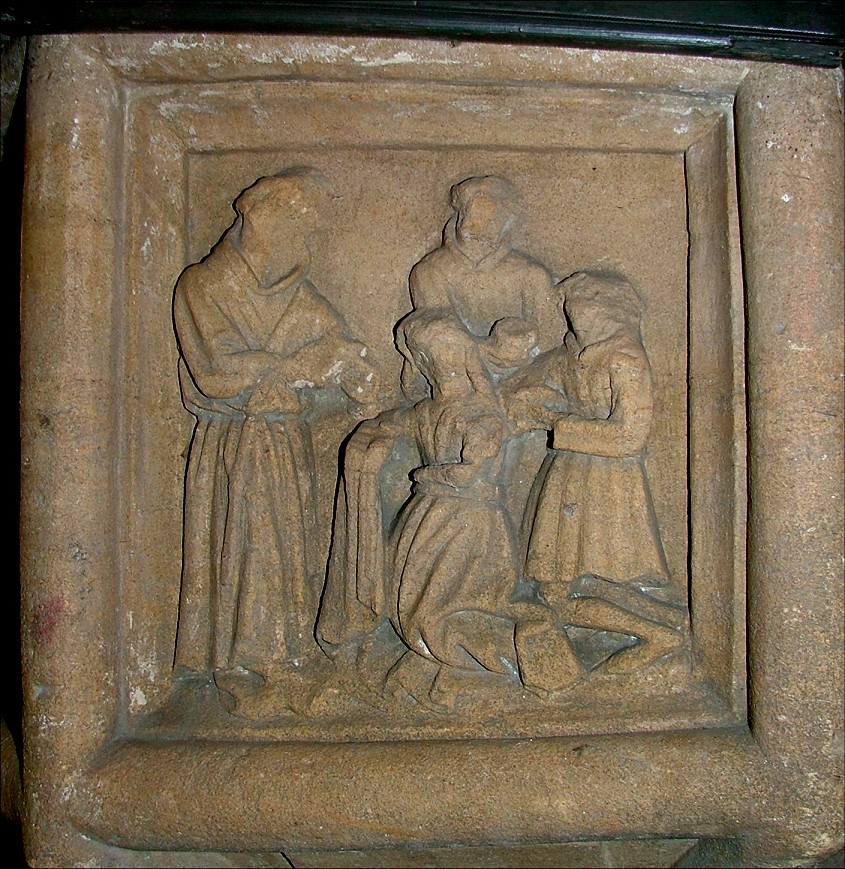
Translated by AWR and reprinted with permission from the blog Populo Congregato. Original: “Handcommunion oder Mundkommunion?” Fr. Markus Tymister is faculty member at the Pontifical Institute of Liturgy at Sant’ Anselmo in Rome. Image: The Altar of the Notre Dame de Avenas church. Avenas, France; XII century.

Please leave a reply.