

If you have ever visited Chartres cathedral just outside of Paris you are not likely to recognize it any longer. The interior of the cathedral has undergone a contentious 18.5 million euro project the past decade that the Monuments Historiques division of the Ministère de la Culture called a “restoration”. The architectural historian Martin Filler has denounced it as a scandalous “unfolding cultural disaster”. The first phase of the project was officially completed this past September. The cavernous gloom in which the medieval Chartres-blue windows gave off their cosmic glow has now been replaced by a searing bright cream colored interior. Over a decade ago the scientific team of the Monuments Historiques discovered fragments of two 14th century paint schemes. Frédéric Didier, the lead restorationist, then proceeded to create an artistic pastiche to serve as the basis of the campaign bringing together the two medieval colour schemes and Baroque additions made in the apse.

What has occurred is by definition not a restoration but a redecorating of the cathedral. In violation of the 1969 conservation protocols of the Charter of Venice the project is not simply a cleaning, nor is it reversible; Monuments Historiques scraped down to the original layer of medieval plaster, obliterating all layers of history and newly plastered and painted over the stone. The side aisles and transepts have been left encrusted in the familiar aged darkness, by some accounts the result of the outcry of visitors who began calling Didier’s interventions “arrogant” and “kitsch” (though the restoration is to begin again in 2019). Didier’s most heavy-handed work, including Chartres and the Abbey of Paray-le-Monial, which too was repainted, is quite in keeping with the history of French preservation theory. Like Eugène Viollet-le-Duc in the 19th century who would simply demolish and modify medieval buildings as he saw fit, the approach of Monuments Historique to is not to preserve any particular architectural element, but to reveal the monument’s true ‘spirit’.

Indeed, the strongest debates surrounding Chartres have not been regarding the methods employed, but what historical characteristics define Gothic and cultural artifacts themselves. What layers of time are valuable, what layers are to be saved? In this debate innumerable reactions, both scholarly and popular, have defined medieval architecture by dim voluminous interiors of stone which the light of jewel-like stained glass relieves. And even if one objectively recognizes the whole of medieval cathedrals were once polychrome monsters, Chartres’ specific character in the popular imagination has been a Sugerian spectacle of bright-darkness.

To this end perhaps the contemporary Chartres debate is more profound and in it something quite dangerous is being revealed and played with. The unease, I think, the project has elicited is not simply about restoration technique. Rather it reveals the meddling about with what is left of the spiritual imagination in the West. Chartres of all places in Western culture has been thought of as ‘spiritual’ by scholar, tourist, believer, seeker, and non-believer alike. No New Ageyness is meant here. Rather Chartres, and buildings like it, lay bare the fact that there is a precise correlation between place and the felt-experience of the divine as an anthropological reality. Explaining this the British philosopher Owen Barfield (1898-1997) argued for the unity of the material realm and that of mental activity. He suggested, unlike Kant, that what we think of the world is indeed expressive of what the world is, and not simply subjective abstractions of sense experience. For Barfield, human consciousness is the stage upon which thought concept and sensual observation meet and become linked to one another. In saying this he provides a fundamental anthropology of the senses and human thinking. What we feel is the real object of knowing. Importantly, Barfield explored the spiritual ramifications of human consciousness. The self-reflective act of thinking at one and the same time unifies experience and thought but points to reality beyond mere thought. His idea is something akin to Rahner’s Vorgriff – the idea that the spiritual nature of the human is defined by our thinking towards a horizon of possibility that passes to the infinite (Hearer of the Word, 1967). By this measure seeds of the divine in the world are matched to and recognized by our inner experience of the conceptual and volitional boundary of the real-known and the anticipated-unknown. It makes a lot of sense, therefore, to speak of spiritual imagination, as our spirit’s work according to Barfield is to think beyond – to imagine the encounter with the divine as based in real experience but always insufficiently fulfilled. It is precisely the role of the spirit to imagine, to abstract from experience and thought, what communication with the divine is like.
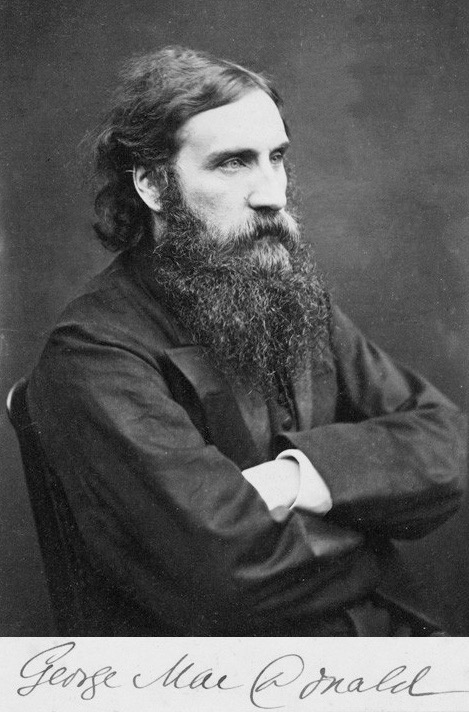
Because of the connection between the human spirit and imagination – that part of us most attune to the Vorgriff – other writers have noted the inherently artistic nature of believing. The 19th century Christian aesthetic movement, based in great part upon the thought of the Scottish Congregationalist presbyter George MacDonald (1824-1905), held that the most effective modes of believing are aesthetic. Hymns, poetry, and especially fantasy writing are inherently spiritual realities since they reach towards the unknown. Aesthetic inclinations, MacDonald taught, render the “deepest convictions” as they unite both sense-experience and the imaginative action of the human spirit in which God is presented as believable before human consciousness. Similar ideas were reflected in the architectural theory of John Ruskin (1819-1900) and Augustus Welby Pugin (1812-1852). In short, the work of these scholars and artists suggest that the religious experience of God is a concrete manifestation made present through the spiritual imagination.

The problem with the Chartres intervention, therefore, is not one simply of historical debate but of the religious imagination. If our sensorial experience is truly spiritual experience then the former is the most dangerous of places to intervene. What in fact ensues when familiar surroundings are modified or destroyed is a type of spiritual violence. As at Chartres, the stimuli that give rise to and embody religious experience are tampered with the faith-identity of the space is rendered unintelligible as the human spirit is cut loose from the recognition of what it once held as observably divinity-provoking. Numerous studies of this dynamic exist in Reformation histories—the ritualized violence of iconoclasm. But I have come to accept the fact that the dynamic has also taken place in our churches more recently. Notorious stories exist from my own family church passionately recounted to me by my grandmother as a youth;
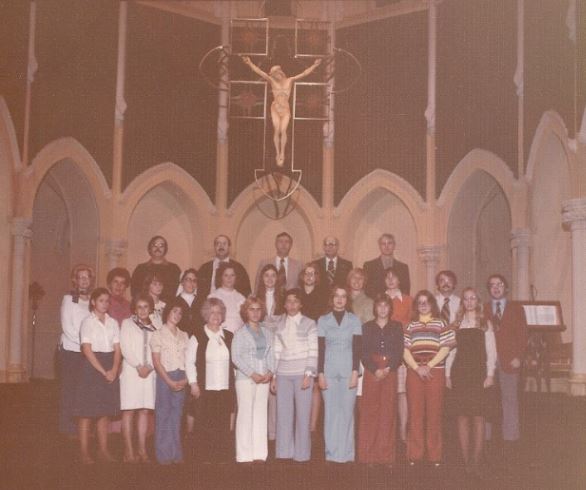
In the early 60’s the larger-than-life Msgr. Powell whitewashed the altars and painted the interior of the Victorian English Gothic church yellow and beige—wholesale. Shortly after the Second Vatican Council a comment by my grandmother regarding this ‘unfortunate’ incident to the new Fr. O’Shea was met with the retort “you haven’t seen noth’n yet.” Everything in the church except the stained glass was removed and auctioned off. The altars were literally cut down. The communion railing became someone’s porch railing which my grandmother passed every Sunday in the car. Statues of the Sacred Heart and Little Flower were placed in the rectory yard where the elements slowly decapitated and dismembered the plaster bodies for all to see. There was a palpable sorrow and offense in her voice when she told these stories—I am convinced her spiritual imagination had suffered untold indignities.
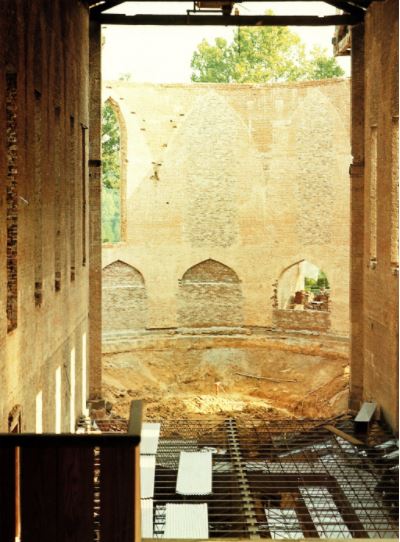
None of this is to be laid at the feet of the Council. One only need read Chapter 8 of Sacrosanctum Concillium to see it proffered no such destructive program. Rather, the trend in church ‘decoration’ followed the greater arc of art and architectural theory. Looking through the journal Liturgical Arts the evidence is clear; A decisive reductive move in church art and architecture runs throughout the 20th century. The same trend that came to eviscerate churches, first eviscerated public buildings and neighborhoods. The City Beautiful movement was replaced with asphalt progress. These places were deeply imprinted in our spiritual imaginations and served the irreplaceable measurement of all other places. Yet the radical change in these environments undermined the very structures that nurtured community
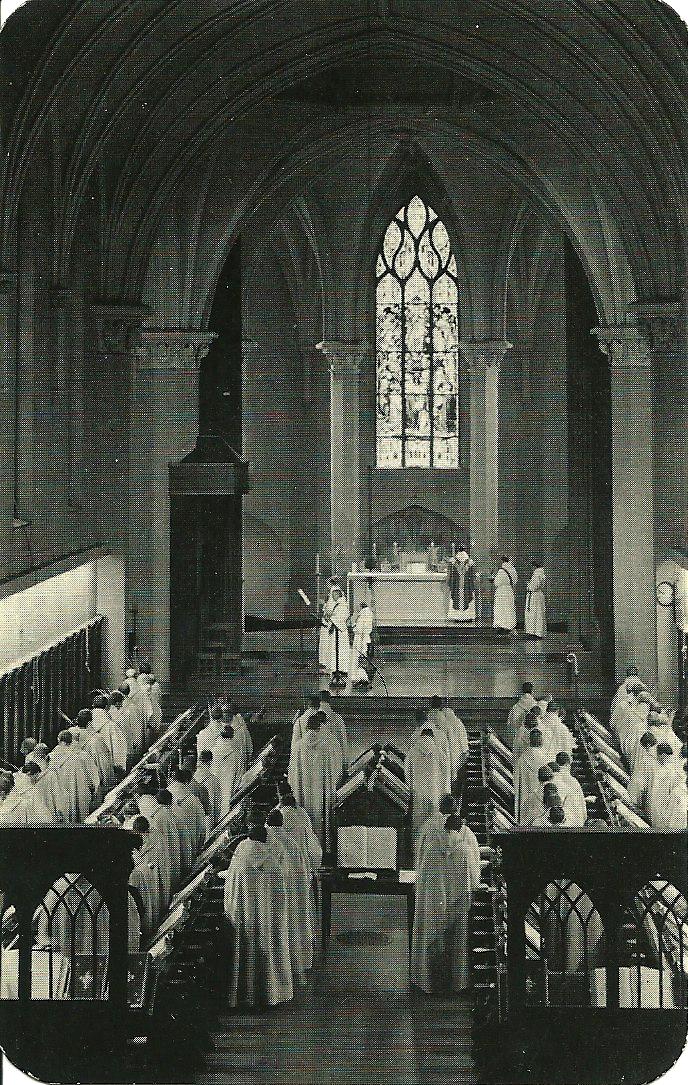
and encouraged informal relationships that sustained us. The car destroyed the walkable town just as much as carpeting aided in domesticating the sacred in churches. But I am no anti-modernist. In fact I love the best of Modernist and contemporary church architecture. But I am for protecting the ever-too-frail religious imagination at all costs. Too many churches were, and are, stripped to their brick cores in search of a feigned architectural ‘truth’. The abbey church of Gethsemani was denounced as a Gothic ‘fake’ and its vernacular brick-work extolled, all the while the authentic brick-work was modified into fake Brutalism!
Understanding religious imagination and how it operates warns us that random tampering with our physical surrounds is a fraught endeavor.
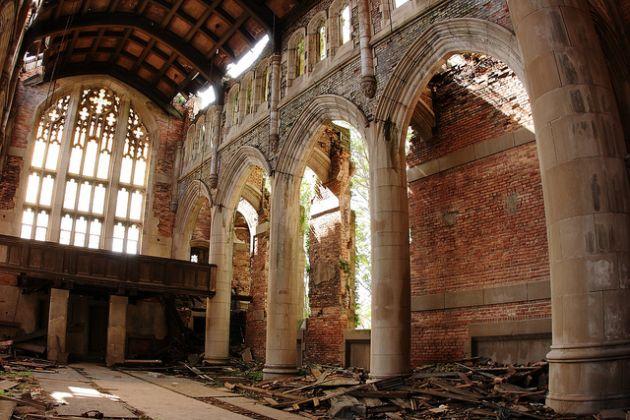
Too often today we are left to discern in both our natural and built environment the partially decayed remains of what was in our memory luminous and alive. Only the shadowy outlines of our memory are confirmed in a church building, a neighborhood—and our believing is left in doubt. Often times the spiritual imagination has lost its moorings in the physical environment. Our memories of divine encounter still exist but their confirmation is obscured by the destruction of physical referents of modified and destroyed places of worship. Belief is sundered from what anchored, confirmed, and symbolized it. Change certainly occurred in the past but at a slower pace that made adaption possible. Hence it was less bewildering, confusing, and disorienting. Today our spiritual imagination is in peril, the price of our speed, our hunger for unreflective change, and the belief that everything is disposable. The loss of the physical referents that once gave rise to religious experience, as at Chartres, leads to a process that the historian Robert Archibald has called an ‘un-remembering’. In this process the places and the belief that such places once sustained are obscured, as if immersed in impenetrable and unhealthy fog (A Place to Remember, 1999).

Don’t get me wrong. I am not necessarily concerned about the style of a building, or the year it was built. I am deeply interested in how we understand a building’s impact upon, and our role in sustaining, the spiritual imagination. The churches we build can never be static, but change must not overwhelm their identity. If we allow that, we imperil the bonds of our faith life, impoverish relationships with people and places, and endanger the religious institutions and the very foundations of this civilization. Yes, we can and should adapt to renewed liturgies, but we are short-sighted to destroy, abandon, or unadvisedly modify historic buildings: Common faith, civic life, neighborhood, and familial life all depend upon shared places that are repositories of common memories and shared experiences—and every change makes this all the less likely.
Today we know that the built environment is a symbolic memory device and stimulates our spiritual imagination. The communities of faith we strive to create and sustain are founded upon shared remembrance and grounded in place, especially churches that are conducive to the spiritual imagination. Hence, we must not only be attentive to the aesthetic impact of our art and architecture, but attentive to our care of places of believing, preserving the historic and imagining the new. We are called to be active conservators of the places, artifacts, and stories of our faith, as real markers of encounters with the divine that both depend upon and propel our spiritual imagination. What can we do to engage the religious imagination better?
- Open your church beyond Sunday. The obvious beginning point is that people cannot engage our buildings if they are forever closed. If insurance concerns require that buildings are locked an open invitation to entry and the means of easily doing so should be clearly posted.
- Treat your church like a museum. Like museums, churches are often full of old and new interesting things—play them up. Don’t present the building and its objects as a distraction or something to be ignored. People go to museums to see the past preserved, to learn, to contemplate and relax. A church can do the same.
- Regularly commission art. Our churches are histories in progress and their aesthetic character matters. They are not one-off creations. A visit to many of the churches of Europe highlight this fact. Churches that engage spiritual imagining are a must so commission a qualified composer, a talented artist and do something beautiful for God and the community. Create murals and mosaics and vestments. Work with the art departments of your local colleges and universities inviting young artists to provide temporary installations that reflect upon the spiritual.
- Don’t cast off tradition. Church buildings come in all types but an essential element of their character is accumulated age. A church interior violently updated to look like every other space we come across in daily life will do little to engage the imagination. Tradition is that character of memory that marks a place as meaningful. Our buildings are not things to be adjusted in as much as they are the artifacts of our fore-bearers religious experience. Buildings are witnesses to us.
- Learn the stories. The religious imagination sores when we know the stories that our churches can tell. When we concentrate on our buildings the very act of that attention leads into understanding the people and faith behind the building. Only when we know the stories of faith that are represented in the building do we actually come to know a history of faith in which we participate. We should know the stories of our buildings and readily share them. How many people have been baptized in this font? Who are these Christians? Do we even know?
- Develop spirituality programs that use your building. The truth is some buildings have more to say than others, hence point 3 and 5. Develop catechesis and prayer events that use the art and stories of your building. Look for qualities of the building to exploit visually and emotionally. Who is the saint in the window, what is the mood of the building? Help others discover how to connect to God through the spiritual imagination.
- Renovate, update, and build with compassion and understanding. No work should ever be started without a professional study of community identity or a building’s history. This is less of a problem in Europe where Ministries of Culture often control church buildings and natural sites and have bodies of law meant to protect cultural heritage. It is a major problem in the United States where churches are regularly gutted, abandoned, and bulldozed. Our buildings are artifacts of faith and shape us into the persons we are. Knowing our buildings specifically will preserve our heritage and help enlighten our interventions.
- If your building does not inspire – build a spire. Not every building is Chartres, but every church should strive to be. If a church is not aesthetically engaging or does not immediately provoke stories it probably has little capacity to engage the spiritual imagination. A big problem. Working towards a building that embodies a sense of transcendence is a good goal.
The house is not for me – it is for Him,
His royal thoughts require many a stair,
Many a tower, many an outlook fair
Of which I have no thought.
– George MacDonald

Please leave a reply.