
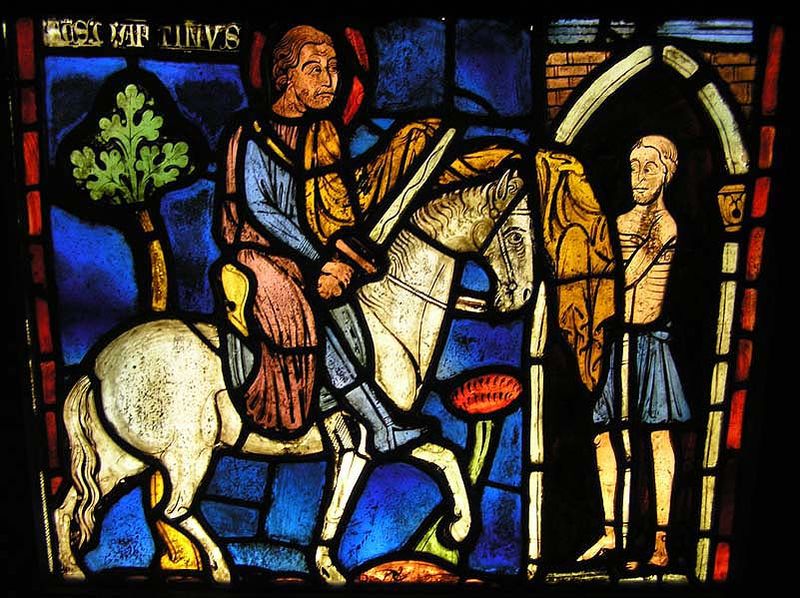
 Stained glass window of St. Martin of Tours in Cluny Paris National Museum. Photograph by Pierre-Emmanuel Malissin and Frederic Valdes
From the Life of St. Martin by Sulpicius Severus
“One day at the gate of the city of Amiens, Martin met a poor man who was naked. Martin’s clothing was reduced to his armor and his simple military cloak. It was the middle of the winter, which had been more severe than usual, and, indeed, many had perished from the extreme cold. Those who had passed that way had been begged by the pitiable pauper to have compassion on him, but all had gone by. Martin, however, filled with God’s grace, saw that it was for him, when others had denied their mercy, that the beggar was being reserved. Yet what should he do? He had nothing except the cloak he was wearing. He had already devoted the rest of his clothing to similar purposes.
Drawing the sword he was wearing, he cut the cloak in two. One part he gave to the pauper; in the other he again dressed himself. Meanwhile some of the bystanders began to laugh, for it was an inelegant figure Martin cut, dressed in half a garment. Yet, many of saner mind sighed deeply. When they, who had more to give, might have clothed the pauper without making themselves naked, they had done nothing of the sort.
When night had come and he was deep in sleep, Martin beheld Christ, clothed in that part of his own cloak with which he had covered the pauper. He was bidden to look attentively upon the Lord and to recognize the garment he had given. And soon, to the throng of angels standing about, he heard Jesus saying in a clear voice: ‘Martin, still a catechumen, has covered me with this cloak.’
The Lord, in declaring it was he who had been clothed in the person of the pauper, was truly mindful of his own words uttered long ago: “As long as you did it to one of these my least, you did it to me.”
–excerpted from Benedictine Daily Prayer: A Short Breviary, first edition (2005), compiled and edited by Maxwell E. Johnson, Oblate of St. John’s Abbey, and the Monks of St. John’s Abbey, p. 2211 – 2212
Please leave a reply.