
St. Peter of Damascus wrote the following in the 12th century about losing track of the text of the liturgy (a psalm in this case) because your prayer takes you elsewhere:
[While you are chanting psalmody,] when God’s grace kindles a sense of deep penitence in the heart, you should allow your intellect to be bathed in tears of compunction, even if this means that your mouth stops reciting psalms and your mind is made captive to what St. Isaac the Syrian calls ‘blessed captivity.’ For now is the time to harvest, not plant. You should therefore persist in such thoughts, so that your heart grows more full of compunction and bears fruit in the form of godly tears.
[“The Third Stage of Contemplation,” in Philokalia, vol. 3, ed. G.E.H. Palmer, Philip Sherrand, and Kallistos Ware (London: Faber and Faber, 1983), 119.]
I think Peter is recommending going with your ‘stray’ thoughts during the liturgy. No worries when your mouth no longer is singing or reciting the text and your mind is captive to other deeply emotional thoughts. Your participation, though apart from the community, is to be praised as “blessed captivity.”
The excellent post-Vatican II document Musicam Sacram (1967) says at no. 15 that full, conscious, and active participation should be “above all internal,” but also “must be…external…to show the internal participation.” To put internal participation first is exactly right.
To be sure, Musicam Sacram thinks of internal participation at no. 15 in a more constricted sense than Peter of Damascus – namely, to “join [your] mind to what [you] pronounce or hear.” Peter seems to be speaking not of internal focus on the liturgical text, but losing track of that text for a time as the mind soars elsewhere.
There has to be both in the liturgy – both a constant undercurrent of internal resonance with the liturgical texts and actions, and room for moments of grace when the mind goes elsewhere. It would be too narrow to expect unrelenting rational comprehension of everything in the liturgy.
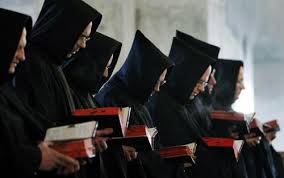 To be honest, my mind goes elsewhere a lot during the liturgy. And not always to the good – certainly not always with the “tears of compunction” Peter extols (but my brother monks would wonder about if I cried too much during the Office). Perhaps we might distinguish between blessed captivity, as Peter of Damascus describes it, and cursed captivity (papers to grade, errands to run…).
Now if everyone in the congregation is soaring into blessed captivity at the same time, there will be no one left to recite the texts or sing the chants. That would be a problem.
But I wouldn’t worry about it. I think more blessed captivity would be a good thing.
What do you think? What is your experience of blessed captivity?
awr

Please leave a reply.