
 “Marginal movements attract marginal people,” Michael Brendan Dougherty observes in a National Review piece.
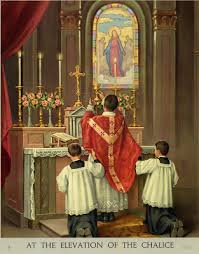
He’s doing political commentary about why libertarians sometimes became fascists. But to get there, Dougherty talks about his experience with the pre-Vatican II Latin liturgy. He recounts what it was like for him back in 2002 when the unreformed Mass was a pretty socially unacceptable thing, but he was drawn to it. Dougherty had to decide whether to put up with “the people for whom the Latin Mass was just the first or the latest in a long line of disreputable fascinations and commitments.”
Dougherty jumped in and joined the TLM (Traditional Latin Mass) movement with gusto. And ever since Benedict mainstreamed the TLM in 2007, according to Doughtery, “the ratio of normal people to kooks has changed dramatically in favor of normal people.” I think Dougherty is saying that the kooks are still there – but now that that the TLM is more socially acceptable, more normal people are comfortable associating with it.
Dougherty’s point is that we make our intellectual commitments and construct our theological arguments for very emotional and social reasons. As much as we may think we’re rational and objective, we are actually making decisions about what group we want to identify with. Do I want to be one of them?
Dougherty puts it well:
“People don’t just think themselves into their ideas; they feel their way to them emotionally, and they are socialized into them. Adopting a big new idea can be like adopting a new wardrobe; it can signify and propel a change in persona.”
Which brings us to “cup” or “chalice.”
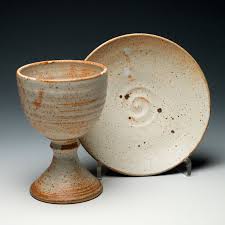 We’ve all heard ad nauseam all the arguments on every side of this issue. The Greek poterion means blah blah blah; the nature of ritual language is etc.etc.etc.; people don’t speak in normal life of yada yada yada; the liturgy is sacred because on and on and on.
Fine. Those arguments are important. It’s fides et ratio. Faith and reason go together. Rational argumentation has its place in attempting to penetrate into the mysteries of the faith.
But we probably deceive ourselves if we think we favor “cup” or “chalice” because of the strength of any of the usual arguments. In large part, we’re deciding which group we want to hang with. Or defending the commitment we’ve already made to some group or the other.
Like this:
- All the late middle-aged liturgists and musicians I talk to think the new Missal is bad, and that Pope Benedict insulted us by tearing down so much of what we have accomplished the last three decades or so. My generation had it right, and loyalty to them demands I speak up for “cup.”
- Some of the other seminarians I respect are pro-“chalice” (and pro-Benedict and pro-Latin Mass) and I think I want to be one of them. I’m in class with them, we play soccer together, we dream about remaking the church, and it’s exciting to be part of this group’s cause.
- I’m in academia – maybe up for tenure, maybe hoping to land a teaching position – and the academic guild will not respect me if I break with them on the “chalice”/”cup” issue. I pen journal articles, and write Pray Tell posts, accordingly.
- I’m an undergrad or grad theology major, and my theo friends are all over the map. We talk a lot about theology in the hallway and over beer, and when something like “chalice”/”cup” comes up, sparks fly. As I look around, this clique seems kinda weird but that group seems kinda lame, and I think I want to associate with…
If Dougherty is right about group association – and I think he is – there are important implications for the cause of liturgical renewal after the Second Vatican Council. (And on the Second Vatican Council, of course, Dougherty and I part company.)
Rational argumentation has its place, but it probably won’t carry the day. Those of us passionate about the liturgy have to be the kind of people that seminarians and young Catholics and church leaders can readily identify with.
Although the forces resisting the Second Vatican Council’s liturgy have to be countered by direct argumentation (which is not that difficult on the merits of the arguments), the long-term strategy has to be to use the power of attraction to bring those people and their passion into the fold of the reformed liturgy. It may take a few decades, but we must hope that most of them can be brought in. Then, the outright, blatant resistance to the Church’s teachings on liturgy will be marginalized. To apply Dougherty’s terminology to my worldview: the unreformed liturgy has to become the realm again of the kooks, with little power of attraction for the normal people.
I hesitate mightily to call anyone a kook, but in this case I’m going with the word usage of an insider like Dougherty. Let me put it this way: if too many of the people drawn to the TLM are normal, then we have a problem. And to any TLM-worshiper reading this, please assume that I think you’re one of those normal people! But here’s my point, to state it as honestly as possible: I’d rather have you either attracted to the reformed liturgy or else marginalized.
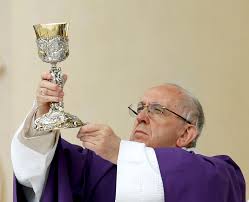 Pope Francis is all about this two-fold work of attraction and marginalization. He is laboring mightily to bring as many as possible back to the Second Vatican Council, while reducing the legitimacy of the resisters.
OK, Pray Tell readers, let’s get on it with Francis. Let’s be the kind of people who make the reformed liturgy attractive to traditionalists and conservatives and young idealists and seminarians and everyone else.
Let’s be the kind of people who are clear that the reformed liturgy has plenty of room for reverence, Latin chant, Catholic identity, beauty, transcendance.
Let’s be the kind of people who see no dissonance between all that and our commitments to community, inclusion, social justice, and engagement of contemporary culture.
As to whether it should be “cup” or “chalice,” I could go either way. But as to the reformed liturgy becoming the spacious, inclusive home for all Catholics: that’s the group I want to hang with.
awr

Please leave a reply.