
“Re-Launching the Project of the Council”

In a hard-hitting and riveting address focused on the vision put forth by Pope Francis, Bishop Long of Parramatta, Australia said Thursday that

I firmly believe that we’re on the threshold of renewal and transformation. The Second Vatican Council set in motion a new paradigm that cannot be thwarted by fear and paralysis. Once the genie is out of the bottle, it cannot be put back.

Drawing rather sharp contrasts, the bishop stated:

Prior to the 2nd Vatican Council, the church was suspicious of the world which was perceived as evil. Remember the classic three enemies: the world, the flesh and the devil. It was a defensive, fortress church. Followed the lead of Pope John XXXIII and his optimistic aggiornamento, guided by “the signs of the times,, the gathered bishops recognized that the church needed to open itself to the world, engage with the world and even to learn from the world. Gaudium et Spes – the guiding document of the Council presented a new paradigm: the church is not an enclosure which protects its members against the sinful world. It is a fellow pilgrim with the men and women of our age. It is a church incarnate in the world. Therefore, it is time not of fearful retreat, disengagement and self-referential pomp, but of accompaniment and engagement.

Bishop LongThe occasion was the Ann D. Clark Lecture, named for the beloved Parramatta diocesan director of schools who succumbed to cancer some years back. Bishop Vincent Long, OFM Conv, was recently translated from Auxiliary Melbourne to be Ordinary of Parramatta, Australia. He was born in Vietnam and arrived in Australia as a refugee.

Bishop Long stated in his address that it is the time to reclaim for the Church:

  • Less a role of power, dominance and privilege but more a position of vulnerability and powerlessness;
  • Less an enclosure for the virtuous but more an oasis for the weary and downtrodden;
  • Less an experience of exclusion and elitism but more an encounter of radical love, inclusiveness and solidarity;
  • Less of an attitude of “we are right and you are wrong” and more of an attitude of openness to truth wherever and whoever it is to be found;
  • Less a leadership of control and clericalism but more a diakonia of a humble servant exemplified by Christ at the Last Supper;
  • Less a language of condemnation but more a language of affirmation and compassion; and
  • Less a preoccupation for its own maintenance but more a concern for the kingdom of God.

Bishop Long see the need for

a church attentive to the signs of the times and incarnate grace at work in the world, even among the unorthodox and the marginalized.

The Transition to Pope Francis

The bishop described the shift from Pope Benedict to Pope Francis:

When Pope Emeritus Benedict XVI announced his resignation in early 2013, we were adrift… Why? Because in 600 years, there had not been a papal resignation. … The Barque of Peter was truly launched into uncharted waters. We Catholics felt we were in dire straits. The mood wasn’t good. And yet somehow that mood was changed remarkably with the arrival of a rather unlikely pope. …Talk about a God of surprises.

Bishop Long emphasized the unexpectedness of Pope Francis, and what his unexpected pontificate means:

Pope Francis is the embodiment of our hope. His unexpected election and the way he exercises his leadership give us a breath of fresh air and a source of great hope.

And this:

Pope Francis has unleashed a new energy, he has poured a new wine which cannot be contained in old wineskins. He has challenged us to move in concert with him and bring about the rebirth of the church.

He drew out the implications of the pope’s vision for the life of the church:

I believe that we are living in a watershed and a privileged moment in the history of the church. Just as the biblical exile brought about the most transforming experience that profoundly shaped the faith of Israel, this transition time can potentially launch the Church into a new era of hope, engagement and solidarity that the Second Vatican Council beckoned us with great foresight. …. It is not “business as usual”. There needs to be an attitudinal change at every level, a conversion of mind and heart that conforms us to the spirit of the Gospel, a new wine into new wineskins, not a superficial change or worse a retreat into restorationism.

Burke cappa 2Attendees at the lecture report that the bishop’s PowerPoint presentation illustrated the “retreat into restorationism” with this picture of a well-known cardinal wearing a cappa magna.

Divesture

The implications of Pope Francis’s vision include divesting, according to the bishop:

Pope Francis challenges all of us to divest ourselves of clericalism and elitism, and return to the purity of the Gospel. His constant call to the church to be less concerned with itself and to be more outward looking encourages us to walk with our people in the ambiguities and complexities of their lives. The self-referential church steeped in a culture of splendor is in stark contrast with the church of the poor and for the poor.

The bishop stated that he has forfeited his club membership with Quantas airlines, as he endeavors to follow the pope’s lead to live simply.

But that’s the easy part. The harder part is to do what most of you do, which is to labor at the coalface of the church.  It is have the smell of the sheep, to walk with people, identifying with them in their struggles, their questions and their uncertainties.

An Inclusive Church

Bishop Long spoke of the challenge to be an inclusive church, a “big tent church”:

There must be space for everyone, especially those who have been hurt, excluded or alienated, be they abuse victims, survivors, divorcees, gays, lesbians, women, disaffected members.

Bishop Long gave particular emphasis to the issue of gay Catholics, noting that

as the Gospel illustrates, it is the holders of the tradition who are often guilty of prejudice, discrimination and oppressive stereotype. …

He continued,

We cannot talk about the integrity of creation, the universal and inclusive love of God, while at the same time colluding with the forces of oppression in the ill-treatment of racial minorities, women and homosexual persons. It won’t wash with young people especially when we purport to treat gay people with love and compassion and yet define their sexuality as “intrinsically disordered”. This is particularly true when the Church has not been a shining beacon and a trail-blazer in the fight against inequality and intolerance.
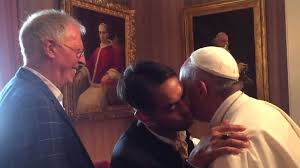
Pope gay coupleThe bishop put up an image of Pope Francis meeting at the Vatican with a former student, a gay man, and his same-sex partner, and said:

Pope Francis says that we must always consider the person, because – I quote “when God looks at a gay person, does he endorse the existence of this person with love, or reject and condemn this person?”

Prophets for Our People

The bishop concluded with a call to be prophets:

May we be like the prophets for our people during this our contemporary exile. May we be strengthened to walk the journey of faith with them, proclaim the message of hope, the signs of the new Kairos and lead them in the direction of the kingdom. May all of us enact the rhythm of the paschal mystery of dying and rising in the pattern of our Lord who is the Alpha and the Omega.

The entire address can be read here.


Editor

Katharine E. Harmon, Ph.D., edits the blog, Pray Tell: Worship, Wit & Wisdom.

Please leave a reply.

Comments

32 responses to ““Re-Launching the Project of the Council””

  1. Wow. Praise God! Bravo Bishop Long.

  2. Karl Liam Saur

    Oh, the headline tricked me; I wondered if it referred to the Council of (Basel-Ferrara-) Florence….

  3. Rita Ferrone Avatar
    Rita Ferrone

    The link to the talk does not work.

    1. Anthony Ruff, OSB Avatar
      Anthony Ruff, OSB

      @Rita Ferrone:
      Hmmm – it seems they just pulled the story from the diocesan website.
      ???

  4. Steve Hartley

    Wow, great talk! Too bad he had to publicly humiliate a prelate of the Church to make one point in his article. He could have done it in a more charitable way. It’s probably the reason it was taken down. I hope he gives a public apology. It would be the Christian thing to do.

    1. Anthony Ruff, OSB Avatar
      Anthony Ruff, OSB

      @Steve Hartley:
      Well, it’s public information and a public photo. I’m not sure of his tone of delivery, so it could have come across more as illustration than as humiliation. It’s not like he falsely accused the cardinal, or put words in his mouth – he just showed him doing what he in fact does publicly.
      awr

  5. Elisabeth Ahn

    Attendees at the lecture report that the bishop’s PowerPoint presentation illustrated the “retreat into restorationism” with a picture of a well-known cardinal wearing a cappa magna.

    Ha. Bishop Long has some chutzpah to do this.

    It will be interesting to follow up on how such a “hard-hitting and riveting address” actually translates into specific decisions and actions — pastorally but not only — on the ground (and as possible, to what effect).

    Meantime, you may also have heard that they — the Australian Catholic Church — are planning a historic plenary council for Australia, to be held in 2020: http://catholicleader.com.au/news/brisbane-archbishop-calls-for-first-synod-for-entire-catholic-church-in-australia-since-1937

  6. How long will it be before a Vatican spokesperson tells us what the bishop meant to say?

  7. Jack Wayne

    I’d say it was obviously meant as a slam, since he contrasts it with “a conversion of mind and heart that conforms us to the spirit of the Gospel.” I also don’t know how it could be interpreted as anything but an insult when you begin to describe someone with the words “or worse..” unless you are being sarcastic. It’d be nice if these sorts of initiatives didn’t always get bogged down with the anti-traditionalist agenda, since the bishop otherwise made a lot of excellent points that many Catholics could likely get behind.

    I’m all for a big tent church, but if there’s no room for the cappa magna, then the tent obviously isn’t big enough 🙂

  8. Anthony Ruff, OSB Avatar
    Anthony Ruff, OSB

    I think it’s overly sensitive to call this a slam or an insult. Maybe it’s just a disagreement. He showed what he disagrees with.

    Otherwise, no one could ever show an image of an ugly post-Vatican II church (there are plenty…) or a tacky liturgical scene without being accused of insulting it. (And note, there are lots of websites showing such scenes.) Honest disagreement has to be possible, and that includes showing what you disagree with.

    awr

  9. Ryan Kelley

    This is truly remarkable and I am hopeful to see this reflection occurring within the upper echelons of the church. I am curious to see how these words actually get displayed. A concern of mine is that the shift to a big tent church becomes an avenue to further shelve Palestrina, Victoria, Byrd, and Mozart from the liturgy and only strum guitars and use OCP.
    I find it so frustrating that much of the Catholic Church, lay and ordained, can only seem to equate “progressive and open” with On Eagle’s Wings and Be Not Afraid, and “traditional” as “conservative” with Taverner or Allegri. The most beautiful and mystical experiences I have had at church were when the parish and priest preached what I’ll call progressive and inclusive theology while incorporating more “traditional” music. It seems so simplistic to not be able to see this blending. In the few Episcopalian services I have attended I have experienced a beautiful balance of this “traditional liturgy” and “progressive theology”. I hope that the Catholic Church can too.

    1. Ron Jones

      @Ryan Kelley:
      I understand your fears Ryan. In my present parish home we have spent the last three years nurturing and renewing a sense of beauty and reverence into our liturgies. When I started, there was no time given to silence at appropriate times and they never had the cantor sing the psalm from the ambo. The communion procession was also out of whack (there’s a little known liturgical term). These are the sort of situations that can be easily remedied without long explanations. Modeling good liturgy speaks volumes.
      The next Sunday, the cantor started sing from the ambo, we started periods of silence which we have slowly expanded to what now seems a sacred time, and we have one song for communion (usually based on the proper) which lasts until the final person receives. The choir is no longer receiving first, which delayed the start of the music. Now everyone is singing as they go to communion. Once these good habits were in place, we started to add more formal music and taught the entire community (including the spanish speaking) to chant the mass in latin. The children’s choir has told us the latin chant is their favorite setting.
      I love to play the guitar and I love how it can be used on almost any style or period of music. The trick is to train your guitarists and open them up to the possibilities. When I was a teenager, I love playing the traditional hymns on my guitar. I also found it to be more subtle than the organ as chant accompaniment. It’s all about education and spending quality time developing the sensibilities of the people in your ministry. The assembly will “get it” if they can experience it. Once they experience it, they own it.

  10. Francis Duero

    “There must be space for everyone…”

    So this must include the traditionalists. But now they are always attacked as hypocrites…

  11. Jack Wayne

    I cannot disagree, awr. I certainly wouldn’t want an environment where one cannot disagree or express opinions due to oversensitivity.

    I still think his focus is on the wrong thing, so this call for greater inclusivity will likely come to nothing, which is sad.

  12. I’m all for big tent Catholicism. At the same time, the bishop comes across, at least in this talk, as being far more positive about the culture of late modernity than I can bring myself to be. One thing I don’t sense in this talk if that fine balance of openness and critique with regard to the bourgeois West that one finds in Pope Francis. But of course you can’t base everything on a single talk.

    1. Anthony Ruff, OSB Avatar
      Anthony Ruff, OSB

      @Fritz Bauerschmidt:
      I agree with you, Fritz. I posted the talk because it’s a sensation and deserves to be known – but I knew people would ‘like’ and ‘share’ it on Facebook as if it’s my view and I’m affirming the bishop’s talk. I think his perspective is an important part of the mix, and it will have great appeal for those who have felt hurt or excluded or mistreated by the Church (and there are many such). But as a program in and of itself, it’s a bit weak on some aspects that aren’t present.
      awr

    2. Elisabeth Ahn

      @Fritz Bauerschmidt#15:

      One thing I don’t sense in this talk if that fine balance of openness and critique with regard to the bourgeois West that one finds in Pope Francis.

      Yes.

      As an aside, you might find this tweet from Abp. Coleridge of Brisbane interesting:

      “Love of truth leads us from world to God; truth of love sends us back from God to world. Getting love & truth, God & world right is the key.”

      The Aussie bishops (well, some of them anyway) are talking some interesting things. Maybe, hopefully, they’ll find that key, that balance, together.

  13. Matthew Roth

    The difference between criticizing an ugly church and the use of the image of Cardinal Burke is thus: there are objective criteria to determine whether a church is adequate for the sacred liturgy or not. One thinks of symbolism such as a cruciform shape or a hexagonal baptistry. The use of precious materials, e.g. for the altar and tabernacle, should be evident. It ought to be acoustically live. The tabernacle ought to be prominent and easily accessed. For new churches, the GIRM lays out criteria such as an altar which can be walked around, etc.

    On the other hand, the bishop’s words and image imply His Eminence is doing none of the positive which the bishop had just laid out, and in fact it implies traditionally–minded Catholics do the opposite.

    1. Anthony Ruff, OSB Avatar
      Anthony Ruff, OSB

      @Matthew Roth:
      But none of those are in fact objective criteria – plenty of Christian churches are not cruciform and plenty of baptisteries are not hexagonal, and nothing in church documentation requires that or limits the options to that. And the use of precious materials, however much you or I affirm it, is not uniform throughout church history. And even now there are exceptions in the US to the universal norms on sacred vessels. And the guidelines that are given in any of these areas always require interpretation, which always brings in a subjective aspect.

      awr

  14. Jordan Zarembo

    What I’ve noticed about Bishop Long’s statements is his emphasis on the holistic nature of sin and injustice. In the Tridentine era, penitents were instructed to list discrete acts and the number of times committed to a priest during confession. Limiting the conditions of reconciliation to a list of sins, however, sometimes may obscure evil and injustice in less readily recognizable forms.

    Pope Francis has likened the Church to a hospital for sinners, not a golem designed to destroy the psyche through the stigmatization of a handful of personal and discrete acts. A characterization of the world as a good guys/bad guys scenario closes our minds and ears to vulnerable brothers and sisters, as well as the injustices and horror of evil against humanity. Sin, injustice, greed, evil — all of these are not caricatures, but polyvalent realities.

  15. Matthew Roth

    Come on, Father. The point is not that symbolism is limited to such elements. It is that such elements work very well in building churches suitable for the sacred liturgy. (I also meant *octagonal*– six does not have the symbolism of eight!) I think of large historical Byzantine churches such as those in Constantinople being circular, more or less. All the action points towards the sanctuary, which is still understood by visitors to churches now closed for worship such as the Hagia Sophia. On the other hand, I have been to circular churches which completely distort this focus or become targets of ridicule for looking like spaceships. One can look at a church and say “This is appropriate for worship, even if perhaps something is overemphasized to the neglect of another element,” or one can say, “there is so much needed that it cannot be appropriate.” It also isn’t a personal insult in the same way as the bishop’s remarks. Bad taste doesn’t necessarily reflect bad theology or sinful behavior or tendencies. Some of this is in the realm of taste. I hate plaster statues, for example, and prefer marble to wood, because of fire hazards, for the mensa. Other parts are in the realm of legislation and theology; we can all agree a room in the back of the church not clearly marked or not visible from main walking areas is not a prominent place for the Blessed Sacrament. Should it be on the central axis? Sometimes, at least, but not always (the bishop never pontificated at the Sacrament altar). But for the most part, it is a matter of theological balance, whereas the bishop here has no room for that.

    1. Anthony Ruff, OSB Avatar
      Anthony Ruff, OSB

      @Matthew Roth:
      I guess I’m not sure what the point is here. You claimed that there are objective criteria for ugly churches but not for symbolic elements (like the cappa magna). I said that subjective interpretation is always involved in both categories, and that the criteria for what is an ugly church are not entirely objective.
      awr

  16. Lee Bacchi

    My guess is, reflecting on yesterday’s Gospel, that the big tent is more for those who always thought, or were treated as if, they were automatically out, and may not include those thought they were automatically in.

  17. Fr. Jack Feehily

    The reform of the Roman Rite clearly called for noble simplicity in the celebration of the Sacred Mysteries. The only justification for the wearing of the cappa is a desire to set aside that reform in favor of reviving the TLM. Bishop Long comes from a culture in which clericalism is still firmly fixed and it is to his great credit that he is able to join Pope Francis in calling for it to give way to the servant leadership which so characterizes that of Jesus himself. I respect the sensitivities of those who seem unable to accept that Francis has already begun to restore the project of the Second Vatican Council which had been put on a back burner by his two most recent predecessors. It is risky business, but taking up one’s cross was risky business for Jesus as well as for those of us who seek to be his faithful disciples. We live in a world that does not believe that a Galilean Jew by the name of Jesus was sent by God to be our Savior. Nor does it believe that this Jesus came to make it possible for us to have life in all its fullness. The first disciples believed because they saw God’s mighty deeds in the one they called rabbi. First century Jewish and Gentile believers became disciples on the testimony of Paul and the other Apostles. There was a Peter, but no papacy. There was a mother church but not yet in Rome. There were overseers, presbyters, and deacons but no clergy. The project of Vatican II is no less than the proclamation of the same kerygma that fueled the fire upon the earth which Jesus came to start. This involves acknowledging that Jesus is the head of a church that is not simply an institution but a sacrament, a herald, a servant, a communion, and a community of disciples. The project is further elaborated by an understanding of the Holy Spirit who inspires charismatic gifts in all the members of the church so that they can participate fully in its mission in cooperation with but not just under the direction of the hierarchy. Just getting started but out of space.

  18. Elisabeth Ahn

    “inclusive” vision or “big-tent Catholicism” does not mean anything goes, does it?

    Singling out Burke like that was in poor taste, I agree, but, Burke’s kind of restorationism, much less his way of “keeping the faith”– as he is wont to say — has no place in our outgoing missionary Church, IMO.

    (PS — The link is now working.)

  19. Peter Kwasniewski

    Question: Why is this bishop still wearing clerical attire of any sort? Why is he still using prescribed rituals and ceremonies? Ratzinger saw that the post-modern critique of structures and institutions extends to everything — there is no logical reason to stop at the cappa magna or the gold chalice or the medieval chant, as opposed to carrying the deconstruction of religion all the way to its entire visible material system of power.

    For this reason, therefore, the post-modern critique has to be rejected at its root.

    1. Karl Liam Saur

      @Peter Kwasniewski:
      That’s an interesting distillation of Ratzinger’s perspective, but it doesn’t scour as well as you appear to think it does. What is logical depends on your assumptions and the boundaries of what you consider to be relevant facts. (It’s not so much that X is true or false, but *how* true or false X is.)

      Human vesture changes, albeit with varying lag times. Certainly we’ve not preserved the vesture of the Apostolic era, and it kept changing over the centuries; the process of change has never stopped, even in the Tridentine era. The cappa magna is an a-liturgical vestment. It was a sign of jurisdiction and authority that developed in a time of many such signs. In that time, in conveyed a certain, shall we say, gravitas. Now, it would be more likely to convey the opposite of gravitas (say, for example, more of a whiff of the Society for Creative Anachronism). Trying to keep one thing from changing while other things around it move means the context of the thing you trying to keep still nevertheless changes. E pur si muove. That doesn’t mean God changes or that we’ve lost our connection to God. I guess I have a great deal of hope and faith about this, and not so much fear, though I possess a greatly conservative *temperament*. Now that I am well into midlife, I have an even greater appreciation for the relaxed and trusting cosmic perspective of the wonderful elderly people I knew (and sort of envied or at least wondered at, since I was a terribly anxious lad) as a boy. We people do tend to get in our own way, however, and it’s always good to keep that in mind.

  20. Fr. Jack Feehily

    Peter, in terms of change with regard to liturgical vesture, consider the maniple. You do understand that the original maniples were pieces of cloth that the priest could use to wipe sweat away on very warm days. In a subsequent age clerics must have become unaware of that original need and began to fashion maniples from materials of various kinds and it became an adornment. Same thing with amices. The amice was used to protect cassocks and albs from damage and discoloration due to excess sweat. Later someone innovated a spiritual significance to the amice when it was no longer needed for its original purpose. I haven’t worn an amice in over 40 years, nor a cassock for that matter as they have been replaced by newer clerical apparel. Surely we can adapt without supposing that the next thing we’ll discard is the meaning of the Mass.

  21. Jack Wayne

    I think one needs to look at how people’s perception of a garment changes, and look at whether or not it is a positive change. The maniple came to symbolize the toil and hardship that a priest should undertake (at least, according to an old St Joseph missal I have), which seems like a rather powerful symbolic meaning that is also intimately tied to the garment’s original basic function. The amice gained the symbolic meaning of representing the trust the priest should put in Christ, and while that is less tied to the original function of the garment, it isn’t something that detracts or obscures the meaning of the Mass in any way – in fact both symbolize traits that priests should be reminded of and aspire to. Catholics wear and use lots of things that have no real function other than to act as symbols and reminders of how to live the Gospel.

    I’ll admit that I’m not the biggest defender of the cappa magna, as it has a different history from, say, the maniple – but at the same time I find it hard to really speak against something that really has no negative impact on the Church today, unless you count people on a few blogs getting flustered over *other* people seeing one at a Mass they themselves didn’t attend. I attend the EF almost exclusively, and I’ve yet to see one in person.

    Of course, I realize the cappa magna picture was probably meant to symbolize traditional liturgy in general and point out that it is a problem in today’s Church because it supposedly doesn’t “conform us to the spirit of the Gospel” – a position which seems wildly out-of-touch with the realities of typical Catholic life. I live in a diocese of around 200 parishes – of those, only a tiny handful offer one EF Mass each Sunday. Unless one can statistically prove that those few Masses account for the vast majority of people leaving or feeling alienated from the Church, then one is just finding an easy scapegoat that lets them ignore real problems.

    If one is going to bring up the topic of liturgy in a discussion about the problems in the Church today, then that discussion needs to center almost entirely around the OF. I’m not saying that because I am a liturgical traditionalist, I’m saying that because it is an objective reality that 99% of Catholics today attend and are formed by the OF exclusively. If liturgy is part of the problem, then that problem lies in the OF.

  22. Jack Feehily

    And the reason that 99% of Catholics are formed by the so-called “OF” is because it is the Latin Rite as reformed by the spirit inspired initiative of the Fathers of the Church gathered in Council with the Bishop of Rome between 1962 and 1965. When the Missal of Pius V was promulgated it abrogated all others which preceded it even though these former rites validly guided the celebration of the Sacred Mysteries. There was resistance to the new missal then as now, but it ultimately prevailed. Traditionalists seem to have the odd idea that whatever may be “wrong” or “deficient” in the church of the 21st century, is all due to the NO. Perhaps restoring even some elements of the TLM will bring hordes of Catholics into half empty churches. Maybe Birettas, maniples, and fiddle backs will restore reverence and sanctity. And maybe if bishops and priests will simply teach the doctrines as codified in Denzinger, Catholics will be transformed into ardent and intentional disciples of Jesus Christ? Dream on.

    1. Jack Wayne

      @Jack Feehily:
      I think you totally missed the point of my post, but to respond: I thought the Missal of Pius V allowed all rites that were older than 200 years to continue to be used since they rightly saw that those older rites had “validly guided the celebration of the Sacred Mysteries.” Were those who continued to use these rites really resisting the new Missal, or were they simply doing what the Church allowed them to do?

      And to re-phrase your uncalled for rant about traditionalists to be slightly more realistic and less straw-man: Traditionalists seem to have the odd idea that whatever may be “wrong” or “deficient” in the church of the 21st century might actually have something to do with the liturgy experienced by 99% of Catholics. Perhaps restoring even some elements of the TLM will attract some Catholics back to the Church due to their symbolic richness and cause a few with one foot out the door to give pause. Maybe quality vestments, art, and music will restore reverence and sanctity to the liturgy and help people enter the sacred mysteries. And maybe if bishops and priests will simply teach what the Church teaches, Catholics will be transformed into ardent and intentional disciples of Jesus Christ.


Posted

in

by

Tags:

Discover more from Home

Subscribe now to keep reading and get access to the full archive.

Continue reading