
Daniel Berrigan, poet, peace activist, and Jesuit priest, died on April 30, 2016, at the age of 94. He was buried from the Church of St. Francis Xavier in New York last Friday. His passing was mourned by many who honored his life work and witness, and noted by many more simply because he was a public figure with a place in American history.
About 800-900 people took part in the liturgy. A procession — with banners and a brass band — assembled at 7:30 at Mary House, the Catholic Worker house on 3rd Street between First and Second Avenues, and marched to Xavier, which is on 16th Street and Sixth, for the 10 AM liturgy. These veterans of many public marches organized a good one, despite the rain.
At the church, the Call to Worship included “These Alone Are Enough” (Schutte), sung by the Ignatian Schola, and an original setting of Fr. Berrigan’s poem, “We Love,” composed and performed by baritone John Cimino and marimbist Richard Albagli. There was a choir of 28 voices, mandolin and clarinet, and the cantor was Anne Holland. Director of Music was John Uehlein.
“We Are Called” (Haas) was the opening hymn. The Mass of Creation, and several well-known hymns such as “Make Me a Channel of Your Peace” (Temple), “Servant Song” (Gillard), “I Am the Bread of Life” (Toolan), and “Take, Lord, Receive” (Foley) were sung during the liturgy. The sanctuary was decorated with iconic banners, recalling peace marches.
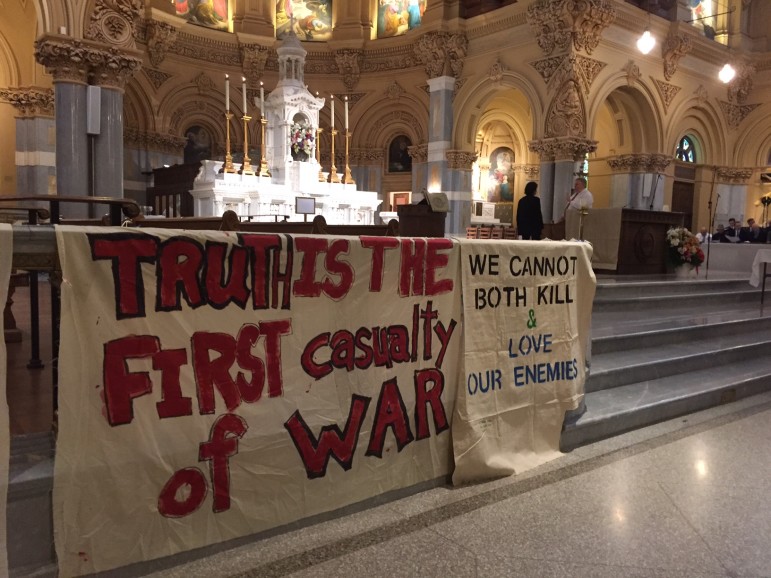
The Very Rev. John J. Cecero, SJ, Provincial of the New York Province of the Society of Jesus, presided at the liturgy, and peace activist Rev. Stephen Kelly, SJ, preached. Members of the family were involved in reading, in the gifts procession (which included a plowshare and a hammer), and in offering reflections on his life (after communion). Elizabeth McAlister, his sister-in-law, who was also a veteran of many peace actions, gave one of the reflections.
Fr. Berrigan holds a special place in the history of American Catholicism. Historian Mark Massa, SJ, in his book, The American Catholic Revolution: How the ’60s Changed the Church Forever, recounted the story of the protest Berrigan and eight others staged in 1968 (the burning of draft records in Catonville, MD, during the Vietnam war) as a pivotal moment for the American Church. Fissures appeared at that time between the Constantinian model of accommodation to the state, and a more prophetic stand which invokes the “dangerous memory” of Jesus (a term coined by the theologian Johannes Baptist Metz that same year). Massa draws this conclusion:
The events that surrounded the burning of the draft records in Catonsville was a critical moment in the sixties for Catholics in the United States. The Catonsville Nine, both the actual participants in the events and the political meanings that event took on after 1968, represented the moment when the American Catholic engagement with history, and particularly the Catholic place in American history, entered into an identity crisis from which it has yet to fully emerge. The Catonsville events served to catalyze that identity crisis because it pluralized how, and in what ways, one could be a good American Catholic. (p, 124)
Although many are aware of Dan Berrigan as a poet and witness for peace, who served prison terms for his nonviolent protests, Jim Dwyer, of the New York Times, also drew attention to the way he freely lived a life of evangelical simplicity and poverty, and did so to the end:
Deeds, not things, made Father Berrigan one of the best-known Roman Catholic priests of the 20th century: His physical possessions barely filled the modest room in the Jesuit infirmary at Fordham University in the Bronx where he spent his final years. He departed indifferently penniless from a world that often seems to keep score in gilded ink.
May he rest in peace.
America Media live streamed the funeral liturgy. It is posted in two parts: here, and here.

Please leave a reply.