
by James Thomas Hadley
Italy and the whole of Europe are the frontlines of a migrant crisis being met head-on by Christian charity of all sorts: Papal charities, The Church of England’s Diocese in Europe that takes in the geography of Italy, Greece, Turkey and beyond, The Episcopal Church (USA) represented by Saint Paul’s Episcopal church Rome and their Joel Nafuma Refugees Center, and the Church of Greece, to name a few.
The crisis has given rise to public monuments from the “Porta di Lampedusa – Porta d’Europe” (Gateway to Lampedusa – Gateway to Europe) by acclaimed Italian artist Mimmo Paladino, to the now destroyed church and mosque at the Calais refugee camp in France.
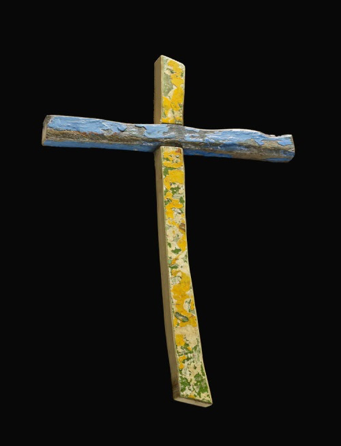
It has also, especially in Italy, given way to artistic reflection. The British Museum recently acquired the Lampadusa Cross made from the wood of North African from the wood of a North African boat by the Italian artist Francesco Tuccio. Recently, while traveling in the Sicily I came across two other sculptures in the Cathedral of Noto also made from immigrant boats that had traversed the Mediterranean from North Africa to Italy. Installed before a side chapel their form and color is striking. The damaged color-saturated varnished wood harmonizes with the far more serene Nativity hanging above the altar.
Art? Yes. But I have found myself wondering, given its placement in a church, if it is liturgical art? Does it belong in a church? From the perspective of Roman Catholic documents on the liturgy I have had cause to reflect: Does it somehow reflect the beauty of God (Sacrosantum Concilium 122), is it noble (General Instruction of the Roman Missal 292), is it appropriate (Built of Living Stones 148), does it reflect that which the liturgy celebrates (Built of Living Stones 143)?
Liturgical art? The answer, I believe, is also a resounding yes. In the complexity of crisis, and sin, hope and salvation, the sculptures capture the struggles of God’s people today surely as much as that Holy Family which found itself homeless and in crisis imaged in the nearly Neoclassical painting of the Nativity hanging above the rugged water-tumbled forms that represent those who today seek a place, not in the Bethlehem inn, but in a future of hope.
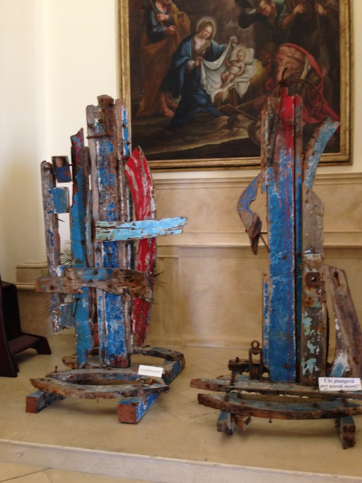 I would suggest the best liturgical art takes up the “joys and the hopes, the griefs and the anxieties of the people of this age” (Gaudium et Spes 1). Representing in art our worship that redeems is not accomplished by facile attempts at gilded beauty but through the more fundamental and searching beauty of the possibility of resurrection from seemingly sealed tombs. Beauty is much more than the raffination of taste…Pope Francis has recently affirmed this perspective in Evangelii Gaudium 167 writing: “Each particular Church should encourage the use of the arts in evangelization, building on the treasures of the past but also drawing upon the wide variety of contemporary expressions so as to transmit the faith in a new ‘language of parables’. We must be bold enough to discover new signs and new symbols, new flesh to embody and communicate the word, and different forms of beauty which are valued in different cultural settings, including those unconventional modes of beauty which may mean little to the evangelizers, yet prove particularly attractive for others.”
A further discussion of contemporary liturgical arts, and the question of beauty and appropriateness, is found here: Ars Gratia Artis: The Freedom of the Arts in the Twentieth-Century Liturgical Reform and Today.
James Thomas Hadley, an Oblate of Saint Benedict, teaches Liturgical Art and Architecture at The Catholic University of America’s Rome Campus.
Please leave a reply.