
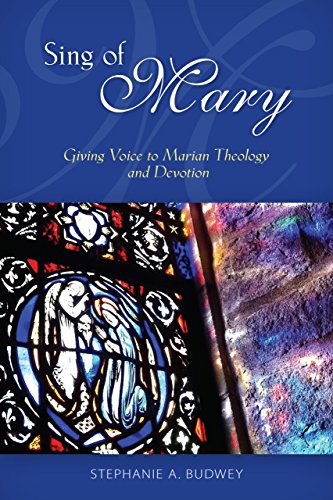
 Pray Tell continues with this series, “My New Book,” in which authors answer a few questions about their recently-released book.
What’s the point of your book, in ten words or less?
Mary is awesome and can still speak to us today! Or, seeing Marian devotion and theology through the lens of hymnody.
What do you think is the most interesting thing you say in the book?
I think one of the most interesting things my book shows is that you can’t simply take a hymn at face value—you need to consider the context out of which it came. Many of the Marian hymns, particularly from the Victorian period, have been criticized for being too sentimental, too focused on Mary, etc. But when you stop and look at all the influences on these hymns—papal declarations, cultural issues, church movements—you can see just how much these all had an impact on the writing of a hymn. I think this is something to consider as we try to discern what hymns to use in our worship today.
What’s the most controversial thing you say in it?
I think the most controversial thing I say is that Mary can be reimagined in order to be culturally inclusive, speaking to all of God’s children, no matter what their race, gender, class, sexual orientation, or gender identity.
Why should I buy your book? Who do you hope will buy it?
You should buy my book so that Mary will grant you 300 days free from purgatory—no seriously, you should buy my book because it looks at Marian hymns in the context out of which they came, helping us to understand how all that is going on in the church, in the world, and in Marian devotion and theology all has an effect on Marian hymns, and what this means for Marian hymns today and in the future.
I hope that a wide range of people will buy my book, both laypeople as well as students and academics. The book is interdisciplinary, so I hope that it appeals to theologians, musicians, hymnologist, and of course those who study Mary specifically.
Who will like your book? Who won’t?
I think anyone who has an interest in Marian theology, devotion, and music throughout the ages, as well as a desire to reimagine her and make her relevant for today will like my book. I also think anyone who has an interest in the impact of Vatican II on hymnody and devotions will also find this book interesting as I try to offer some reasons as to why Marian hymnody and devotion has dropped significantly in some areas after Vatican II.
Those who are on the more conservative end of things might not like my book. There’s a good part of it that I think they would enjoy, but towards the end my opinions come through a little bit more “strongly” shall we say, and while I consider myself to be fairly orthodox theologically, in trying to reclaim and reimagine Mary for today, I think I push the boundaries of what is considered “traditional” while still maintaining the biblical and theological foundations of Mariology.
What do you hope might change in the church because of your book?
My hope is that by reimagining Mary we can help to reclaim her for those who might have felt like “outsiders” in the past, as well as removing some of the oppressive associations that have been put on Mary. I try to take Mary out of the box we’ve put her in to make her relevant to the issues we face today. We need to take Mary down off of her “meek and mild” pedestal and bring her into the streets where she causes Gospel trouble as she disrupts those things in our world that need disrupting. This is why I look to Pope Francis at the beginning and end of the book, as his vision for action and justice, not just lip service, is what I hope to reclaim in the Magnificat—don’t spiritualize its message, but put it into concrete action to help address the problems in the world today.
Anything that didn’t survive the chopping block? Anything you didn’t include that might be in your next book?
For those who are interested in number crunching and “Top 30 Lists,” that part of my quantitative analysis didn’t make the book, as it can be a little boring to some! But for those who love graphs and lists, that work can be found in my article “Mary, Star of Hope: Marian Congregational Song as an Expression of Devotion to the Blessed Virgin Mary in the United States from 1854 to 2010” in The Hymn 63, no. 2 (Spring 2012): 7-17. My next book will be looking at some broader issues revolving around gender and what that means for pastoral care as well as the words we use in the liturgy (including hymns), so I think I will be able to take some of the work I’ve done here and expand it ever further.
Stephanie Budwey’s book can be purchased through Liturgical Press.

Please leave a reply.