
Announcement: The Yale ISM Review

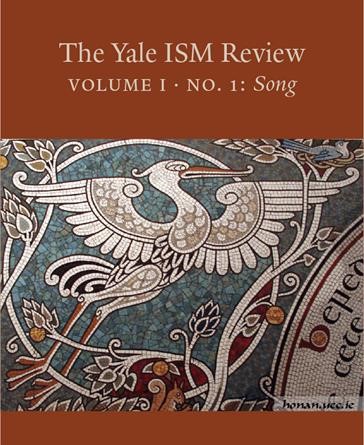
This is really important and exciting: The Yale ISM Review. Note that the editor is Pray Tell’s own Rita Ferrone. Note that the first issue (free online) has a piece on “Psalm Singing in Roman Catholic Liturgy” by Pray Tell’s own Paul Inwood. The first issue is organized around the theme of song (and includes a provocative piece titled “Have Hymnals Become Dinosaurs?” by Karen Westerfield Tucker). Rita writes in the first issue:

We are pleased to present a new venture:ย The Yale ISMReview.ย Published by Yale Institute of Sacred Music, it is a biannual, open-access online publication serving practitioners in the fields of sacred music, worship, and the related arts. You are invited to join us for stimulating discussions, enriched by contributions from Yale faculty and others who are leaders in their fields. Our inaugural issue is organized around the theme of song โ€” that deeply human expression so important to worship, yet also fragile and needing care if it is to flourish. The theme of song is reflected here through music, poetry, art, and prayer; in these pages you will discover connections between song and human health, philosophy, architecture, and more. Thank you for visiting us today. If you like what you see, subscribe! Subscription is absolutely free and open to all.

~ Rita Ferrone, editor

Congratulations Rita! And ISM!

Go check it out, everyone.
ISM Review

awr

Editor

Katharine E. Harmon, Ph.D., edits the blog, Pray Tell: Worship, Wit & Wisdom.

Please leave a reply.

Comments

19 responses to “Announcement: The Yale ISM Review

  1. Linda Reid

    Congratulations, Rita! I look forward to working my way through the articles!!!!

    1. Rita Ferrone

      @Linda Reid – comment #1:
      Thank you, Linda! I hope you will enjoy it.

  2. CHip Stalter

    “Before the Second Vatican Council, Roman Catholics were an unbiblical people.”

    I stopped reading Mr. Inwood’s article at this point. It’s the first sentence.

    1. Anthony Ruff, OSB Avatar
      Anthony Ruff, OSB

      @CHip Stalter – comment #3:
      Excellent! You remain pure and untouched by ideas you might disagree with! But it’s hard to know to what extent you might disagree, since you’re not going to read about those ideas. ๐Ÿ™
      awr

    2. Paul Inwood

      @CHip Stalter – comment #3:

      โ€œBefore the Second Vatican Council, Roman Catholics were an unbiblical people.โ€
      I stopped reading Mr. Inwoodโ€™s article at this point. Itโ€™s the first sentence.

      The fact is, it is true. Before Vatican II, the prevalent attitude was that only Protestants read the Bible. Catholics didn’t need to โ€” an almost Calvinist view.

      I remember leaving primary school at the age of 11, and on our last day we were all presented with a Bible, courtesy of the local council. Inside the front cover, a very handsome bookplate with our names inscribed in beautiful calligraphy. Our teacher said to us, “Here’s your Bible, but whatever you do, don’t open it!” This was not just because they didn’t want us reading the naughty bits in the OT but because Catholics at that time just didn’t read the Bible. Although we all knew some of the basic OT and NT stories, we were indeed essentially an unbiblical people.

      One of the great post-conciliar developments is precisely that Catholics have rediscovered scripture. My article is about one factor that helped that to happen.

      1. Paul R. Schwankl

        @Paul Inwood – comment #6:
        In the early 1970s, Alan Watts wrote, โ€œTo this day, you can still get rid of a Bible salesman by saying, โ€˜But we are Catholics and, of course, donโ€™t read the Bible.โ€™โ€
        Of course it seems that more Catholics now read Scripture on their own, but how many and how much? I shudder to think that Watts might still be able to make his comment in 2014. Thanks to Paul Inwood for pointing out that, through the verses and response of the Psalm at Mass, Catholics are better exposed to the Bibleโ€™s prayerbook, maybe without their full awareness that thatโ€™s happening.

  3. Clay Zambo

    Well, there goes my afternoon! Can’t wait to dive in. Congratulations!

  4. Alexander Larkin

    I remember Fr. Johannes Hofinger telling us (early 60’s) that was scandalous that a student could graduate from a Catholic High School without having read the Gospels.

  5. Thomas Cooper

    I get what is intended by “an unbiblical people.” Had that been literally true, of course there would have been nothing left to revive or reform at V2! At any rate, I’m thankful that we have less of an excuse for being unbiblical nowadays.

  6. Chip Stalter

    Mr. Inwood, I’m sorry about your experience in primary school, that is indeed unfortunate. I’m only 52 have no recollection of the Latin Mass, and have attended only one Latin Mass in my life.

    My reaction to all those who proclaim, believe, indicate or even just hint at the “Catholicism pre VII is bad, Catholicism post VII is so much better” meme, is a huge head shake. When one looks at the number of priests, religious, seminarians, Mass attendance % in 1965 vs the same numbers today I fail to understand how anyone thinks it is better now than then. The trend began earlier than the priest abuse scandals, so it doesn’t lie there. It began and continued during the papacy of the hugely popular Pope St. JP II, so why must so many insist that we are better off now than pre VII?

    1. Paul Inwood

      @Chip Stalter – comment #9:

      Chip, I’m sorry, but I don’t know what Latin Masses have to do with what we’re discussing โ€” I certainly didn’t mention them.

      My point, once again, is that before the Council Catholics generally didn’t read the Bible since doing so was considered to be a Protestant thing. My primary school experience was just the tip of an iceberg of prejudice. “We’re better than the Prots; we don’t need to read the Bible like they do because we’ve got the Mass” was the prevalent attitude, no matter which country you lived in. Even at Mass, for those following the translation in their hand missals, there was a very restricted diet of scripture โ€” almost no Old Testament readings, for example. We just didn’t know scripture in the same way that our non-catholic sisters and brothers did, and we were certainly rather unfamiliar with the psalms. They were “people of the Word” and we were “people of the Eucharist”. Today, we have made up a lot of ground (so have they), and I rejoice in that.

      If that clears everything up, perhaps you’d like to read my brief article on the Responsorial Psalm which might now make more sense.

  7. Karl Liam Saur

    About the unbiblical point: it’s a provocative essay opener. It was not uniformly true before Vatican II as a cultural matter (it would be interesting to survey how true it was of German Catholics and those in their diaspora, for example – my father’s family read the Bible avidly, long before Vatican II, and my father indicates this was common in his German national parish; understanding that it’s not data, just an anecdote), and one wonders how much genuinely more biblical average Catholics are post-Vatican II.

    1. Paul Inwood

      @Karl Liam Saur – comment #11:

      Karl,

      I agree with you (and also about the provocative opening!). I do think, though, that with the advent of readings in the vernacular, a vastly-expanded lectionary, and the many lectors who take the trouble to research the biblical context of what they are proclaiming, we are now in a very different (and better) place from the 1950s as far as being familiar with the contents of the Bible and its structure is concerned.

      1. Karl Liam Saur

        @Paul Inwood – comment #12:
        Paul

        Just to be clear, I heartily embrace the increased opportunities for laity to more immediately engage the Word as word in the Mass. It’s funny to read the contradictory criticisms of the conciliar reforms in this regard (the postconciliar liturgy has become too didactic with too much Scripture to digest vs the preconciliar liturgy had tons more SCripture in the form of the propers (well, then there’s the whole matter of form and medium)). (Mind you, we progressives are not aliens to this kind of whiplashed duality of rationalization on our pet things.)

        My point is that, without really good data, it would be rash to assume a uniformity of “unbiblicality” (yes, a neologism here) among preconciliar lay Catholics at a subcultural level (above the individual level, where of course variations would be expected). When we progressives overargue on squishy facts, we subvert our credibility in making such a critique of those who disagree with us.

  8. Rita Ferrone

    Interesting discussion of Paul’s first line. I knew it would be provocative — thank you, Paul!

    In the early 20th C. we were no longer burning Bibles (as some Catholics had in Europe after the Reformation) but the liturgical changes at V-II combined with Dei Verbum created a definitively new moment for Catholics vis a vis Scripture. Pius XII’s efforts to revive scriptural study (1943 onward) did not bear nearly as much fruit in his time as in the period following Vatican II.

    Any comments on the other two essays on singing the Psalms?

    I’m curious as to whether any of our readers ever heard of the Coburn painting, or the mosaic floor with the Benedicite. Coburn is an interesting artist, who became Catholic as an adult, and who was also interested in aboriginal spirituality. Is he better known in Australia than in the US, I wonder? (Although his creation tapestries hang in the Kennedy Center in DC.)

    The floor mosaic in the Honan Chapel in Cork was constructed in 1916–a terrible time for Ireland, coinciding with casualties from World War I and of course the Easter Rising. But as I researched it more in depth I discovered that Irish self-rule, and the Great War — although fitting to the “trial by fire” motif of the Daniel canticle — were probably not in anyone’s mind when the design was being decided upon and created. It is, rather, Lauds that sets the stage.

    Of course, the chapel as a whole is determinedly devoted to Celtic revival art deco, thus some of the design motifs and sea monsters do exhibit a pride in national identity. That’s there. Perhaps the multivalent nature of the biblical text is prophetic. The artist is not known, but best guesses are that he fought in the war and was killed in action on the Somme the same year the church was dedicated.

    And what did people think of Tom Murray’s organ videos?

    1. Paul Inwood

      @Rita Ferrone – comment #14:

      I had not seen the other two essays on the psalms when I wrote mine. Each of them offers good insights, in my view.

      Karen Westermeyer’s contribution is very much worth reading. I am hoping that we may see a further essay from her. Having discussed the notion of hymnals, it would be interesting to have her view on the kind of contents that hymnals do have today and might have tomorrow.

      I was not previouslty familiar with the work of Coburn, so that will lead me on a journey. And I loved the chapel mosaic floor (you have to go to the chapel website and scroll a long way through the gallery to find a shot of the entire floor, which is quite simply stunning). The idea of the River of Life is intriguing. Are you walking down it from the font or source, or are you in fact walking upstream to the source of life at the altar? Perhaps both of these, in tension with each other.

      I have not had time to watch the organ videos yet.

    2. Paul R. Schwankl

      @Rita Ferrone – comment #14:
      I watched the two videos, Rita. That Murray, heโ€™s a tough customer. No interludes between verses? No modulation up a step for the doxology? And, worst of all, an insistence that we play accurately?
      Seriously, the pointer I most appreciated in these videos was Murrayโ€™s insistence on a tiny breath-catching fermata between linesโ€”imposing human rather than metronomic rhythm on the hymn. (But I donโ€™t think human rhythm is any defense for the cursed โ€œfermata nowhereโ€ some hymnals put at the end of the second and fourth lines of โ€œNow Thank We All Our God.โ€)
      It would be interesting to see how he would play for a group other than Christ Church New Haven. But if the organistโ€™s job is to mediate between the words of the hymn and the congregationโ€™s voices, Murray does it remarkably well. Iโ€™m inspired.

  9. Donna Eschenauer

    Congratulations Rita! This looks terrific.

    1. Rita Ferrone

      @Donna Eschenauer – comment #17:
      Thanks, Donna!


Posted

in

by

Discover more from Home

Subscribe now to keep reading and get access to the full archive.

Continue reading