
One Year Ago Today: The Election

Exactly one year ago, this happened:

I was teaching Monastic Liturgy. When the white smoke came, earlier than expected, I gave up all hope of trying to concentrate on the class material, and we tuned in to the online news coverage and watched anxiously.

And then he appeared on the loggia. I confess that I had entirely forgotten about Bergoglio being the runner-up in 2005, and he wasnโ€™t on my list of papabile. He was a blank slate to me. I didnโ€™t know what to make of him at first, as he just stood there and did nothing. No big waves, no big grins, he just stood there. I was nervous.

I also confess that Iโ€™m more musical than visual, and I honestly didnโ€™t notice anything amiss in his vesture (or lack thereof). No red cape! It wasnโ€™t until the blogosphere lit up, which took about 2 minutes, that I gradually realized that something big was happening.

And then I read that the ultraconservative website Rorate Coeli was horrified at the worst possible choice. And Pray Tell friend Chris Grady emailed me, โ€œIโ€™m pretty happy.โ€ Two sources who track this stuff closely โ€“ from opposite perspectives. I began to feel very, very happy.

From the get-go, Pope Francis seemed very resolute about his way of doing things. In retrospect, it looks as if he began thinking on February 11, the date Benedict announced his resignation, โ€œI could be the next pope. What will I do?โ€ He hit the ground running.

His first appearance was in many ways an announcement of his governing program.

  • His first words were โ€œBrothers and sisters, good eveningโ€ โ€“ nothing churchy or pious, but a normal greeting from a normal person. As he said in his most recent interview, โ€œTheย popeย is a man who laughs, cries, sleeps calmly and has friends like everyone else. A normal person.”
  • He wasnโ€™t wearing red shoes or stole or red cape. He only put the stole on for the blessing, and then removed it immediately, in full view of the public. The focus is not on churchy rituals, but as he has since said so often, on the church getting out of the sacristy and into the streets.
  • He called himself โ€œBishop of Romeโ€ rather than โ€œPope,โ€ and he referred to Benedict as the โ€œBishop Emeritus.โ€ He has to have known of the announcement that the title was to be โ€œPope Emeritus.โ€ But โ€œBishop of Romeโ€ suggests a ministry which is more collegial, within the college of bishops, with less emphasis on the primacy of the guy at the top of the pyramid. Rather like this recent photo of the pope on retreat with curial officials:
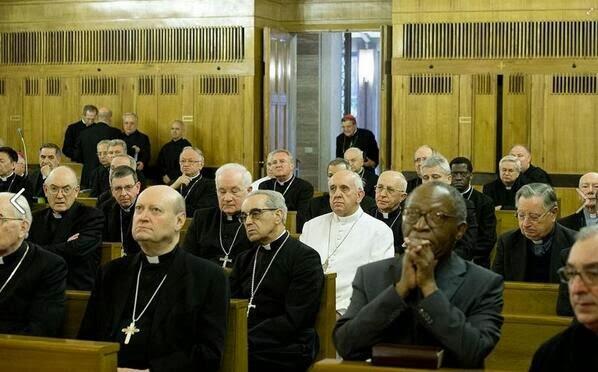
  • Francis retreat


  • He asked all to pray for Pope Benedict. For all the difference in emphasis between him and his predecessor, he made clear his great esteem for Benedict and his desire to work in continuity with the good work Benedict had done.
  • He asked the people to pray for a blessing of him before he blessed the people. This suggests collaboration and sharing of gifts between clergy and laity, rather than a one-way ministration of a higher class to a lower class.

And then, in rapid succession, so much more โ€“ he rode the bus with the other cardinals back to the guesthouse, paid his own bill at the hotel (and changed the light bulb that had gone out), celebrating Mass facing the congregation (i.e. the cardinal electors), preached extemporaneously and without miter, stayed in the guesthouse, cancelled Holy Thursday Mass at the cathedral and went to a youth prisonโ€ฆ to wash the feet of females!

Here are some of the archived Pray Tell stories on the new pope:

Teresa Berger andย Fritz Bauerschmidt andย Anthony Ruff on first impressions from March 13, 2013.

The first report from the Onion that Pope Francis had resigned.

The first report that Cardinal Bergoglio had said that the Ordinariate is โ€œquite unnecessary.โ€

The first report that Francis supposedly told that MC that โ€œcarnival is overโ€ โ€“ we still donโ€™t know for sure whether he really said that.

And then the report, later confirmed,ย that he was open to legalized gay civil unions in Argentina.

Pray Tell contributor Jonathan Day wrote a landmark piece on the language of papal clothing.

And the famous to-ing and fro-ing about the candles moved away from the center of the altar.

Today, a year later, I feel indescribably grateful. The Holy Spirit was at work a year ago!

How has it been for you? What are your first memories?

awr


Anthony Ruff, OSB

Fr. Anthony Ruff, OSB, is a monk of St. John's Abbey. He teaches liturgy, liturgical music, and Gregorian chant at St. John's University School of Theology-Seminary. He is widely published and frequently presents across the country on liturgy and music. He is the author of Sacred Music and Liturgical Reform: Treasures and Transformations, and of Responsorial Psalms for Weekday Mass: Advent, Christmas, Lent, Easter. He does priestly ministry at the neighboring community of Benedictine sisters in St. Joseph.

Please leave a reply.

Comments

11 responses to “One Year Ago Today: The Election”

  1. Jack Rakosky

    I had been praying for a NEW POPE and NEW BISHOPS.

    Benedictโ€™s withdrawal to a life of prayer was an inspired response to the needs of the church and the world. When Francis stepped out onto the balcony and asked for our prayers, I knew my prayer for a NEW POPE had been answered.

    Close to sixty percent of Americans (and Catholics) pray daily, an indicator of religiosity that has remained steady whereas since 1972 โ€œalmost weekly or betterโ€ church attendance has declined from fifty percent to forty percent or less for Americans (and Catholics). So Francis was astute when he began his relationship with Americans and others by asking for our prayers.

    Much of our daily prayer is for loved ones. Francis decided wisely to center synod reform on the needs of families, and to seek answers in prayer, discernment, and mutual care rather than in self-righteousness and blaming others.

    The recent Pew Study on the โ€œFrancis Effectโ€ has some amazing but relatively unnoticed findings that 40% of Catholics say they are praying MORE now. Among those attending church weekly, this rises to 50% praying MORE; even among those attending less than weekly 36% are praying MORE.

    Much prayer and discernment are essential to renew ourselves, our families, church structures, and our nation.

    Becoming a poor church for the poor, and going out to the peripheries are enormous challenges for a church centered upon Rome, diocesan offices, and elaborate parish campuses.

    Basking in the media attention on Francis, hoping for trickle down reform from the Vatican and waiting for people to flock to our churches are inadequate responses. Renewal cannot wait for the leadership of bishops and pastors.

    I am still praying for NEW BISHOPS. The bishops themselves should be praying for new bishops. Each bishop should be asking whether the church and nation would be better served if he chose a life of prayer like Benedict. IF YOU CANNOT BE A FRANCIS, BE A BENEDICT!

  2. Charles Day

    A friend of mine who is a former Jesuit that left the priesthood 30 years ago (he just turned 80) told me he thought that this was a papal election truly inspired by the Holy Spirit. I think he was talking about the choice of Bergoglio, but I think even more remarkable was the resignation of Benedict. Either way, the sum of the events that took place are hard to explain without the intervention of the Holy Spirit.

  3. Jack Feehily

    I also remember being perplexed as Francis emerged on the balcony with a blank expression. But as he spoke so plainly and directly and then bowed low as he requested the prayers of the people for God’s blessing, I wept tears of joy for a bishop of Rome who could confirm his brethren in unity. Often not a day goes by that I don’t refer to Francis in my homilies. Dear God, thank you for this humble shepherd, lead him and guide him to do your will always.

  4. joseph mangone

    i was at work and when he emerged, he just stood there and did nothing but stare at the crowds. i said to myself “who is this guy? he is either shy or in shock.” Anyway, once he began speaking, my doubts melted away. Here was a pastor, the chief pastor, asking his flock to pray for him, to extend their blessings on him. This was going to be a two-way relationship between fellow believers and ministers; this was going to be a partnership. As the days and weeks went by we discovered that indeed the cardinals had listened to the Holy Spirit and He provided a simple humble man to lead us. I read in a past posting on Praytell that when an assistant handed him the red shoulder cape, he told him “The carnival is over”. AMEN! It is time to get to work saving souls for Christ and damn the external garb and pomp. I just hope he is kept safe from the enemies within….we don’t need another JPI martyr…..

  5. Dale R. Rodrigue

    As I commented about one year ago on this site and again I say it today:
    “This is the day the Lord has made, let us rejoice and be glad in it”!

    1. Bill deHaas

      @Dale R. Rodrigue – comment #5:
      Agree, Dale – here is what I stated in Fr. Ruff’s link in the post:

      “…… Like the fact that he called him bishop emeritus โ€“ that is what he is; retired bishop of Rome. Pope is an office; not a sacrament. Ratzinger is the bishop emeritus. Goes along with the fact that we speak about *resignation* not *abdication*.
      – not sure what happens in terms of the *cultural war issues*. He lives a simple lifestyle marked by solidarity with the poor; he has spoken out against the Argentine government and business community in terms of unrestrained captialism, globalization and its impact on the poor. He corrected his priests who refused to baptize children of unmarried parents (called it gross clericalism). He toes the line on sexual issues but has reached out to victims of AIDS. Going forward, wonder what happens when his pastoral sense supported by his intellectual honesty runs into a situation.

      He is latino; from both the Americas hemisphere and the southern hemisphere. He is Jesuit (so, tradition that the reform orders played in the church after Trent). His liturgical style will not be European; it will be pastoral.”

      (with this retort, of course, from M. Jackson Osborne:

      “This is a preposterous non sequitur dripping with bias and judgment which have no logical foundation. (Resentful, too!)”)

      Well, after one year, it is not a non sequitur nor is it drippiing with bias and judgment with no logical foundation.

  6. Dale Rodrigue

    Bill and Kelly, it seems that we can all breathe a bit easier now. No longer is there that “creeping infallibility” or somehow we’re driving backwards. Maybe we all can breathe easier because those windows have been flung open again???
    Francis the pope of hope!

  7. Stanislaus Kosala

    At first I was disappointed because I thought that the cardinals had elected a caretaker pope, given his age and the speed of the conclave. Thankfully I was wrong. He continues to amaze and stun me in a good way, on the one year anniversary the fear is that he’ll be another John Paul II, the cult of personality and his willingness to sidestep norms on a whim such as in the canonization of JOhn XXIII, is worrisome.
    In the second year of this pontificate, I hope that this blog will tackle the relationship between Francis and devotions (another close parallel to JPII)

  8. Gerard Flynn

    That looks like Raymond Burke coming in the back door dressed more formally than Francis. ๐Ÿ™‚ All are dressed soberly and simply. No purple or red to be seen, apart from his hat.

  9. Jack Rakosky

    I spent an interesting Friday-Saturday at John Carroll program The Papacy: One Year Later

    John Oโ€™Malley reminded us of John XXIIIโ€™s image of the church as the loving mother of all and suggested โ€œreconciliationโ€ (multi-cultural, change, ecumenism, modernity) as the legacy of the Council and foundation for Francis โ€œmercy.โ€

    Byran Hehir argued for the importance of ecclesiology in Francis approach to the social teaching of the Church, and its relationship to Vatican II. Before Vatican II including Pacem in Terris the basis for Catholic Social Teaching was philosophical. Beginning with Gaudium et Spes it shifted to a more biblical basis, i.e. the Kingdom. The advantage of the philosophical was its precise implications; the advantage of the biblical is its prophetic voice. Francis in the Joy of the Gospel comes down solidly as biblical prophetic witness. ( My own opinion is that Francis is going to let it up to us laity, inspired by the Gospel, to figure out the practical implications).

    Hehir, who is a Harvard professor and advisor to Oโ€™Malley, said that the impact of Francis on non-Catholic elites and the request for Oโ€™Malleyโ€™s time are great.

    Natalia Imperitori-Lee gave us the perspective of a Mother, Wife, Theologian and Latina. She suggested that some of the things that most impress Europeans and North Americans (Francis critique of clericalism, de-emphasis upon rules) actually are congenial to Latin Americans who are generally suspicious and distrustful of the clergy because they are often close to the government and aristocracy.โ€ While Francis may be bringing in some beneficial Latin rather than Germanic culture, she sees him as strongly influenced by โ€œMarianismoโ€ the cultural ideal of woman โ€as a virgin in her youth, suffering in patience and humility during adulthood, and then leading a life of mourning.โ€

    Robert Mickens emphasized the importance of the coming Synods, and recommended Quinnโ€™s book The Reform of the Papacy which Francis had read in Spanish. Like at Vatican Ii, the bishops need to have the opportunity to find their voices over time. What will happen then?

    Any interesting idea that surfaced several times in the talks and Q@A was that of Francis as โ€œinfantโ€. While there is much fascination and interest, what lies ahead? The terrible twoโ€™s?

  10. John Larkin

    Why has Pope Francis spiritually alienated many traditional conservative catholics?
    I am not talking either about the SSPX or similiar groups but many ordinary traditional lay catholics who are trying abide by the doctrines and faith transmitted to them by their hierarchy.

    I always thought a popes job was to unify and strengthen all the brethern.

    The many confusing and borderline statements made by Pope Francis
    diminish his credibility and make it difficult for such people to have trust in him.


Posted

in

by

Tags:

Discover more from Home

Subscribe now to keep reading and get access to the full archive.

Continue reading