
Icons
I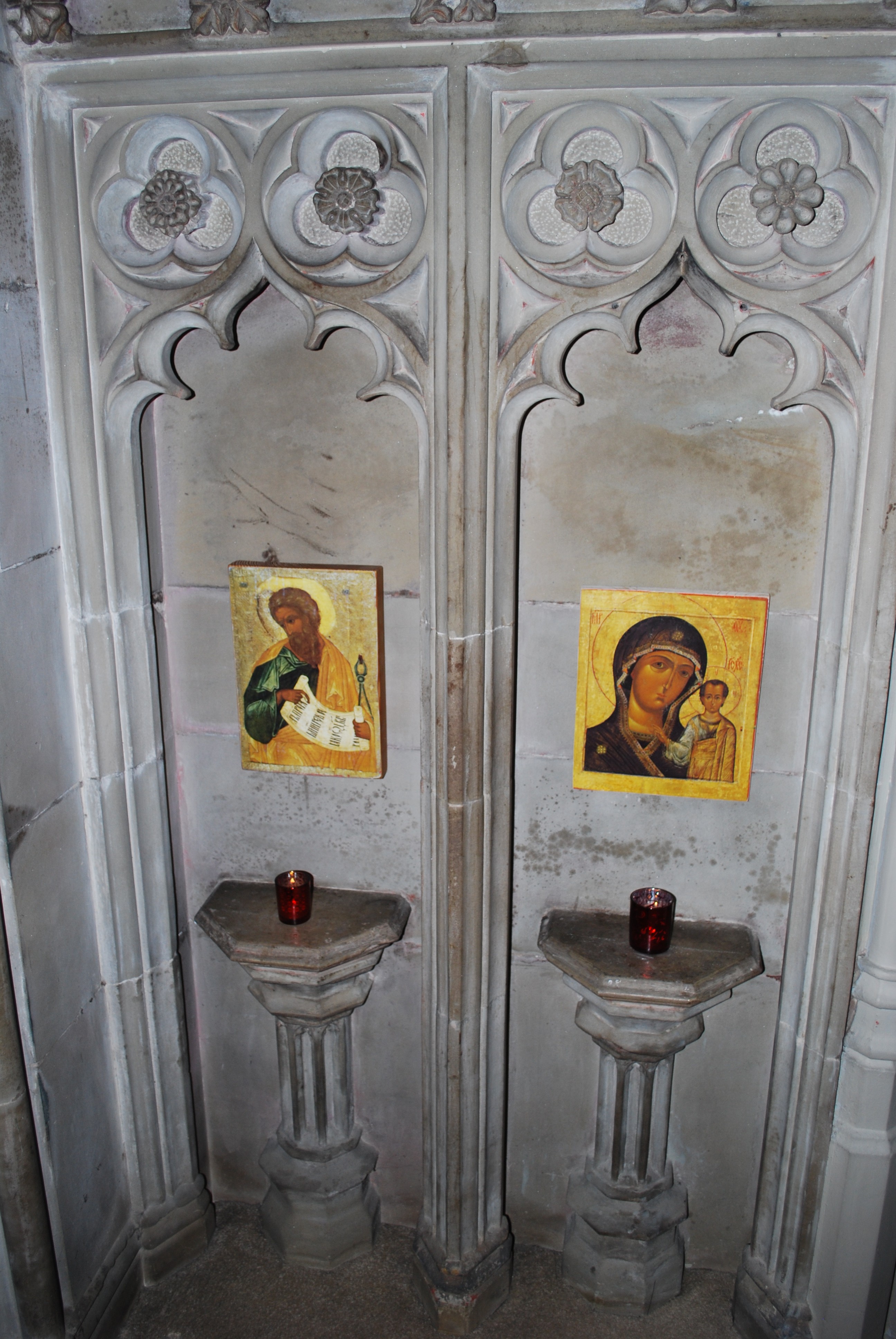 cons: (Greek εἰκών, an image)
The early “iconography” or art of the Church consisted of beautiful and often symbolic representations of Our Lord, Our Lady and the Saints painted on walls or on pieces of board. While the depictions in catacombs and churches are well preserved, few of the very early “Icons” on wooden boards survive before the start of the second millennium. However, by this time a sacred tradition had developed so that stylised images were reproduced of earlier depiction, now often destroyed or lost. An artist, often a monk, would prepare himself with fasting and prayer before taking on the solemn portrayal of his holy devotion. The resulting image or icon would be blessed and revered as a spiritual depiction of the holy.
While most icons have their origin in the East, we should remember that they date from the time when the whole of Christendom was eastern in character, before the growth of the western, Roman, Church. Hence the writing on these images is usually in Greek or Cyrillic script. We have four reproductions of icons in the sanctuary. These represent the three angelic visitors to Abraham (the Old Testament Trinity), The Prophet Isaiah, St. John the Baptist and Our Lady.
John the Baptist
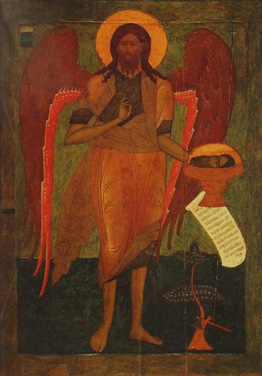 The representation of John the Baptist with the wings of an angel, dressed simply as a hermit with a scroll in his hand, has its origins in the description given in the Gospel – John the precursor and prophet of the Christ. This image from 1560 is in the Andrei Rublev museum in Moscow. The dish held in his hand signifies the nature of his later martyrdom. John the Baptist is the patron of our parish church.
The Prophet Isaiah
 This icon, which originally came from the cathedral of the Nativity of the Mother of God in the monastery of St. Anthony in Novogorod, was part of the tier of the prophets in the iconostasis. It is now in the Novogorod Museum. In the iconographical tradition, Isaiah is shown holding an open scroll on which the words of his prophecy are written – I foretell that You will be born of the Virgin. He is also pointing to the text with his right finger, while in his left hand he holds tongs. It was with such tongs that a seraph has touched Isaiah’s lips with a burning coal taken from the altar.
Kazan Mother and Child
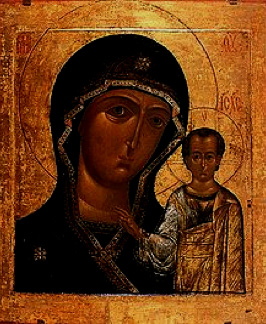 According to tradition, the icon was discovered on July 8, 1579, underground in the city of Kazan by a little girl, Matrona, to whom the location of the image was revealed by the Theotokos, the Blessed Virgin Mary, in a Marian apparition. The original icon was kept in the Theotokos Monastery of Kazan, built to commemorate the spot where it had been discovered. Other churches were built in honour of the revelation of the Virgin of Kazan and copies of the image displayed at the Kazan Cathedral of Moscow, at Yaroslavl, and at St. Petersburg. On the night of June 29, 1904 the icon was stolen from the church in Kazan where it had been kept for centuries (the cathedral was later blown up by the communist authorities). Although the frame of the icon was recovered years later, the icon itself it believed to have been destroyed.
The Trinity
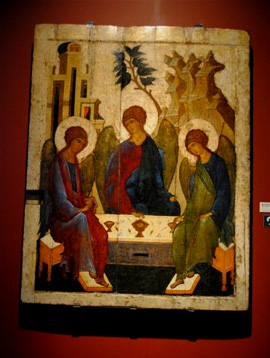 A mid-sixteenth century icon of the Trinity, now in the Rublev Museum in Moscow. This icon is based on an Old Testament subject – the hospitality of Abraham. According to traditional Orthodox interpretations these angels were for Abraham a revelation of the consubstantial and triune God. It was given its finest and fullest expression in the icon by Andrei Rublev, painted for the Cathedral of the Trinity in the Monastery of St Sergius in 1425-27. Rublev’s icon became the model for generations of iconographers. As with many other sixteenth century icons, this icon broadly follows the iconography of Rublev’s famous picture.
Chris McDonnell
Please leave a reply.