
Pour out a spirit of compunction, O God,
on those who bow before your majesty…
The Prayer over the People from which this phrase comes was heard for the first time at the end of Mass on Ash Wednesday this February. The prayer illustrates two of the issues that have emerged from the use of the new translation of the Missal. Firstly, there are aspects of the text in the original Latin edition that need greater consideration because in this case the tone of the prayer is out of keeping with traditional forms. Secondly, some of the words used in the new translation seem to have been chosen deliberately to sound more like their Latin counterpart.
The original phrase, spiritu compunctionis, comes from one of the prayers used at the beginning of the Ash Wednesday celebration for the blessing and imposition of ashes in the pre-Vatican II Missal. The phrase was removed by the compilers of the New Missal when the prayers for the blessing and imposition of ashes were reworked for the Novus Ordo of 1970. The phrase reappeared when the 3rd edition of the Latin Missal was issued in 2002 in the form of a Prayer over the People at the final blessing – compulsory on Ash Wednesday – with other prayers over the people (optional on weekdays and compulsory on Sundays) to be used at the end of Mass on the other days in Lent. The published English text of this prayer on Ash Wednesday not only chooses to use a Latin-sounding equivalent (in contrast to the words that the ICEL bishops had proposed – “spirit of sorrow”), but also, in both Latin and English, causes considerable symbolic rupture to the spirit of the liturgy of the celebration of the Eucharist on that day.
Where did these Prayers over the People come from? After Vatican II one of the ways the compilers chose to interpret the desire of the universal church to renew the Liturgy and to render it more up to date was to take out the fixed Prayer over the People at the end of all weekday Masses during Lent, and to provide a range of optional blessing prayers for Sundays only, allowing the priest to choose the most appropriate form. The texts provided in 1970, however, were rather slim in number, with just a formula for Passiontide and several in Ordinary Time being appropriate for Lent.
The Lenten Prayers over the people, which appear in missals up to and including 1967, seem to have been used as a spiritual aid and comfort to members of the faithful as they traversed the Lenten journey toward Holy Week. Examples in an edition of 1961 (translations by the monks of St. Andrew’s Abbey, Bruges, Belgium) show expressions of encouragement and healing, protection, strength and mercy: “Spare, O Lord, spare Your people; that having undergone the punishment that they deserve, they may find relief in Your mercy” (Thursday after Ash Wednesday); “Protect Your people, Lord, and in Your mercy cleanse them from all sin; for no harm shall hurt them if no wickedness has dominion over them” (Friday after Ash Wednesday); “May Your faithful people, Lord, be strengthened by Your gifts, so that in receiving them they may desire them, and by seeking them may receive them for ever “ (Saturday after Ash Wednesday).
These are just a few examples and there are many others. The Prayer over the People for Ash Wednesday had a particularly encouraging ring to it:
Look with favour, Lord, on those who bow before your majesty so that they who are refreshed by Your divine gift may be always sustained by Your heavenly help.
So, what of the prayers over the ashes and over the penitents from which the new Prayer over the People originated? As I stated earlier, it comes, not from the end of Mass, but from the very beginning. From the time of the origins of the custom, and up to the 11th century in most places, the giving of ashes at the beginning of Lent marked the occasion of the dismissal of the members of the Order of Penitents from the church by the bishop.

He sprinkled ashes on their heads, led them out of the church, and closed the door on them. They were barred from Mass until Thursday in Holy Week.
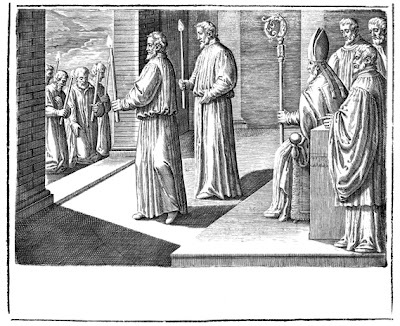
In the pre-1970 missals there were two prayers to bless the ashes, and two prayers for the penitents who were to receive them. One of these prayers captures the sense of guilt and sorrow that would be appropriate for those repentant sinners who were seeking forgiveness, but who needed to ritualise the experience of longer penance through the forty days of Lent:
Lord, You are moved by humiliation and appeased by satisfaction; give ear in Your goodness to our prayers and mercifully pour forth the grace of Your blessing on Your servants whose heads are sprinkled by these ashes, so that You may fill them with the spirit of compunction (spiritu compunctionis), and effectually grant what they have duly prayed for and ordain that what You have granted may remain always established in them whole and entire.
It would seem entirely appropriate, ritually, that a prayer requesting a spirit of sorrow/guilt for sin would be used during the ritual of giving ashes to members of the Order of Penitents, who would then be led out of the church. But for all who remain? Perhaps it was doubts about this that led the compilers of the 1970 missal to rework the prayers at the beginning of the ceremony, thus providing the celebrant with a choice of two blessing prayers, while at the same time removing the spiritu compunctionis text altogether.
The 2002 reform of the Missal brings with it the restoration of the Prayers over the People during Lent. These are consoling and appealing prayers for the most part. On Ash Wednesday, however, the compilers of the Missal did not simply reuse the pre-Vatican II prayer, but created their own version out of several of the pre-Vatican II texts: the second ash blessing prayer, the opening phrase of the Prayer over the People, and the first prayer over the penitents. Our published new translation renders it in this way [ICEL 2011]:
Pour out a spirit of compunction, O God,
on those who bow before your majesty,
and by your mercy may they merit the rewards you promise
to those who do penance.
This prayer seems entirely appropriate for members of the Order of Penitents – massive and notorious public sinners who would have been led out of the church to begin their extended period of penance. It is understandable that they would experience guilt and sorrow for their sins. It seems singularly unsuited as a prayer for those present in church for the celebration of the memorial of Christ’s redeeming passion and death, and over people who, just a few minutes before, have received the Body and Blood of Christ himself. As such, therefore, it seems to cause rupture in the flow of the liturgy: the presider, having just given the sacrament of salvation to the people, then prays for them to be filled with guilt and sorrow for sin; and these are the last words they hear in church on Ash Wednesday.
Those who managed to hear the text correctly for the first time in English on this Ash Wednesday (“Did he say compulsion or compunction?”) may justifiably have experienced the inquisitiveness which Liturgiam Authenticam (2001) predicted, but they may also have experienced confusion and even frustration. For those who grasp the meaning of the prayer as a whole it becomes apparent that this is an inappropriate prayer, and in the wrong place in the celebration of Mass on Ash Wednesday.
Andrew Cameron-Mowat, SJ is Lecturer in Liturgy at Heythrop College, University of London.

Please leave a reply.